 KidNestClub
Learning Activities & Printables
Preschool STEM Activities at Home: 10 Science Setups, Ages 4-6
Ten kitchen-supply setups for ages 4-6, each one a question you can see the answer to with your eyes: does the cork sink, does the ice melt faster in warm water, does the sugar tower stand at six cubes. Every one runs on a jar, a spoon and tap water, and the two questions you ask are the same two every time.
By KidNestClub · Updated 20 November 2026
Total scope: 10 setups · Ages 4-6 · 5-10 minutes each · a jar, a spoon, ice, pantry items · one adult at the table · nothing tasted, no flame.
This is the science page. The twenty-five learning setups cover counting, letters, shapes and sensory trays, and the four sensory bases run the rice, pasta, water and dough rounds. Here the job is ten setups where a child watches something change and says what they see, with nothing beyond kitchen ingredients, no flame, and nothing tasted.
What a STEM setup actually is at this age
A setup at 4-6 is a question you can watch the answer to. “Does the cork sink?” is a setup; “today we talk about density” is not. The child drops the cork in the jar, watches what happens, and says what they saw. The round ends when the change is over — the ice has melted.
For anything with a hazard in it — scissors, heat, water, small parts — the same rule applies: an adult, close enough to act. The water and small parts on this page mean an adult sits at the table for every round.
Ten setups in kitchen-supply terms
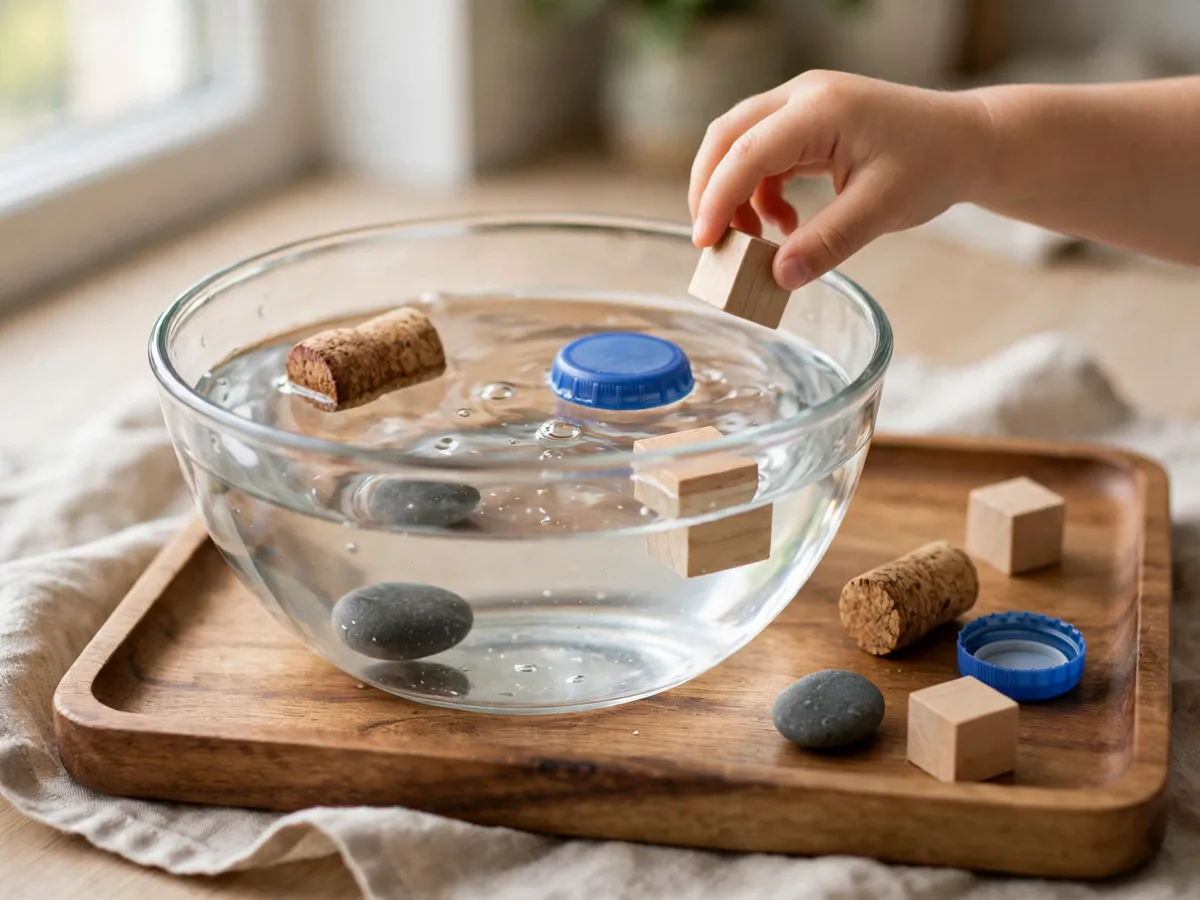
1. Sink or float. One jar of water, three items beside it: a cork, a pebble, a wooden spoon. Drop each in, watch, pull each out with the spoon.
2. Ice melting. Three ice cubes: one in cold water, one in room-temperature water, one on a dry plate. Watch which goes first.
3. Baking soda and vinegar. Two spoons of baking soda in a jar, a splash of vinegar poured by the adult. Watch the fizz, let it settle, run it again with one more spoon. Nothing here is tasted.
4. Sugar-cube towers. Six sugar cubes on a plate. Stack them until the stack falls, then start with a wider base.
5. Rain in a jar. A jar half full of warm tap water (poured by the adult), a plate on top, three ice cubes on the plate. Watch the underside of the plate fog, then drip.
6. Magnet hunt. One fridge magnet and five items on a tray: a paper clip, a bottle cap, a pebble, a coin, a wooden block. Touch the magnet to each; set the ones that stick on one side, the rest on the other. Bottle caps and coins are small parts for under three, so this stays at ages 4-6.
7. Shadow tracing. One object on a sheet of paper in the sun, a pencil, a line drawn around the shadow. Move the object an hour later and trace the new one. The two shapes are the answer.
8. Dissolving. Three cups of water: salt in one, sugar in one, sand in one. Stir each ten turns with the same spoon and watch which clears. The sand cup is the one that does not.
9. What sinks, what floats, by kind. Six items on a tray, dropped into the jar one at a time. Lay the floaters in a row, the sinkers in a row beside them.
10. Simple pulley with a broomstick. A broomstick held horizontal between two chairs by the adult, a string over it with a small cup on each end. Drop one spoon in one cup and watch the other cup go down. The adult holds the broomstick the whole round.
What to ask at each one: the two questions
Two questions, not twenty, and the same two at every setup. More than two turns the round into a quiz. The first asks what your child sees, and the second asks what they think will happen next, with no score kept on either answer.
Question one — what do you see? Asked first, and the answer is a description, not a guess: “the cork is on top,” “the ice went small.”
Question two — what do you think will happen next?Asked once, before the second run. The guess can be wrong and still be the right answer, because the next run shows whether it held. No score is kept, and the next setup opens with the same two questions.
How long a setup runs
Five to ten minutes is a full round at ages 4-6, and the round ends at the change — not at the clock. The ice melts in ten, the tower falls in five, the rain drips in three. Three setups in one morning is a full session, and a fourth on the bench is the backup, not the plan.
What to change at 6 versus 4
At 4: one jar, two items, one question. The sink or float round runs with a cork and a pebble, nothing else. The tower stops at four cubes, the adult pours every liquid, and one setup fills the round before the change is over and the tray clears.
At 6: two jars and a comparison. Six items in two jars — fresh water on the left, salty water on the right — and the child says which jar the cork floats higher in. The tower goes to ten cubes, and the shadow tracing moves to three spots.
Both ages: the same order of the morning — water setups first while the towel is dry, dry setups in the middle, the broomstick pulley last because it needs two chairs.
Frequently asked questions
Do I need anything from a shop to run these ten?
No. Every setup is kitchen supplies and tap water: a jar, a spoon, ice from the freezer, sugar cubes, baking soda and vinegar if you have them, and a magnet off the fridge. If the box is missing one item, run the other nine.
How long do these setups run at 4-6?
Five to ten minutes is a full round at this age, and the round ends when the ice melts or the tower falls, whichever lands first. Two or three setups in one morning is a complete session.
Can a 4-year-old do the magnet hunt with pebbles?
Yes, with the small-parts note. Anything that fits through a toilet-roll tube stays off the tray for a child under three, so the pebbles and bottle caps here stay with ages three and up. Run the hunt with three large items rather than six small ones, and an adult sits at the table for the whole round.
Save the ten for the next tray morning
Pick three for this week rather than ten for someday: one water setup, one dry setup, one build. Pin this page, then move to the twenty-five learning setups when the science round runs short, the four sensory bases for a tray-of-rice morning, and the outdoor ideas for a small yard for the afternoon the same questions go outside.
Ages 4-6 · one adult at the table · nothing here runs without you beside the tray.