 KidNestClub
Kids Activities & Play
Sensory Bin Supplies Ages 2-6 | 4 Listings, What to Buy and What to Skip
A sensory bin is a container, a filler, and something to do with the filler. That is the whole thing, and you can build one from a baking tray and a bag of lentils in five minutes.
So this page answers the narrower question: what is worth buying for a bin, and what is the tray you already own. Below are four listings for ages 2-6, a filler, a themed kit, a set of tools and a table, with the checks that decide which of the four is your gap.
By KidNestClub · Updated 18 November 2026
Ages 2-6 · 4 listings · 4 comparison rows · no outcome promised.
What a pick on this page means
A pick here means we compared what the listing and the maker publish. It does not mean we ran a test, and nothing below is a score or measured ranking. A recommendation starts from published guidance and the current listing. Where the two disagree, the listing wins on product facts and the guidance wins on safety.
An age on a product is the maker's own age grade, not a statement about what your child can do. Three of these four print a band the maker left wide open. Every bin here carries the age band it was written for, and a younger child may still need a different version.
Budget, mid-range and premium describe a price band at writing time, not a number you will see at checkout, and all four here sit in the same band anyway. Some links below pay a commission, and a commission never changes which listing is on this page or what a guide says about safety.
The four checks, before you look at a single listing
Read this section and you can leave without buying anything. Half the families who land here already own everything a bin needs except the idea.
Which of the three parts is missing. Container, filler, something to do. A bin with no container needs a kit or a table. A bin with no filler needs the pantry. A bin that has both and still falls flat is the one a set of tools helps. Buying the wrong part is why the second bin in a household goes unused.
What the name on the listing says it is. That is the only source of truth on this page. One listing names a weight, one names a bin, one names tools and one names a table. Anything past the name, the pieces inside, the material, the size, is a question for the listing itself, and this page does not guess on your behalf.
Where it would live. A tray goes on the table. A kit goes in a cupboard, and filler that is not sealed needs a clip or a tub. A water table needs a spot you can mop and clothes you do not mind losing. Decide the room before the basket, because a bin kept somewhere inconvenient stops being filled.
The younger sibling. A bin is full of small things by definition. If a child under 3 is in the house, the small-parts warning on the listing matters more than the printed age band, and the answer is the adult-held version rather than the bigger one.
The four listings at a glance
Every row below is a descriptor taken from the listing name or the maker band, never a verdict. The names jump to the cards further down the page.
| At a glance | Sensory-N-Stuff Rainbow Rice, 2 lbSensory-N-Stuff · Ages 0–99 | JOVA Dinosaur Sensory BinKlever Kits · Ages 3–99 | Yowlieu Wooden Sensory Bin ToolsYowlieu · Ages 3–99 | Kidoozie Sand 'n Splash Activity TableKidoozie · Ages 2–99 |
|---|---|---|---|---|
| Best for | Filling a bin you already own | One order that arrives ready to dig | Tools for a bin already in the house | Sand and water play, off the floor |
| Format | Colored rice filler, 2 lb | Themed dinosaur bin kit | Wooden bin tools | Sand and water activity table |
| Age band on the listing | Ages 0-99 | Ages 3-99 | Ages 3-99 | Ages 2-99 |
| Price band | Mid-range | Mid-range | Mid-range | Mid-range |
The four listings, one by one
The numbers are the reading order, not a ranking. They run from the smallest thing on this page, a bag of filler, to the largest, a table.
Sensory-N-Stuff Rainbow Rice, 2 lb
Sensory-N-Stuff · Ages 0–99
The filler rather than the bin. Colored rice sold at 2 lb per the listing, the part that goes in the bottom of the container and gives everything else something to dig through.
Check price on Amazon (opens in a new tab)Affiliate link — we may earn a commission.
JOVA Dinosaur Sensory Bin
Klever Kits · Ages 3–99
A themed kit sold as a bin, per the name on the listing: container, filler and pieces in one order. Pick it when you want the whole thing to arrive at once.
Check price on Amazon (opens in a new tab)Affiliate link — we may earn a commission.
Yowlieu Wooden Sensory Bin Tools
Yowlieu · Ages 3–99
Tools, not filler. Wooden scoops for a bin you already have, which solves the cheaper half of the problem: the rice and the tray stay whatever they already are.
Check price on Amazon (opens in a new tab)Affiliate link — we may earn a commission.
Kidoozie Sand 'n Splash Activity Table
Kidoozie · Ages 2–99
A table rather than a bin. The listing names sand and splash use, so this is the one here that involves water, and it needs the floor space that goes with that.
Check price on Amazon (opens in a new tab)Affiliate link — we may earn a commission.
What a bin needs, and what it does not
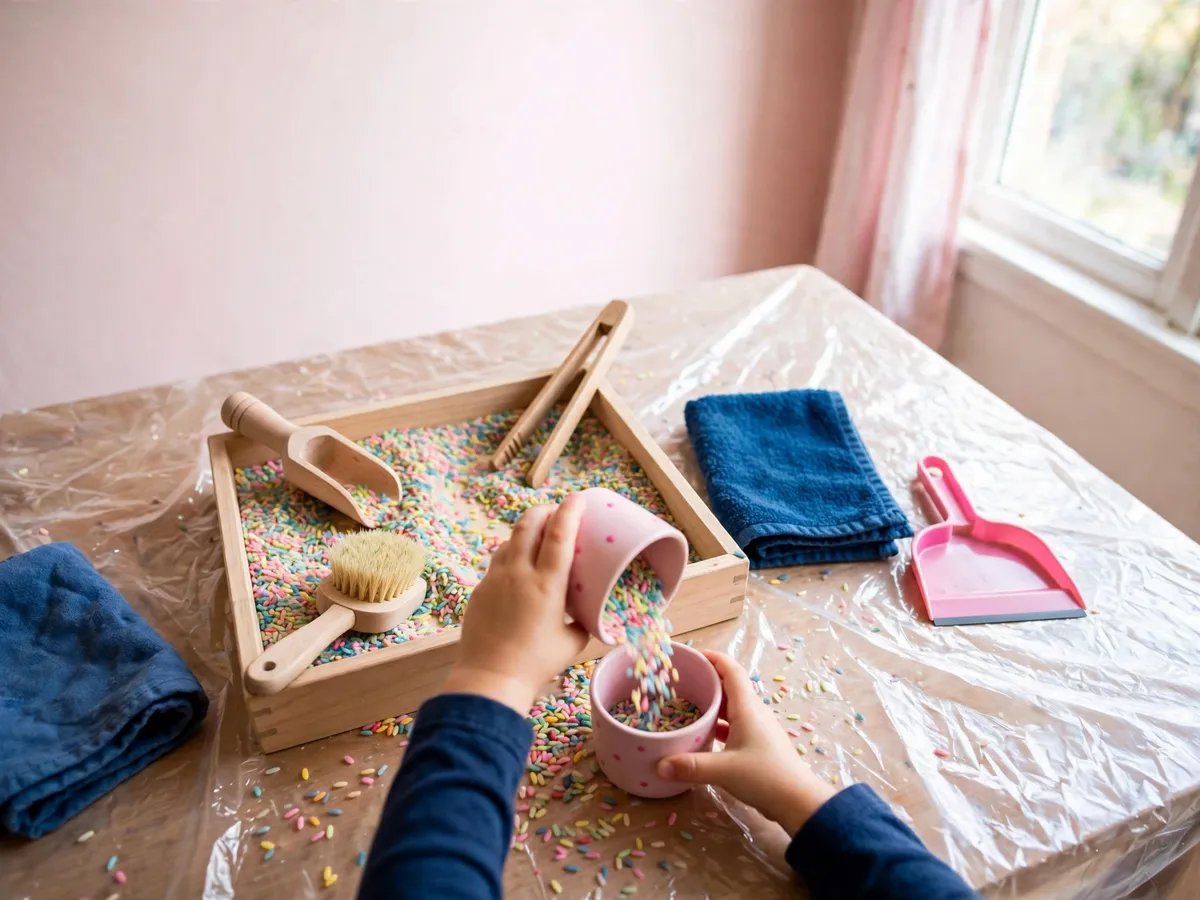
The container is anything with raised edges: a shallow baking tray, a washing-up bowl, a cardboard box with the flaps taped. Deep sides keep the filler on the table instead of the floor. The filler and the tools are in the house already, and the restraint is the advice on this page.
The filler: dried lentils, oats, pasta, sand from the garden, leaves in autumn. All of it is in the house or outside already. Colored rice is one filler among many, bought when you want the same bin to last a month rather than an afternoon.
Something to do: two measuring cups, a funnel, a whisk. That is the only part where a bought set saves a trip to the kitchen, and it is what the tool listing covers. What you do not need: four containers, three bags of filler, a themed kit for every animal, and a table before you have proved the child fills a bin twice. The restraint is the advice on this page.
Small pieces, and the child who still mouths things
A bin is a bowl of small parts: rice grains, beans, dinosaur figures, beads and buttons all belong to the same warning. Anything that fits fully inside a small-parts cylinder, about the size of a child's throat under 3, is a choking hazard, so keep coins, beads, buttons and pins off the floor.
When you choose toys and craft supplies, check the small-parts warning on the listing. It matters most under 3, and it stays relevant for the younger end of every playdate. A printed band like Ages 3-99 is the maker's grade, not a small-parts warning.
Between 2 and 4, a child does not grasp danger and will not remember a spoken no in the middle of play, so the watching has to be hands-on. In practice: the bin comes out when an adult can stay with it, the pieces get counted before and after, and the bin goes back on a shelf a toddler cannot tip over. For anything with a hazard in it, small parts included, the same rule applies: an adult, close enough to act.
The splash table, and what water play requires
One of these four is a table for sand and water, and it is the only one that changes the safety question. Shallow water in a tray still counts as water, and a few centimetres is not a licence for a moment of looking away.
Stay within arm's reach of your child near water. That close, all the time, is what touch supervision means: not the same room, not the next doorway. Never step away from a young child near water, not even for a moment, and not with another child in tow. An older sibling is not a supervisor for the splash table. If the water has to be left, it gets tipped out and the table comes back tomorrow. The practical version: the table goes where the floor can get wet, clothes change before the water comes out, and an adult sits down with it rather than standing over it.
Bins you do not have to buy
The supply is the small part of this and the idea is the rest of it. The sensory play starter guide runs a first bin on things already in the kitchen, and the dinosaur dig bin page builds the kit theme without the order. For the season outside your door, the autumn sensory bin needs a walk rather than a delivery, and the rainy day rescue list is where a bin earns its keep.
Sensory bin questions
What does a bin need to be a sensory bin?
Three things: a container with raised edges, a filler to dig through, and something to do with the filler. The container can be a baking tray and the filler can be dried pasta or leaves. Only the third part is where a bought tool helps, and even that is optional.
Will a sensory bin keep my child busy longer than ordinary play?
This page does not claim that, and no listing here carries a result. A bin holds whatever a child puts into it, for as long as it holds their interest. Some children go deep for twenty minutes and some walk away in four, and nothing about the box settles which one you get.
Is the rice or the kit the better first buy?
Buy for the gap. If there is already a tray and a cup in the kitchen, the filler is the missing piece. If there is nothing, a kit brings the tray, the filler and the pieces in one order, which is the difference between playing this afternoon and playing after a shop trip.
My child still mouths everything. Is a bin off limits?
That is the small-parts question. Read the warning on the listing before anything goes on the floor, keep the pieces where an adult holds them, and stay within arm's reach of a child under 3. The printed age band does not answer that question for you.
Do I need to buy anything at all for a first bin?
No. A baking tray, a bag of dried lentils and two measuring cups is a bin, and it is the fastest way to find out whether your child uses one. Buy the tool after the third play, not before the first.
Build the first one tonight
Take the tray out, pour in whatever the cupboard has, put two cups beside it, and see whether the bin gets used a third time. Buy after that, and buy the part that is missing. How these four listings were chosen is written up in how we research, and the links in the cards are covered in the affiliate disclosure.