 KidNestClub
Kids Activities & Screen-Free Play
Low Energy Screen-Free Activities | 30 Quiet Ideas for Slow Days
Some afternoons ask for less, not more. The child who slept badly, the day after a long outing, the hours when the household is moving at half speed — on those days a list of high-energy games is the wrong list. Here are thirty screen-free ideas for a slow day at home, sorted by how much the grown-up has to do. The first eight ask nothing of you but a voice.
By KidNestClub · Updated 18 November 2026
Total scope: 30 ideas · Ages 2-10 · four groups, easiest for the grown-up first · 5-40 minutes each · what is already in the house.
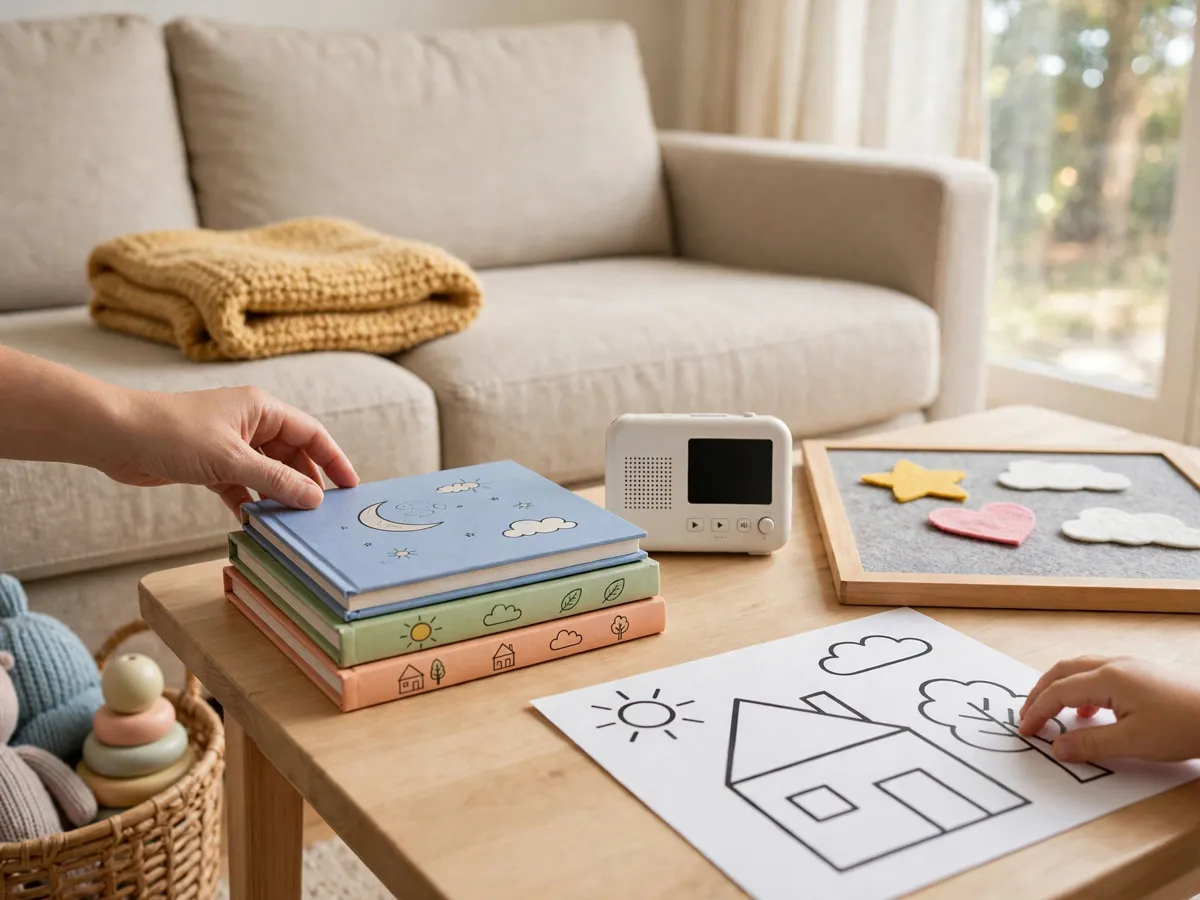
The four groups run easiest to hardest on you: listen-only, lie-down, table-slow, then build-slow. If the day is wet rather than slow, the rainy-day rescue menu and the rainy-day games list are the weather-led pages. For a straight swap on an ordinary day, the screen-free swaps page trades one routine for one activity, and the indoor activities list covers the afternoons when the child still has energy to spend.
Before you start: lower the ask
Three things make a slow day work. One: one thing out at a time — a tray, a basket, a box, then the next. Two: the grown-up sits at the same height as the child, on the floor or at the table, rather than standing over the activity. Three: a drink within reach and a plain snack before the grumbles start, not after.
If an idea lands flat, put it away without comment and take the next one from the same group. Nothing on this page has to be finished, and a half-built tower that gets knocked down still filled the hour.
Group 1: listen-only — ideas 1 to 8
Ages 2-10 · the grown-up speaks, reads or presses play · the child can be flat on the sofa, under a blanket, or on the floor with a cushion under their head. These eight carry the first half hour of a slow afternoon, and they cost you nothing but your voice.
1. One chapter, read aloud
Pick a book with short chapters and read one chapter, then stop at the interesting part. A child who is lying down still listens, and stopping mid-scene leaves the next chapter as something to ask for later. If your voice needs a rest, an audiobook does the same job.
Ages 3-10 · 15-20 minutes · one book, one voice · the child can lie down for the whole chapter.
2. A story podcast with the lights low
Dim the room, put a story podcast on a speaker, and lie on the floor beside the child. One episode, then a pause. Ask a single question about the story afterwards — who lost the map, where the dog went — and let the answer be short.
Ages 4-10 · 15-25 minutes · a speaker and one episode · an adult in the room for the whole listen.
3. Sound hunt from a cushion
Sit still for two minutes and name every sound you can hear: the fridge, a bird, a car, the clock in the hall. Take turns naming one each. A child who is worn out can do this flat on their back with their eyes shut.
Ages 2-8 · 5-10 minutes · no supplies · the room stays quiet enough to hear the house.
4. One song, three ways
Play a song the child knows and ask for it three ways: hummed, clapped, then sung in a silly voice. Then let the child pick the next song and set the order. This one runs on a phone speaker and a sofa, and it fills the gap before lunch.
Ages 2-6 · 10 minutes · one song, three versions · an adult sits with the child.
5. The picture-book pile
Stack six picture books beside the child and let them choose the order. Read the first two properly, then let them turn the pages and tell you the story from the pictures. A four-year-old narrates; a two-year-old points and names.
Ages 2-6 · 15 minutes · six picture books · an adult beside the pile.
6. Guess the sound behind the book
One person hides behind a book or a cushion and makes a sound with something in the room: a spoon on a mug, paper torn, a zip pulled slowly. Everyone else guesses. Swap after three sounds, and let the child choose the objects for the next round.
Ages 3-8 · 10 minutes · household objects only · nothing sharp or breakable goes behind the book.
7. The story chain
One sentence each, taking turns, building a single story. The rule is that every sentence adds something the last one did not. Start with a character and a place, then let the child take the second sentence and the fourth.
Ages 5-10 · 10-15 minutes · no supplies · two chairs and a blanket are enough.
8. Two-voice radio play
Read a picture book aloud with two voices: one for each character and a low narrator voice for the rest. A child who can read takes one part. This is the version that holds a seven-year-old on the sofa for twenty minutes on a wet Sunday.
Ages 5-10 · 20 minutes · one picture book, two voices · an adult takes the narrator part.
Group 2: lie-down — ideas 9 to 16
Ages 2-8 · the grown-up sets one thing down beside the child, then sits nearby. Everything in this group works from a bed, a sofa or a rug on the floor, and none of it needs a table.
9. Lap-tray felt board
Felt sticks to felt, so a board on a lap tray holds shapes with no glue and no tape. Cut the shapes together before the child lies down — a house, three animals, a road — then let them build and rebuild on the tray. The pieces store in a zip bag between sessions.
Ages 2-6 · 20-30 minutes · felt squares and a board · the cutting is done together, and the scissors go back in the drawer.
10. Blanket tent over two chairs
Two chairs, one sheet over the top, cushions underneath. Add a flashlight and one book each. The child lies inside and the adult lies at the entrance with a shoulder in the doorway. Keep the sheet clear of any lamp or heater in the room.
Ages 3-8 · 20 minutes · a sheet, two chairs, a flashlight · an adult sets the sheet and stays in the room.
11. Sticker line
Draw one long wavy line across a sheet of paper and let the child cover it with dot stickers, one at a time. It is slow work by design, and the paper can be finished across two sittings. A lap desk makes it work lying down.
Ages 2-6 · 15-25 minutes · dot stickers and one sheet of paper · an adult within reach at the start.
12. Window shapes
Lie on a bed under the window, or sit at it, and name what the clouds look like. Then count the birds, or the cars in one color, or the windows with lights on. Ten minutes of looking out counts as a real activity on a day like this one.
Ages 2-8 · 10 minutes · no supplies · the window stays shut and the child stays off the sill.
13. Back drawing
Draw a shape, a letter or a number on the child's back with one finger, and let them guess. Then swap and let them draw on yours. Keep the pressure light and the shapes simple at first. A six-year-old asks for harder ones by the third round.
Ages 3-8 · 10-15 minutes · no supplies · both players stay sitting or lying down.
14. Beanbag balance
One beanbag or a folded sock on the tummy, one on the forehead, one on each knee. The game is to keep all four still for a count of ten. Lying down is allowed and usually wins. A second round adds one more bag somewhere the child chooses.
Ages 3-8 · 10 minutes · four soft weights · an adult counts and plays too.
15. Smell jars
Four small jars with a cotton ball in each: vanilla, lemon peel, cinnamon, a sprig of mint. An adult opens the lids and holds each jar under the child's nose; the child guesses. Close the jars afterwards and put them on a high shelf.
Ages 3-8 · 10-15 minutes · four lidded jars · an adult handles the lids and the jars stay out of reach afterwards.
16. Name and wiggle
Start at the toes and work up: name the part, wiggle it, move on. Toes, ankles, knees, hips, fingers, wrists, elbows, shoulders, nose, ears. A two-year-old joins at the toes; a six-year-old adds a rule, such as only the left side or only the parts that bend.
Ages 2-6 · 5 minutes · no supplies · both players stay on the floor or the sofa.
Group 3: table-slow — ideas 17 to 24
Ages 2-10 · the grown-up sets a tray at the table and sits down too. These run 15 to 30 minutes and end when the child pushes the tray away, which is the signal to stop rather than to offer something new.
17. Button tray
Tip a jar of buttons into a muffin tin and let the child fill each cup with one color. A tray with a lip keeps the pieces from rolling onto the floor. Large buttons for the youngest children, and the whole tray goes back in the cupboard when the game ends.
Ages 4-10 · 20-30 minutes · buttons are a choking hazard, so keep the tray on a table away from a child under 3, and an adult stays at the table.
18. Card sort
A pack of old playing cards, put in order four ways in turn: by color, by suit, by number, then back into one pile. A tired child moves slowly, which is the point of the exercise. No game rules, no winner, and no timer.
Ages 4-10 · 15-20 minutes · one pack of cards · an adult at the table to start the first pile.
19. Dot-sticker mosaic
Draw a big shape — a fish, a house, a letter — and fill it with dot stickers, one at a time, no overlapping needed. A five-year-old finishes a small shape in one sitting and comes back to a large one after lunch.
Ages 2-6 · 20 minutes · dot stickers and a marker · an adult draws the outline.
20. One-color watercolor
One color, one brush, one small cup of water, one sheet of thick paper. The child paints the whole page and watches the color go from dark at the top to pale at the bottom. Change the water when it turns muddy, and lay the sheet flat to dry.
Ages 3-8 · 20-30 minutes · washable paint only · an adult at the table with the water cup.
21. Printed maze, one pencil
Print four mazes at rising difficulty, or draw them: one line that has to reach the star without crossing a wall. One maze, then a break, then the next. Stop when the pencil starts pressing hard enough to tear the paper.
Ages 4-10 · 15 minutes · four printed pages and a pencil · an adult sits beside the child for the first one.
22. Paper strip chain
Cut the strips together before the child sits down, then loop them into a chain one link at a time, with tape or a glue stick at each join. A child who is lying low can still make a chain long enough to cross the table twice.
Ages 4-10 · 20-30 minutes · paper strips and tape · the strips are cut together, and the scissors go away before the gluing starts.
23. Tape peel line
Run a strip of masking tape along the edge of the table and let the child peel it off in one slow pull, then press it back down. Repeat along a second edge. It sounds like nothing and it holds a three-year-old for a quarter of an hour.
Ages 2-5 · 10-15 minutes · masking tape · an adult presses the tape down and peels the last strip off.
24. Playdough, one tool
One lump of playdough, one tool. Roll snakes, press dots, make a flat pancake and start again. The rule that keeps it slow is one tool at a time, swapped only when the child asks for a different one.
Ages 2-6 · 20 minutes · one lump and one tool · an adult at the table, and the mat goes down first.
Group 4: build-slow — ideas 25 to 30
Ages 2-10 · the grown-up clears a corner and then steps back. These take the longest to set up and the longest to run, and each one ends with something standing that was not there before.
25. Domino line
Stand dominoes on the floor in a long curve, one at a time, then tap the first one. Laying the line takes longer than the fall, which is the whole idea. Rebuild it in a different shape and send it around a chair leg.
Ages 5-10 · 30 minutes · one box of dominoes · keep the pieces on the floor away from a child under 3, and an adult stays in the room.
26. Book bridge
Two stacks of books, a ruler across the gap, and a small toy to test the span. Add one book to each stack and test again. The bridge either holds or it does not, and both answers are worth a second try.
Ages 5-10 · 30 minutes · books, a ruler, one toy · an adult sets the first span.
27. Box city
A cardboard box, a marker, and a grown-up with the craft knife. Cut the door and window openings together before the child starts drawing; the child draws the rest and moves small toys in. One box makes one building, and two boxes make a street.
Ages 3-8 · 30-40 minutes · one box and a marker · the knife stays with the adult, and it goes away before the drawing starts.
28. Tube marble run
Tape paper towel tubes to the side of a low shelf, angled so a marble rolls from the top to the bottom and lands in a bowl. Add one tube at a time and test after each. Between runs the marbles go back in a lidded jar.
Ages 5-10 · 30 minutes · tubes, tape and marbles · marbles are a choking hazard, so keep them away from a child under 3, and an adult stays with the run.
29. The tower that has to stand
Build the tallest tower that still stands after a snack break. Blocks, boxes, books — anything stackable. The rule is that the tower has to be standing when everyone comes back to the room, which turns the break into part of the game.
Ages 2-8 · 20-30 minutes · stackable things · large blocks for the youngest, and an adult builds alongside.
30. The big puzzle by the window
Tip a puzzle onto a tray and put the edge pieces in first. A 24-piece puzzle suits a four-year-old and a 100-piece suits a nine-year-old. Leave it out on the tray between sittings and come back to it after lunch rather than packing it away.
Ages 3-10 · 30-40 minutes · one puzzle and a tray · an adult sorts the first edge with the child.
A quiet day at home is not a care plan
Every idea on this page fills time. None of them is care. If a child is unwell, the decisions about that day — what to watch, when to check in, whether to keep them home — belong to you and to your child's own clinician, and a list of activities has nothing to add to that. Follow their advice for the day, then come back here for the hours in between.
The same holds for a child who is worn out after a big week or a long journey. Rest is the plan. These ideas are what to do around it, not instead of it, and a child who falls asleep on the sofa halfway through idea 12 has had the afternoon they needed.
When an idea lands flat
Two signs that it is time to stop: the child starts throwing the pieces, or the grown-up starts tidying while the child is still working. Put the tray away, take a drink, and move one group lower down this page. The listen-only group is the floor of the list.
Save the page for the next slow day and skip straight to the group that matches the room. Ages 2-10 · four groups · thirty ideas · nothing to buy.
Save this for the next slow afternoon
Pin the group that fits the day — listen-only for the worst of it, build-slow for a child on the mend and looking for something to do. The Kids Activities & Screen-Free Play collection holds the higher-energy lists for the days when the child is back on their feet, and the indoor play menu has the tray games that sit beside these.