 KidNestClub
Kids Activities & Screen-Free Play
DIY Outdoor Play Village | 6 Builds From Loose Parts
Six small builds that turn one corner of a yard into a place children keep coming back to: a mud kitchen, a plank ramp, a crate shop, a tire garden, a water wall and a stick-and-string den. Each one lists its parts, its build time and where it wants to sit, so you can start with whichever your scrap pile already supports.
By KidNestClub · Updated 18 November 2026
Total scope: 6 builds · Ages 3-8 · Scrap, crates and garden offcuts · One afternoon per build.
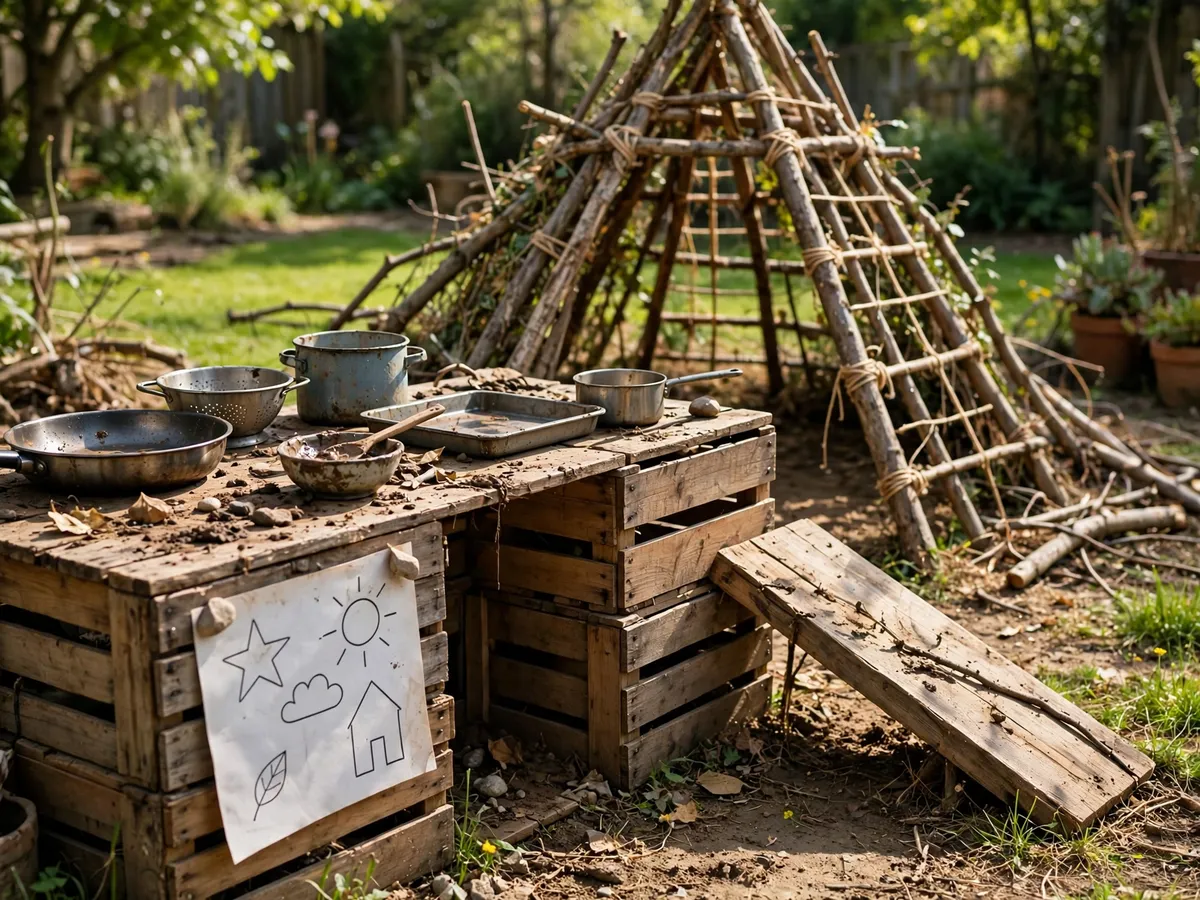
This is the build page. Where the pieces sit relative to each other, and how much of the yard each one takes, is a separate question answered in the outdoor play area layout guide. Here it is only what each build is made of, how long it takes, and where in the yard it works best.
Three rules before the first build
- Keep every build low and open. A child can step out of it rather than climb over it.
- Check every piece of reused timber for splinters and loose nails before it goes into a build, and again at the start of each season.
- Adults do the cutting, drilling and lifting. A child’s job is the layout, the filling and the playing.
1. Mud kitchen
Parts: a crate or an upturned wooden box for the counter, two old pans, a jug, a wooden spoon, a bowl for soil and a bucket of water.
Build: 20 minutes. Stand the crate on end, set the pans on top, and put the soil bowl at one end. Nothing is fixed down. Shift it to follow the shade.
Siting: on soil or grass rather than paving, close enough to a door that a hand-wash is quick, and in view of a window you sit at.
Ages 3-8 · Soil and water play · An adult stays outside with the water bucket, and hands get washed at the end of the round.
2. Plank ramp
Parts: one wide plank, two flat blocks or a low crate to rest one end on, and a few loose bricks as a stop at the bottom.
Build: 5 minutes. Rest one end of the plank on the block, check that the other end sits flat on the ground, and set the bricks where the run-out lands.
Siting: on flat grass or short turf, with a clear run of a few steps past the bottom end and nothing hard in that space.
Ages 3-8 · Keep the high end low, under a knee, and turn the plank over after rain so it dries.
3. Crate shop
Parts: two crates stacked or side by side, a plank across the top as a counter, and a box of loose shop stock such as pinecones, shells, stones and old jar lids.
Build: 10 minutes. Stack the crates with the heavier one at the bottom, lay the plank across, and set the stock box on the ground beside the counter.
Siting: against a fence or wall so the counter has a back, and on level ground so a stack of two does not lean.
Ages 3-8 · Check the crates for loose nails and split boards before stacking, and keep any small stock pieces too big to fit in a mouth.
4. Tire garden
Parts: one or two clean tires, a bag of compost, and three or four fast-growing plants or herb pots.
Build: 20 minutes. Lay the tire flat, fill the middle with compost, and plant it up. Two tires side by side make a two-bed garden.
Siting: on soil, in the sunniest spot you have, and where a hose reaches.
Ages 3-8 · Wash the tires before they come into the yard, and keep the watering can small enough for a child to carry.
5. Water wall
Parts: a fence panel, four or five cut pieces of guttering or halved plastic pipe, a jug, and a bucket at the bottom.
Build: 30 minutes, adult-led. Screw each piece to the fence at a slight angle, stepping down from top left to bottom right, and test with a jug before handing it over.
Siting: on a fence you can screw into, over grass or gravel rather than a doorway, with the bucket where the last run ends.
Ages 4-8 · Water play · An adult stays within reach while the jug is out, the bucket stays shallow, and hands wash after.
6. Stick-and-string den
Parts: four long straight sticks, a ball of garden string, and two old sheets or a length of netting.
Build: 15 minutes. Push the sticks into the ground in a rough square, lean the tops together and tie them once at the meeting point. Drape the sheet over and peg one corner down.
Siting: on soft ground where the sticks will go in, in the shade of a tree or a wall, with one side left open.
Ages 3-8 · Snap any stick that will not push in rather than forcing it, and check the den for broken ends before the next round.
Scrap timber, water and mud
Between 2 and 4, a child doesn’t grasp danger yet and won’t remember ‘no’ while they’re busy playing — so the watching has to be hands-on. That holds for a build in the yard exactly as it does indoors.
For anything with a hazard in it — scissors, heat, water, small parts — the same rule applies: an adult, close enough to act. Saws, drills and hammers stay with the adult doing the build, and the tools go back in the shed the moment the job is done.
Reused timber gets a splinter and loose-nail check before it goes into a build and again before each season. Pull any nail that sticks out rather than hammering it flat. A board that splits when it is cut goes on the fire pile rather than into a child’s build.
Stay within arm’s reach of your child near water — that close, all the time, is what ‘touch supervision’ means. That covers the water wall, the mud kitchen bucket and the watering can. Mud goes on clothes, not near a mouth, and hands get washed at the door.
This is a guide, not medical advice. For questions about a cut, a splinter or your child’s health, your pediatrician is the right person to ask.
Start with the one your scrap pile already supports
Save this page and build one, not six. The plank ramp costs a plank and five minutes, which makes it the easiest first build, and the mud kitchen is the one children ask for again the next day. The Kids Activities collection holds the outdoor games and garden menus that run beside these builds, and the outdoor games for preschoolers fills the space around them.