 KidNestClub
Kids Room & Toy Storage
Cube Organizer Toy Storage: 6 Setups for a 4-Cube Unit, Ages 2-8
A four-cube unit is the one piece of furniture that can hold a whole playroom if each cube does a different job. Six setups below for a 4-cube or 9-cube unit — a bare cube, a lidded bin, a shallow-front cube for the daily-play toys, a book cube, a top row for the out-of-reach rotation, and one cube you leave empty on purpose. Each one is a home for a category, not another lid to lift.
By KidNestClub · Updated 19 November 2026
About 20 minutes per cube · One adult fits any strap or wall-mount piece.
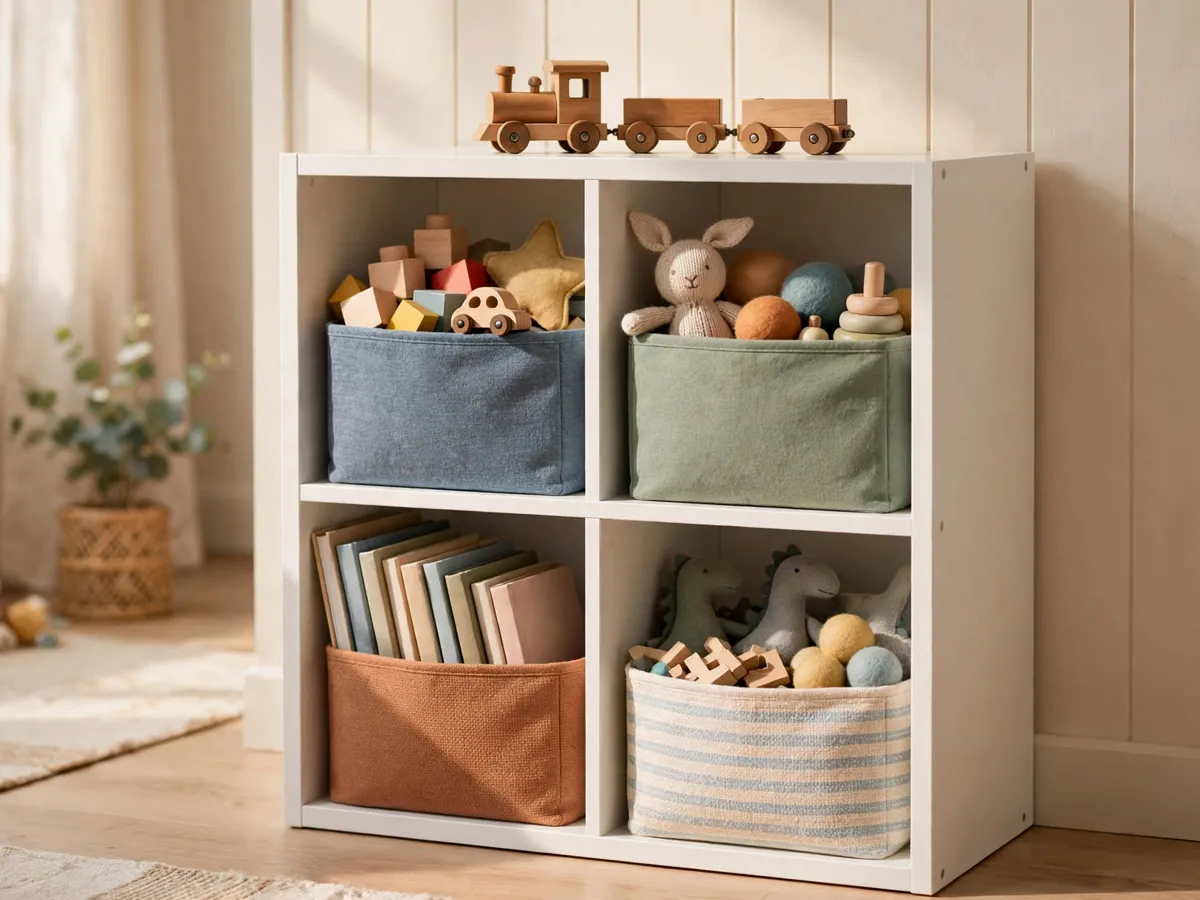
Start with the cube count, not the bins
Ten minutes before you buy a single insert. Stand at the unit and count the cubes you have, then split the toy pile by the job each cube will do: the loose pieces that need a bin, the books that need a face-out row, the daily-play toys that need a shallow front, and the rotation pieces that live out of reach. The unit you already own tells you the bin count — not the other way around.
While you count, pull out anything broken, anything with small loose pieces that belong to a set for older children, and anything your child has outgrown. Keep small pieces out of reach of under-3s.
1. The bare cube for bulky toys
What you need: one cube with no insert at all. Time: 2 minutes · Ages 2-8.
The largest toys — the wooden blocks crate, the big truck, the ball — never fit an insert, and a bin lid stops the whole job. Leave one cube open and drop them straight in. A bare cube is the fastest drop on the floor-to-shelf path, and the one your child reaches for when the big toys come out. Keep this cube on the bottom row so the weight sits low.
2. The lidded fabric bin for loose pieces
What you need: one fabric bin with a lid that fits the cube. Time: 5 minutes · Ages 2-8.
The loose pieces — puzzle parts, small figures, building bricks — spill across the floor every time the cube is open. A lidded bin holds them in one drop, and the lid means they stay put when the cube next to it comes out. Put this bin on a middle row where the lid lifts without reaching. Ages 4-8 lift the lid and drop the pieces in; for under-3s, keep the lid off and use the bin open, so the pieces land inside rather than on top of a closed lid.
3. The shallow-front cube for daily-play toys
What you need: a shallow-front insert or a bin with the front cut low. Time: 5 minutes · Ages 2-8.
The toys your child reaches for every day need a cube they can see into. A shallow-front insert — one where the front wall is half the height of the back — lets a child spot the toy from across the room and grab it without pulling the whole bin out. This is the cube on the bottom row, the one your child walks past and dips a hand into. Refill it with three or four toys at a time, no more: a packed shallow front means the toy at the back never comes out.
4. The book cube, face-out
What you need: one cube with no insert, used as a shelf. Time: 5 minutes · Ages 2-8.
Books stacked in a pile stay in a pile. Stand them face-out in one cube, the way picture books go on a low shelf, so the cover does the talking. A child picks a book by its cover at this age, not its spine. Put the tallest books at the back and the shortest at the front, and keep this cube on a middle row where the covers sit at eye level. Four or five books is enough; a cube packed with books means the one your child wants is the one wedged at the back.
A cube that holds books can also sit beside a bedtime routine chart, within reach of the last story of the night.
5. The top cubes for the out-of-reach rotation
What you need: the top row of the unit, with bins that have lids. Time: 10 minutes · Ages 2-8.
The toys your child is not playing with this week go up high. The top cubes hold the rotation — the sets that need all their pieces, the toys that come out on a rainy afternoon, the ones that need an adult alongside. A lidded bin on the top row keeps the dust off and the pieces together, and the height means a child asks before pulling one down. Swap one top-cube bin for one bottom-cube bin every two weeks, so the rotation happens without re-doing the whole unit. If the unit is taller than your child, fit the strap the way the instructions in the box describe, and keep the heaviest bins on the bottom row.
6. The cube you leave empty on purpose
What you need: one cube with nothing in it. Time: 0 minutes · Ages 2-8.
A unit where every cube is full is a unit where nothing goes back. Leave one cube empty — the odd-lot bin that catches the toy that does not belong anywhere else, the half-built project that stays out overnight, the stuffed animal that sleeps on the shelf. The empty cube is the one that absorbs the mess that would otherwise land on the floor. When it fills up, that is the signal to clear the unit, not to buy another one.
The safety pass before the first bin goes in
- If the unit came with a wall strap, fit the strap the way the instructions in the box describe. An adult does this before any bins go in.
- Keep the heaviest bins on the bottom row and the lightest on top, so the unit stays steady when a bin slides out.
- No climbing the shelves for a toy. Anything on a top cube waits for an adult or moves down to a row your child can reach.
- Keep small pieces and sets labelled for older children in a lidded bin on the top row, out of reach of under-3s.
- An adult slides bins in and out for the first week while your child carries the toys.
How the same unit changes as your child grows
Ages 2-3: two bare cubes on the bottom row for the bulky toys, one shallow-front cube beside them for the daily three, and the top row stays sealed with lidded bins out of reach. The book cube starts with four board books face-out.
Ages 4-6: the shallow-front cube holds the daily-play set, a lidded bin takes the building pieces, and the book cube moves to picture books. The top row opens up for the sets that need all their pieces.
Ages 7-8: the unit holds the kits and the books. The empty cube becomes the project cube — the half-built model or the drawing that stays out overnight.
The cubes stop working
The floor fills up every night: the shallow-front cube is too full. Cut the daily-play set to three toys and move the rest to a top-row bin.
Toys go back in the wrong cube: the bins are in the wrong spot. Move the daily-play cube to the row your child reaches for first, not the row you picked.
Nothing goes back at all: do it together for five nights. You hold the bin open and your child carries the toy, then hand over the last step.
Every cube is full: the count is the problem, not the unit. Pair this page with a toy rotation checklist and shrink the pile that stays out.
What this page is, and what it is not
This is the guide for one piece of furniture — the cube unit itself, and the six ways its cubes get filled. It is not the room plan. The toy storage organization page holds thirty setups sorted by room, for when one cube unit is not enough.
It is also not the whole-room layout. The playroom storage guide covers seven storage areas across a full room, from the reading nook to the craft corner.
And it is not the label tutorial. The labeling toy bins page shows the picture labels that go on each bin, so the cube tells your child what goes where. For the stuffed animals that never fit a cube, the plush toy storage guide has five setups built for them.
Save this for the weekend reset
Pin the setup that matches your unit — bare cube, lidded bin, shallow front, book cube, top row, or the empty one — then come back when the count is done. The Kids Meals & Family Spaces collection holds the wider storage guides that pair with this unit.