 KidNestClub
Easy Kids Crafts
Lunar New Year Crafts for Kids | 5 Paper Makes Ages 3-8
Many families across East and Southeast Asia mark the new year that falls on the lunar calendar, and red paper is the one material you see on nearly every table. These five makes are that material: envelopes, a lantern, a lion mask, blossoms and a folded cutting. Each one lists its supplies, its age band and the step that stays with an adult. What the day means to your family is yours to decide — this page only covers the paper.
By KidNestClub · Updated 18 November 2026
Total scope: 5 makes · Ages 3-8 · Red and pink paper, glue, string and one battery tea light · Most finish inside 30 minutes.
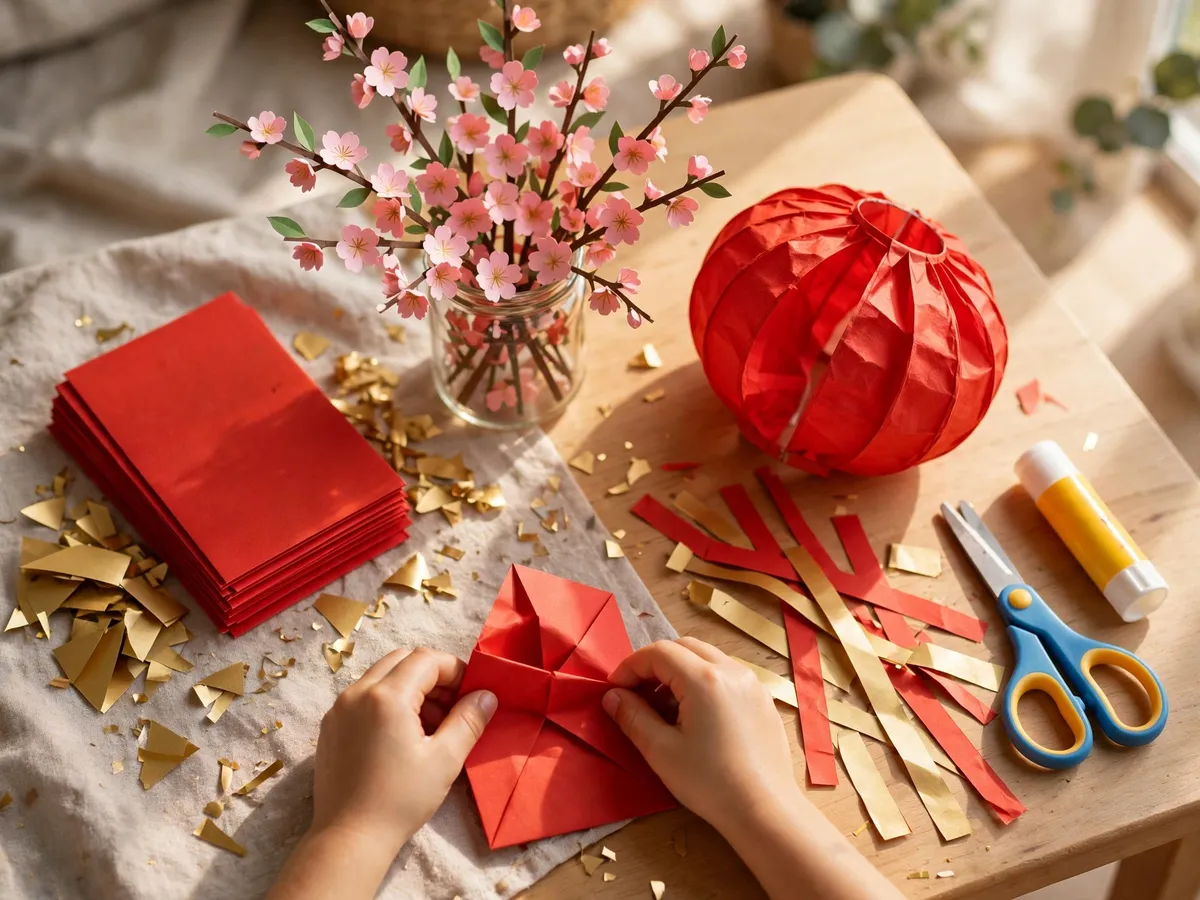
Start with the envelopes and the blossoms. They share one sheet of paper, need no drying rack and both end up somewhere visible — one on the table, one on a branch in the hallway. The lantern and the lion mask each want their own sitting, because of the pleats and the glue.
What to have out before you sit down
One tray covers all five makes. The list below is what sits on it: red paper plus pink, white and gold sheets, glue sticks, string or ribbon, a paper punch if you have one, a bare branch in a jar, and one battery tea light for the lantern.
- Red paper — a few sheets, plus one long strip if you can
- Pink and white paper for the blossoms
- Gold or yellow paper for the lantern bands and the stamps
- Glue sticks, white school glue and a brush or a spoon for it
- Blunt-nosed scissors, one pair per child old enough to use them
- String, ribbon or wool, and a paper punch if you have one
- One bare branch in a jar, and a battery tea light for the lantern
Skip the real candles entirely. A battery tea light gives the same glow through red paper with nothing to burn, nothing to hot, and nothing to blow out. Keep the tea light switch under adult fingers.
1. Red envelopes with a stamped corner
Cut a rectangle of red paper, fold it over into an envelope and glue the flap. Trim the top edge into a shallow point or leave it square. Then stamp a small gold square in the corner with a sponge or the child’s fingertip, one per envelope. Make four or five, because they get given away.
Fill them with something the child wrote or drew — a note, a tally of the year, a folded picture. If your family’s own custom is to fill them another way, follow your family’s way and let the craft stop at the paper.
Ages 3-5 fold and glue while an adult cuts the rectangles. Ages 6-8 cut, fold and stamp their own. Wipe glue off hands before anyone leaves the table.
2. Pleated paper lantern
Take a long strip of red paper and pleat it back and forth like a fan, about a finger-width per fold. Roll the pleated strip into a cylinder and glue the short ends together. Add two gold bands, one around the middle and one at the base, then punch two holes at the top and thread a string handle through. Set it over a battery tea light, or hang it in a window where the daylight goes through it.
Ages 3-5 pleat one section and hold the cylinder closed while an adult glues the seam. Ages 6-8 pleat, roll and band the whole lantern. An adult does the punching, ties the handle knot tight and keeps the tea light off the table where it could get knocked.
3. Lion mask on a card handle
Cut a big rounded square of card for the face. Glue on two white paper circles for eyes with smaller black circles inside them, a curled tube of card for the nose, and a wide grin cut from red paper. Then tear strips of red, gold and green paper and bunch them along the top and both sides as a mane — the more crumpled, the better it reads. Finish with a stick handle glued to the back so the child can hold it up.
Ages 3-5 tear the mane and place the eyes. Ages 6-8 cut the face shape and assemble the whole mask with blunt-nosed scissors. An adult cuts the card face and the handle, and checks the glue on the handle before anyone waves it. The mask is for looking at each other, not for covering eyes while walking.
4. Blossom branches for the hallway jar
Cut pink paper into five-petal shapes, or scrunch a small square between two fingers for a simpler bloom. Twist a short stem of green paper and press the flower onto it, then wind the whole thing around a bare branch in a jar. Add gold stamens cut from the last of the yellow paper. A handful of blooms on one branch is enough to change a hallway.
Ages 3-5 scrunch the squares and hand them over. Ages 6-8 cut the petals, twist the stems and attach them themselves. An adult cuts the petal shapes for the younger group, and brings the branch indoors from outside so the bark stays off the table.
5. Folded paper cutting
Paper cutting in many shapes is an old craft across the region, and the child-sized version is simple. Fold a square of red paper in half, then in half again. Cut a curve or a notch into the folded edges, unfold it slowly, and a symmetrical pattern appears. Do it twice more with different cuts and you have three windows to tape up.
Ages 6-8 fold and cut with blunt-nosed scissors, with an adult at the same table. Under 6, the cutting stays in adult hands and the child draws the line to cut along and chooses the shape. Several layers of paper are too thick for child-size scissors, so do not push a five-year-old onto it. Tape the finished cutting on a window from inside, where it cannot peel off in the wind.
Keeping it respectful at the table
The new year on the lunar calendar is a family occasion first, and it looks different from household to household. Four lines that keep a craft session comfortable for everyone:
- Follow your own family first. If grandparents do something specific on the day, ask them to show the child and let the paper craft sit beside it.
- Let the family describe what the day means to them. Nobody needs a stranger’s explanation of their own tradition, and this page does not give one.
- Keep the food, the music and the greetings the ones your family already uses, rather than the first ones you find online.
- If you are new to the occasion — a school, a neighbour, a friend’s house — treat it as theirs. Join the craft, ask your own questions later, and do not bring a ritual you have read about into someone else’s home.
These five makes are paper, glue and string. They are not a replacement for anything a family does, and they do not carry any promise about what the year will bring.
Scissors, glue and supervision
For anything with a hazard in it — scissors, heat, water, small parts — the same rule applies: an adult, close enough to act. Here that means the scissors on the folded cutting, the glue on the mane, and the branch that came in from outside.
Scissors stay with the adult for the under-6 table on the layered cutting. A child of six or over gets a pair with a rounded tip and an adult at the same table. Black paper circles for the mask eyes are small, so keep that pot shut and off the floor, and sweep for offcuts at the end of the session. Battery tea lights are not a toy: an adult handles the switch and the light goes back in a drawer when the lantern comes down.
Every make here carries the age band it was written for, and a younger child may still need a different version. This is a craft guide, not medical advice. For questions about your child’s health, your pediatrician is the right person to ask.
Three things that go wrong, and what to do
The lantern cylinder springs open. The glue seam needs pressure, not more glue. Hold the seam pinched for a slow count of ten, or wrap a gold band around the join so the band does the holding while it dries.
The pleats come apart. Work from the middle of the strip outwards and keep each fold the width of a finger, not smaller. A fold thinner than a child’s fingers will not hold a crease.
The paper cutting tears instead of cutting. Use one sheet fewer. Two layers of red paper cut cleanly with blunt scissors; four layers need the adult’s pair, and a torn cutting cannot be re-folded.
Questions parents ask
When should we start these?
Two to three weeks before the day gives you room for the drying and a second attempt at the cutting. The envelopes and the blossoms can be made the week itself, since neither needs a drying rack.
What if we are not a lunar new year family?
Then make these for a school or a neighbour’s celebration, and keep the four lines above in mind. The crafts stand on their own as red paper and folds. Let the family hosting the day describe what they do.
Can a two-year-old join in?
Yes, at the blossoms and the envelope stamps. Both are tearing, scrunching and pressing with a glue stick, and no scissors in the child’s hand. Keep the branch, the tea light and the pot of small eye circles out of reach until you sit down together.
What do we do with the finished lantern?
Hang it where a child walks under it rarely — a bedroom door or a low window — and bring it down before it goes soft with handling. Pleated red paper creases once and does not come back.
Save the pair that fits one afternoon
Save this page and start with the envelopes and the blossoms. The lunar new year sensory play page pairs a red-and-gold sensory tray with these makes, the scissor skills by age guide tells you whether the folded cutting at number five is ready for your child, the paper crafts collection holds more folded paper projects, and the five-supply craft list is the fallback when the red paper runs out mid-session. All five makes sit inside the crafts and learning collection.