 KidNestClub
Easy Kids Crafts
Scissor Skills by Age: 10-Minute Practice for Ages 2-6
Set up a 10-minute scissor activity for ages 2-6 with a few paper strips, clear paths and an adult close by. Start with short snips, then offer straight lines and gentle turns at a pace that suits your child.
By KidNestClub · Updated 29 October 2026
Total scope: 10 minutes · Ages 2-6, with a brief 7+ note · Paper, child-sized scissors and an adult alongside.
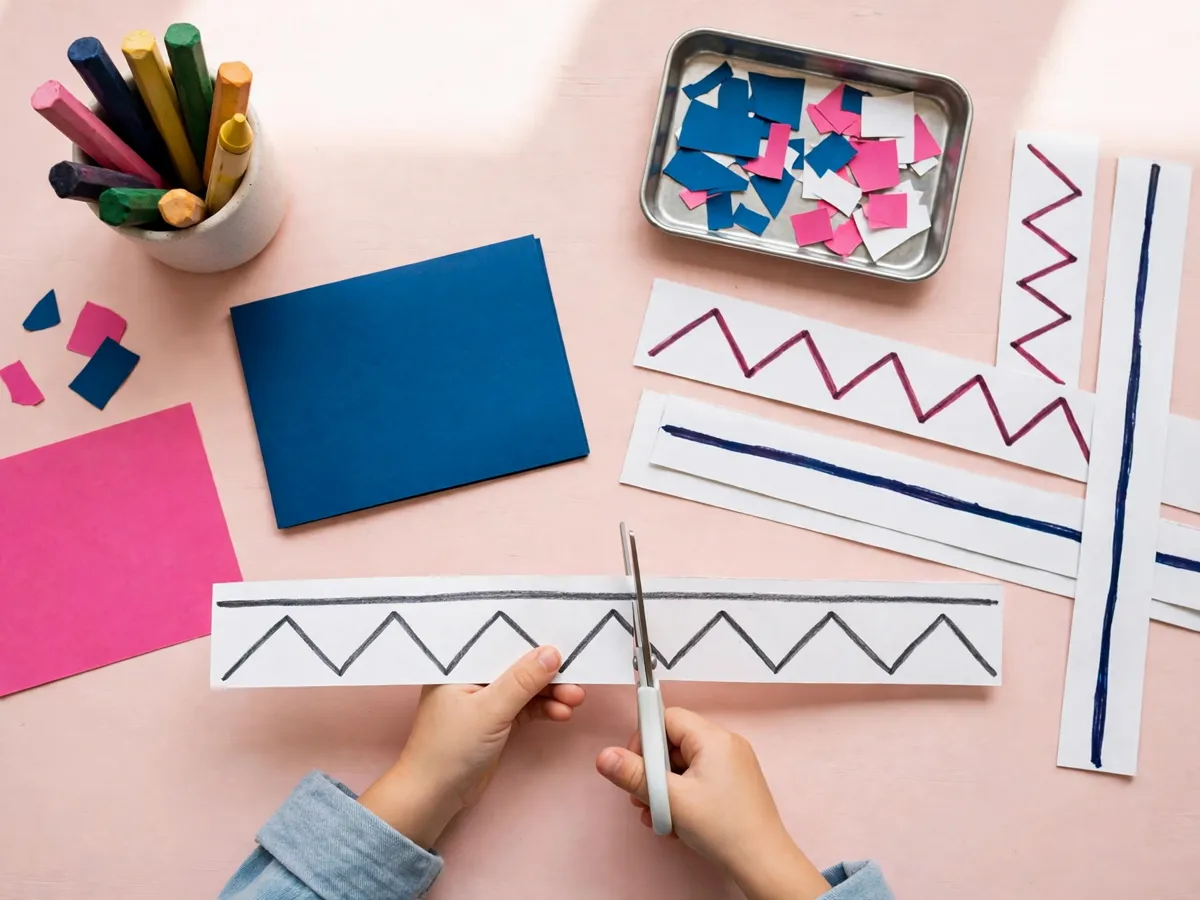
Ages 2-3: try a few short snips
Begin with a scrap strip of paper. Sit beside your child, show how the blades open and close, and offer a few short snips together. If the scissors are not a fit for the task, have the adult prepare the pieces and let your child arrange them on the table.
Age 2-3 · 5-10 minutes · Scrap paper and scissors · With an adult beside your child, close enough to help.
Ages 3-5: follow a broad straight path
Draw one thick line across a short paper strip and invite your child to cut toward its end. Keep extra strips nearby for another turn, and pause when your child wants a break. An adult can hold the paper steady or prepare the strip before the activity.
Age 3-5 · 5-10 minutes · Paper strips, marker and scissors · Practice with an adult at the table.
Ages 4-6: add a turn or simple outline
Offer a straight track first, then a wide curve or a simple outline with broad corners. Let your child pick one path at a time. If a turn feels fiddly, return to a straight strip or finish the shape together.
Age 4-6 · 10 minutes · Printed path and scissors · Stay with your child and supervise each cutting turn.
A short note for ages 7+
For an older child who wants another challenge, offer a longer outline or a shape with a few broad corners. Keep the activity at the table and have an adult nearby; a more detailed page can wait for another day.
Age 7+ · 10 minutes · Paper and scissors · An adult stays nearby throughout cutting.
Make simple printable cutting strips
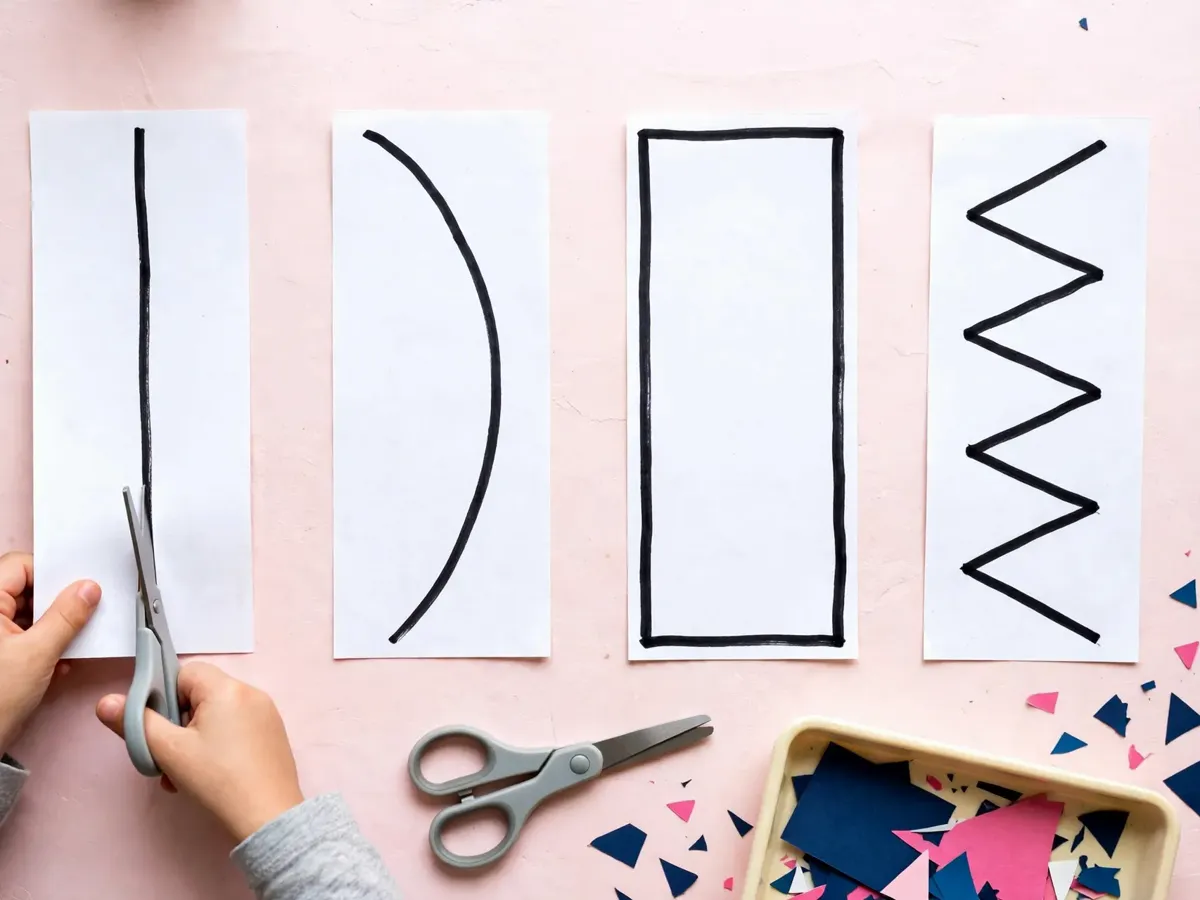
On letter-size paper, draw dark paths about 1/4 inch wide and leave space between them. Make one page of straight lines, one of broad curves and one of large outlines. Print at actual size, or draw the same paths by hand on scrap paper. Cut the sheet into strips before offering it.
Ages 2-6 · 5 minutes to prep · Paper, marker and scissors · An adult prepares the page and stays close during cutting.
Choose tools for the task and the child
Blunt-tip scissors and pointed scissors are different tool designs; a blunt tip is not a substitute for an adult nearby. Keep adult scissors with the adult, and check the package age guidance while choosing a tool for a child. For left-handed children, try left-handed scissors if available and place the paper so the cutting path is easy to see. No tool label replaces close adult supervision.
Ages 2-6 · 2 minutes to set up · Scissors and paper · An adult chooses the tool and supervises the activity.
Keep the paper steady; let the grip vary
Place the paper on the table and pause to reposition it when needed. Most children hold a crayon or pencil between their fingers and thumb by 4 — and the exact shape of the grip matters far less than whether it works. By 5, most children can hold a crayon or pencil between their fingers and thumb rather than in a fist, and most can write some of the letters in their own name.
Consider letting a working grip be — many families find that a grip doesn't have to look textbook, and plenty of kids hold a pencil in a way that still gets the words down cleanly. Consider that grasp tends to develop in stages — from the whole arm, to the forearm and wrist, to the fingertips; a squiggly hold at 4 can be one point along that journey.
Ages 2-6 · 10 minutes · Paper and scissors · Keep cutting together with an adult close by.
A close-by adult is part of the setup
For anything with a hazard in it — scissors, heat, water, small parts — the same rule applies: an adult, close enough to act. Keep the scissors on the table between turns and put them away when the activity ends. This is a practice guide, not medical advice; talk with your pediatrician about questions specific to your child.
Ages 2-6 · Throughout the activity · Paper and scissors · An adult stays close enough to act.
Milestone checklists describe what about 75% or more of children can do at a given age — a guide, not a deadline for your child.
Save this for craft time
Save the age-by-age ideas, then visit the Easy Crafts & Learning collection for more printable-friendly activities.
Ages 2-6 · Review before each session · Paper and scissors · An adult stays close enough to act.