 KidNestClub
Kids Activities & Screen-Free Play
Lunar New Year Sensory Play | 6 Bins to Set Up Ages 2-6
Six sensory bins built around one festival, using what is already in the kitchen: red and gold dyed rice, a pasta coin dig, an orange-peel scent tray, a floating-lantern water tray, a noodle tray and a peel stamp board. Each bin lists the age band it suits, the supervision it needs and a version for the youngest hands. Ages 2-6, one bin a sitting, twenty minutes to set up, and hands wash at the end.
By KidNestClub · Updated 17 November 2026
Six bins · Ages 2-6 · 20 minutes a setup · rice, pasta, oranges, water, paper, paint.
The symbols, in plain terms
Lunar New Year is celebrated by many families across East and Southeast Asia and around the world, and the customs differ by country and by household. The pieces these bins borrow are the common ones: red for luck and celebration, gold for wishes of prosperity, oranges and tangerines given and received as a wish for good fortune, lanterns as light for the year ahead, and long noodles that some families serve as a wish for a long life. These bins are play inspired by the festival, not a re-enactment of it — a small distinction worth saying out loud when you set one up with your child.
Ages 2-6 · One festival · Customs vary by country and family.
The three rules before any bin comes out
These bins are for hands, not mouths. Dry rice and dry pasta are a choking and aspiration hazard for children under 4, which is why every bin below carries an age band and a same-table version for younger children who would mouth the small pieces. Set up on a table, not the floor, keep the bin within arm’s reach of your chair, and have an adult, close enough to act, at the table for every bin. Hands wash with soap at the end, and nothing from a bin goes back to the kitchen shelf.
Ages 2-6 · Hands, not mouths · An adult, close enough to act.
1. Red-and-gold dyed rice
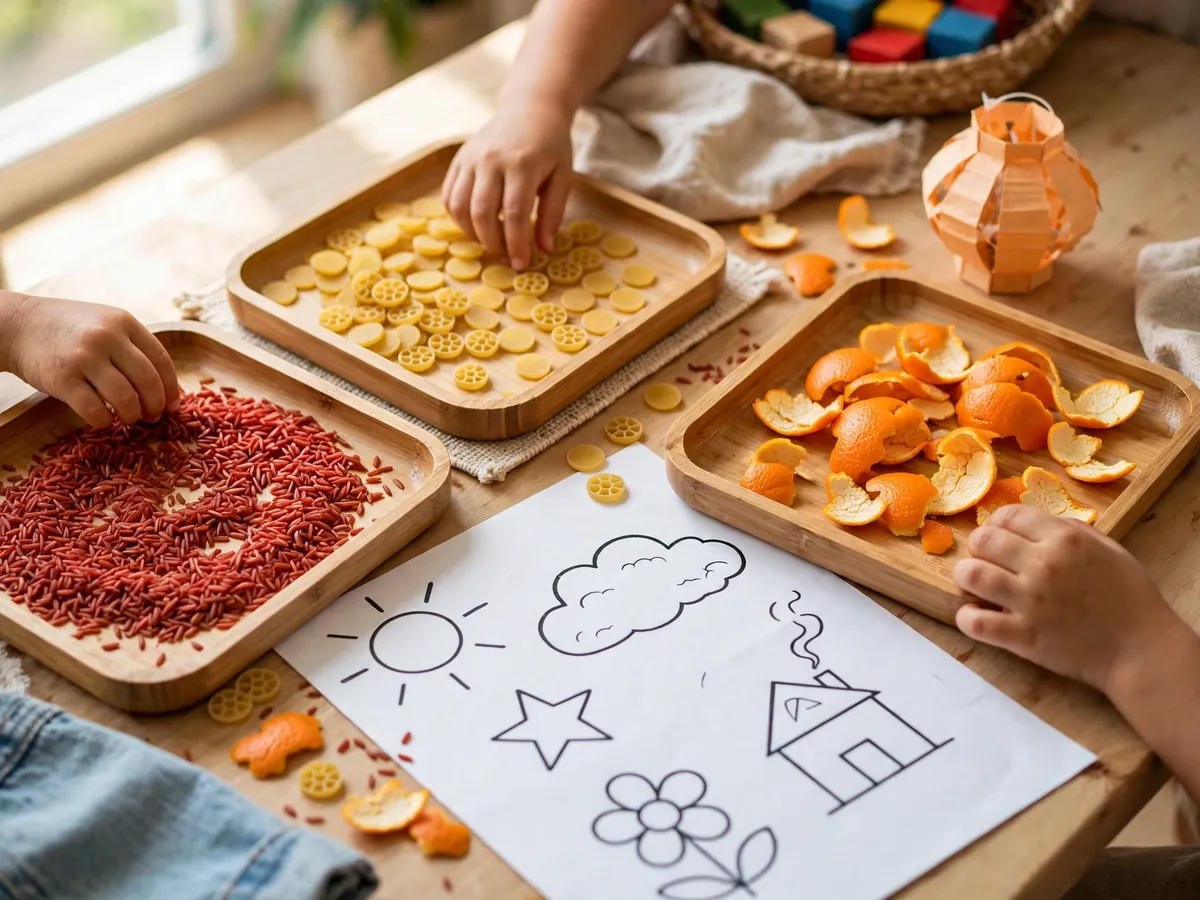
Dye two cups of rice the night before: a spoon of washable paint or food colouring, a splash of vinegar, a zip bag, a shake, then spread the rice on a tray to dry. One batch red, one batch gold. Tip both into a shallow tub with a scoop, a small bowl and paper lantern cut-outs to bury and find. Ages 4-6 scoop and pour; an adult stays at the table because loose rice is a choking and aspiration hazard. Ages 2-3 get the same tub filled with whole oranges and large felt circles instead, and roll, stack and smell those while the older child scoops.
Ages 4-6 · 20 minutes · Dry rice is a choking and aspiration hazard; adult at the table, and the felt version for ages 2-3.
2. Gold-coin pasta dig
Paint a bag of dried pasta shapes gold and let them dry flat. Hide them in a tub of clean, dry sensory filler — rice, lentils or shredded paper — with a pair of tongs and an empty bowl, and the game is to rescue every coin. Tongs are the whole point: they turn a dig into a pinch, and a pinch is a fine thing to practise. Ages 4-6 with an adult at the table, because dry pasta and small filler are choking hazards. Ages 2-3 hunt the same gold coins in a basket of folded cloth strips, where the pieces are large enough to pick up whole.
Ages 4-6 · 20 minutes · Dry pasta and filler are choking hazards; adult at the table, cloth-basket version for ages 2-3.
3. Orange-peel scent tray
Save the peel from two or three oranges, tear it into wide strips and leave it in a shallow tray with a whole orange, a few cinnamon sticks and a small dish of water for dabbing. This is the quiet bin of the six: it asks for smelling, tearing and comparing, not scooping. Ages 2-6 use this one; the strips stay wide so the youngest hand has something to hold rather than a crumb to mouth. An adult stays at the table, and the peel goes in the food waste at the end rather than back in the fruit bowl.
Ages 2-6 · 10 minutes · Wide peel strips, adult at the table, peel discarded after play.
4. Floating-lantern water tray
Fold a few paper lanterns — a rectangle curved into a ring and taped, a paper strip handle on top — and float them in a shallow basin of water with a couple of plastic lids as boats. This is water play, so the rule is the water rule: stay within arm’s reach of your child, that close, all the time. Ages 2-6, on a towel at the table, basin emptied down the sink straight after. No candles, no tea lights, nothing that heats.
Ages 2-6 · 15 minutes · Water play: within arm’s reach the whole time; basin emptied right after.
5. Long-noodle tray
Cook a packet of long noodles, rinse them cool and leave them in a bowl of cold water for the sensory tray: draping, looping, cutting with blunt scissors and lifting with tongs. Some families serve long noodles at the new year as a wish for a long life; here they are texture, not lunch. Keep the tray a hands-only space — nothing from it gets eaten — and tip it away after twenty minutes rather than storing it. Ages 4-6 with an adult at the table and blunt scissors only. Ages 2-3 get long strips of fabric or paper ribbon to drape and sort instead.
Ages 4-6 · 20 minutes · Hands-only tray, blunt scissors with an adult; ribbon version for ages 2-3.
6. Peel stamp board
Cut thick orange-peel halves into chunky stamp shapes — a circle, a crescent, a star-ish blob is fine — press them into washable paint and stamp a row of paper lanterns and coins onto a long sheet of paper taped to the table. The peel prints a soft, dimpled texture that a sponge cannot copy. Ages 4-6 stamp and arrange; ages 2-3 use the same paint with large sponge stamps and an adult’s hand over theirs for the first press. An adult stays at the table, and the peel goes in the bin, not the mouth.
Ages 4-6 · 20 minutes · Washable paint, adult at the table, peel discarded after printing; sponge stamps for ages 2-3.
Safety, every sensory day
For anything with a hazard in it — small parts, water, dry rice or pasta — the same rule applies: an adult, close enough to act, at the table. Small parts stay with the older band and away from the youngest hands, water play stays within arm’s reach from first splash to last, and the bins are hands-only: nothing from a tray goes in a mouth. Wash hands with soap at the end of every sitting, and tip the loose fillers into the bin rather than back into the kitchen.
Save this for the new year
Pin the bin that matches what is in the cupboard this week, then come back when the tray comes out — the Kids Activities & Play collection holds the dinosaur dig bin and the sensory play starter for the days between festivals.