 KidNestClub
Kids Activities & Screen-Free Play
Shaving Cream Sensory Play | 7 Setups Ages 2-6, All On A Tray
One can, one rimmed baking tray, three drops of food color and a spoon are the whole list. The foam holds a swirl, keeps the wall of a pressed shape for a few seconds and opens a letter the moment a finger crosses it, so one tray fills a sitting.
The can stays with you. You read what is on it, shake it away from your own face and the child's, and dispense the foam onto the tray yourself; the hands that follow are your child's. Ages 2-6 is the span here, and a two-year-old at a tray means an adult within arm's reach throughout.
This is the non-edible version of sensory play, so the foam stays on the tray and hands go to the tap when the round ends. There is mess in it: foam reaches wrists, sleeves and the tray rim, and one pass with a damp cloth clears it.
By KidNestClub · Updated 20 November 2026
Total scope: 7 setups · Ages 2-6 · 3 minutes to dispense each · one rimmed tray per setup · the can is an adult step.
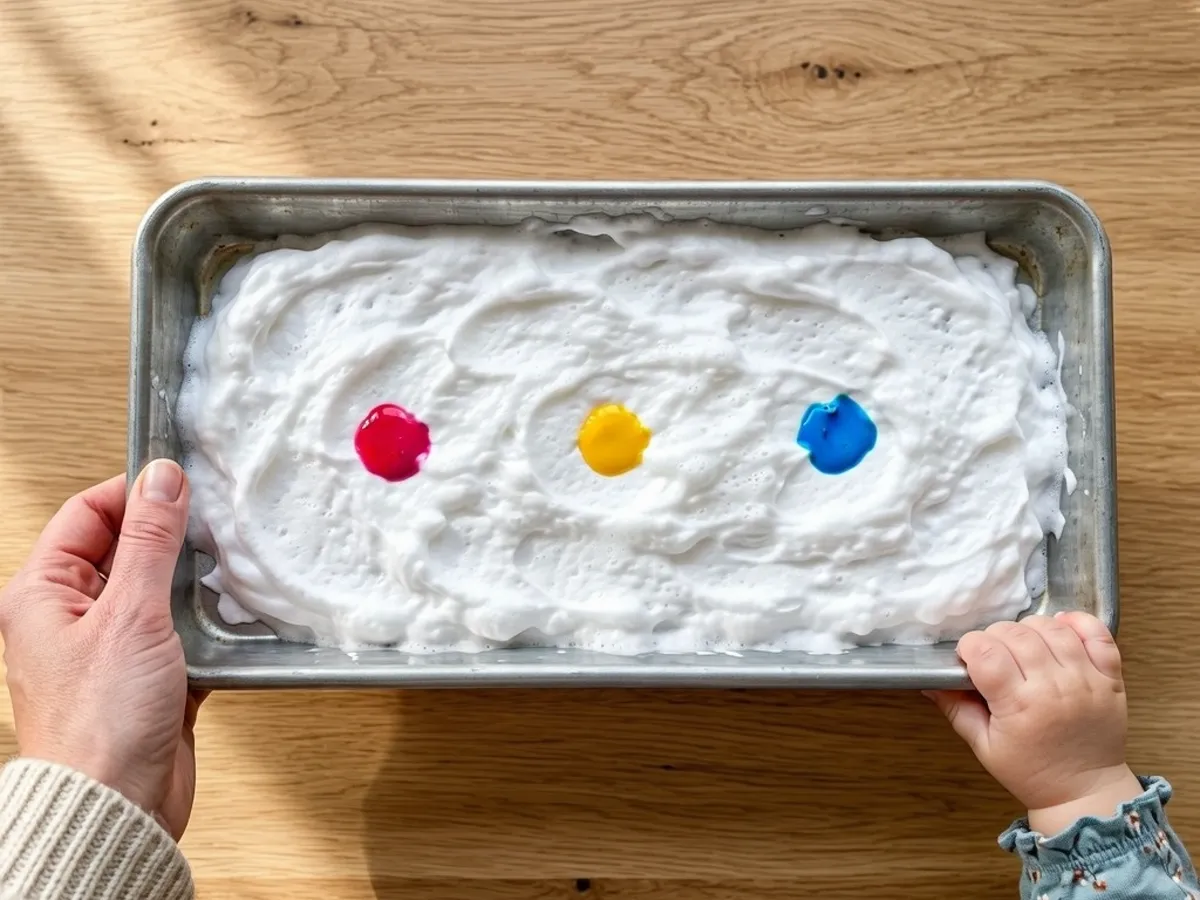
1. The swirl tray
Ages 2-6 · 3 minutes · one can, one rimmed tray, food color, a spoon, a skewer.
Dispense the foam onto the tray and level it with the back of a spoon, two fingers deep. Drop three colors onto the foam well apart. Drag the skewer through the first drop in a slow curve, then the next, and the color trails behind it; the foam holds that line until a hand crosses it. Hand over the spoon for the next swirl, and when the tray looks like a marble cake, press a palm flat over it and start again.
2. The shape press
Ages 3-6 · 5 minutes · the tray, three cookie cutters, a bottle cap, a damp cloth.
Press a cutter straight down into the foam on the tray and lift it straight up, and the foam keeps the wall of the shape for a few seconds. Fill the inside with a second color, or press the next cutter beside it. A bottle cap left on its edge prints a neat ring. Keep the cloth on the tray rim for the wipe between presses, and let your child pick which cutter goes in and how many shapes fit before the tray is full.
3. The letter write-out
Ages 4-6 · 4 minutes · the tray, a popsicle stick.
Smooth the foam flat with a palm. Write a letter with a fingertip or the end of the stick: the line stays open, so it is easy to read and gone with one sweep. Say the next letter out loud and let your child write it, then a number, then a name. Under 4 the write-out is big arm strokes across the whole tray rather than small letters, and the stick goes back on the rim, wiped, between attempts.
4. The dig tray
Ages 3-6 · 5 minutes · the tray, four chunky plastic animals, a spoon.
Press the animals into the foam on the tray while your child looks away, then hand over the spoon. Dig until a shape shows, clear the foam off it and set the find on the tray rim. You do the burying; the digging belongs to your child. Keep the figures big enough to fill a whole fist: anything that slips through a child's fingers is a small part, and a small part lost in foam takes longer to find than the round takes to play.
5. The scoop-and-move tray
Ages 2-6 · 3 minutes · the tray, two cups, a spoon, a fork.
Pile the foam at one end of the tray and set two cups down at the other end, both sitting on the tray itself. Lift a scoop into a cup, fill it, then move the full cup across the tray to the far side. Foam lands in the gap between them, and the spoon scrapes it back into the pile. Swap the spoon for the fork, then for two fingers, and the same sequence runs three times.
6. The rake-and-smooth tray
Ages 3-6 · 4 minutes · the tray, a fork, a comb, a paintbrush.
Level the foam on the tray, then rake a fork through it in straight lines, in curves and in crosses. The tines leave ridges that stand up for a moment before they settle. Press a palm over the whole tray to knock it flat and start again. The comb leaves a finer line and the paintbrush the faintest one, so lay all three along the tray rim and let your child choose which mark to copy.
7. The car-wash tray
Ages 4-6 · 5 minutes · the tray, two chunky toy vehicles, a damp cloth.
Fill the tray deep enough to bury a wheel. Drive a vehicle through the foam in a straight line and it rolls up over the roof; lift it out, wet the cloth and wipe the foam back into the tray. Set the clean one on the dry stretch of the tray rim and send the next one through. A wooden block works the same way, and the cloth returns to the rim between washes.
Frequently asked questions
Can a two-year-old have a shaving cream tray?
An adult reads the can, shakes it away from faces and puts the foam on the tray, then stays within arm's reach throughout. The foam is not a food, so mouthing is the thing to watch at that age: keep the tray where you can see both hands and stop the round if it heads for a mouth.
Does the kind of shaving cream matter?
Every setup here uses the plain foam from the shaving aisle. A gel or a shaving oil does not hold a swirl or the wall of a pressed shape the way foam does, so the type is the one thing not to swap. Read what is on your can before you shake it, keep it upright and off the tray between rounds, and let the adult dispense.
How much foam goes on one tray?
Two or three large spoonfuls cover the bottom of a rimmed baking tray about two fingers deep, which is enough for all seven setups. More than that does not lengthen the sitting; it only makes the tray heavier to carry to the tap. When the foam weeps and goes thin, tip it into the bin and dispense a fresh layer.
Keep the seven trays for the next rainy afternoon
Take two rather than seven. The swirl tray and the letter write-out share one can, one tray and one cloth, which makes them the easiest pair to set out tonight, and the dig tray waits for the day after. The cloud dough setups run the same tray tools without a can, the playdough sensory page keeps the presses going after the foam is tipped out, and the edible sensory recipes are the version for a child who still puts everything in their mouth.