 KidNestClub
Kids Activities & Screen-Free Play
Screen-Free Activities for 18-Month-Olds: 12 Do-This-Now Ideas (Ages 18-24 Months)
Twelve activities for the 18-24 month band, built around two facts about that age. Every idea below is short and starts with one thing already set out. And everything still goes to the mouth, so every object is too big to fit in a toilet paper tube. Each entry names what you put out, how long it lasts, and where you stand.
By KidNestClub · Updated 19 November 2026
Total scope: 12 ideas · Ages 18-24 months · three to ten minutes each · what is already in the house · an adult close enough to act on every one.
The twelve run in three groups: floor ideas, table ideas, and the ones that need water or heat. For the wider list, the screen-free activities page covers ages 2-10, and the low-energy list holds the quiet versions.
Before you start: the size rule and the standing rule
The size rule. Anything that fits fully inside a small-parts cylinder — roughly the size of a child's throat under 3 — is a choking hazard, so coins, beads, buttons, marbles, LEGO and bottle caps stay out of the basket at this age. Test an object against a toilet paper tube: if it drops in, it does not go on the list.
The standing rule. For anything with a hazard in it — scissors, heat, water, small parts — the same rule applies: an adult, close enough to act. Every idea below names a position, not a glance across the room. The watching is hands-on at this age; an 18-month-old will not stop mid-action because a “no” was said earlier.
Nothing here is a long session. Three minutes of a tower is a full activity at this age. Put the objects away without comment and start the next one.
Group 1: on the floor — ideas 1 to 5
Ages 18-24 months · a rug and one basket · the adult sits on the floor at the child's height.
1. The treasure basket
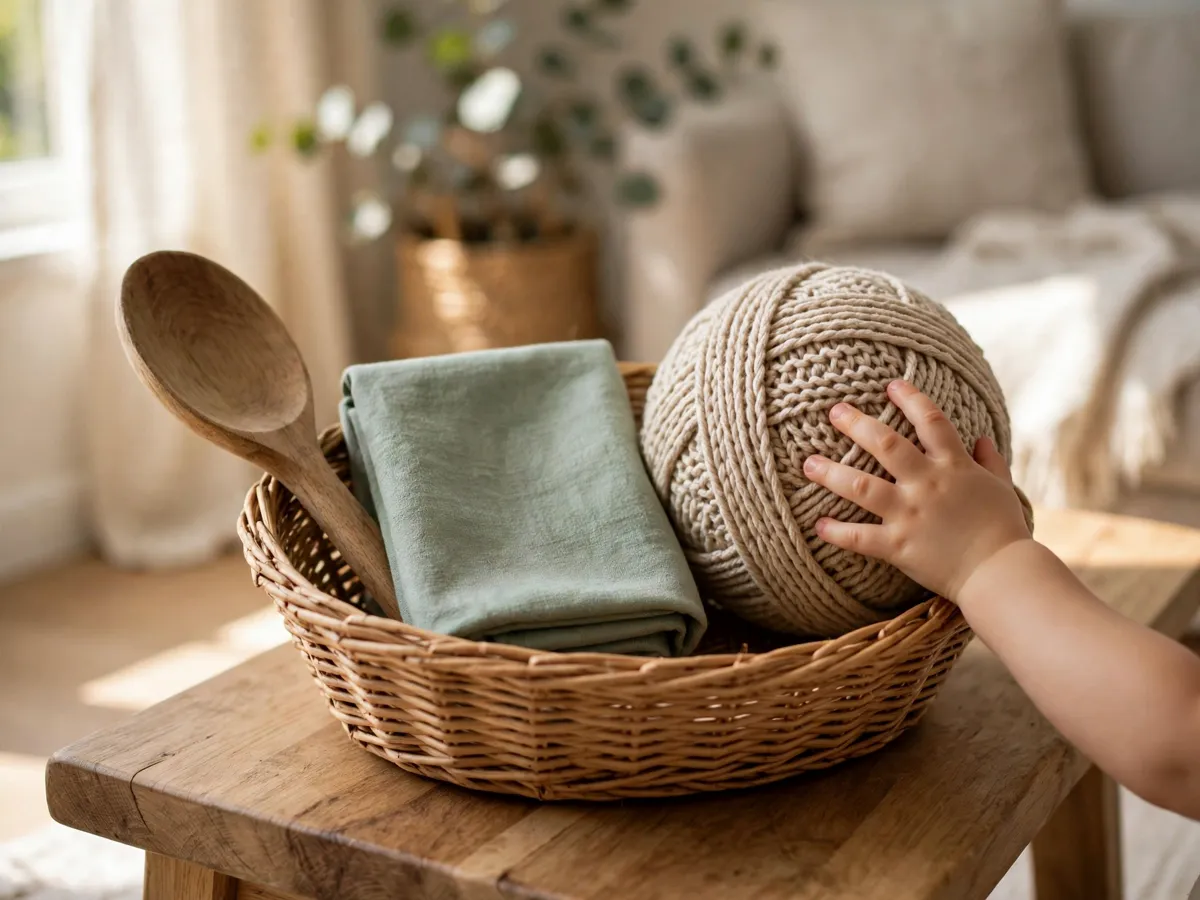
Set a low woven basket on the rug and fill it with six everyday objects, all bigger than a fist: two wooden spoons, a metal whisk, a small stainless measuring jug, a soft ball, a ribbon loop and a big wooden block. Tip them out and let the child take each one out, look at it, and put it back.
How long: 5-10 minutes, sometimes less. Where you stand: sitting on the floor within arm's reach of the basket. Check each object for a chip or a loose end before every session, and retire anything that has cracked.
2. The tall tower and the one big knock
Stack four or five large hollow blocks, or an upside-down bowl under three shoeboxes, into a tower the child can reach while sitting. The build is yours; the knock is theirs. Say “down” as the tower goes, then start the next stack straight away.
How long: 3-5 minutes, repeated twice. Where you stand: kneeling beside the stack, one hand on the box at the top so it tips toward the child rather than onto a lap.
3. The cushion course across the living room
Three sofa cushions on the floor in a line, one folded blanket at the end. The child steps from cushion to cushion holding your hand, then crawls the last stretch and stands up on the blanket. Run it one way, then turn the line around and run it back.
How long: 5 minutes. Where you stand: at the child's side with a hand on their back, the whole way along the line. Keep the cushions away from a table corner or a radiator.
4. Tearing paper into one bowl
A stack of old magazine pages and one big mixing bowl. Show the tear — both hands on the crease, pull apart — then let the child tear and drop each piece in the bowl. Half a page is enough for a first go; the drop is the fun, not the tear.
How long: 3-8 minutes. Where you stand: sitting behind the child at the same level, gathering the scraps back into the bowl as they hit the floor. The scraps stay in the bowl, not on the rug.
5. The box they can sit in
One delivery box, flaps taped down, big enough for the child to sit in with both legs out. Put three large things inside: a rolled sock, a wooden block, a small pillow. The child moves each one out and back in, and may sit in the box and look around the room from it.
How long: 5-10 minutes. Where you stand: next to the box, within arm's reach. Tape down every flap and pull out every staple and strip of packing tape before the box goes on the floor.
Group 2: at the table — ideas 6 to 9
Ages 18-24 months · a low table or a highchair tray and one mat · the adult sits at the same table, hands free.
6. The dough bake
Make the dough yourself: flour, salt, water, oil, kneaded into one lump and divided into two balls. Give the child one ball and one wooden spoon to press and squash on a mat. You roll the second ball flat and put it in the oven. The oven is yours from start to finish.
How long: 5-8 minutes of squashing. Where you stand: at the table with the child while they work, and at the oven yourself. The tray, the rack and the cooled bread stay out of reach; heat is a hazard class, so the adult is the only one near the oven. Raw dough stays off the menu.
7. Spoon and big-lift transfer
Two bowls and one large wooden spoon. Fill the first bowl with things too big to swallow whole: rolled foil balls, or big pasta pieces the size of a thumb. The child scoops from one bowl to the other. Spillage is part of the activity, not a failure of it.
How long: 5 minutes. Where you stand: at the table beside the child, one hand on the bowl being filled. Foil balls go straight in the bin at the end, and anything that has been on the floor is washed before it goes back in the bowl.
8. Sticker peel on the table edge
Round stickers, the size of a thumb or bigger, pressed along the edge of the table at the child's height. The child peels one off and sticks it on the tabletop, the mat, or your sleeve. Peeling is the whole activity, and each one takes ten seconds.
How long: 3-5 minutes. Where you stand: at the end of the table, close enough to take a peeled sticker off the floor before it reaches a mouth. A sticker that has been on the floor goes in the bin, not back on the table.
9. The wash-the-toys round
Two plastic tubs on a mat: one with an inch of warm water and one empty for the wet toys. The child lifts three large bath toys out of one tub and drops them into the other, with a cloth for the splash. This is the idea that ends with the toys back on the shelf, clean.
How long: 5-8 minutes. Where you stand: kneeling at the tubs, within arm's reach the entire time. Water at this age means an adult close enough to act, hands free, no stepping away — not for a towel, not for the phone. Tip both tubs out the moment the round ends and put the cloths in the wash.
Group 3: standing up — ideas 10 to 12
Ages 18-24 months · the kitchen floor, the hallway or the garden · the adult is on their feet alongside the child.
10. Push something heavy across the hallway
A laundry basket with a couple of folded towels in it for weight, or an empty shopping cart if you have one. The child pushes it from one end of the hallway to the other, and you walk beside it. Turning around at the end is half the game, so leave the space for the turn.
How long: 5 minutes. Where you stand: at the child's shoulder, on the same side as the wheels, ready to stop the basket before it reaches a stair gate or an open door. Clear the run first, and keep the basket light enough that a tip is a bump and not a crush.
11. Drop things down the chute
A cardboard tube taped to the stair railing or leaned against a chair, angled into a box on the floor. The child drops large objects in at the top — a wooden block, a ball, a rolled sock — and fetches each one out for the next go.
How long: 5-10 minutes. Where you stand: at the top of the tube, holding it steady, with the child beside you rather than on the stairs. Every object is bigger than the tube's opening, so nothing jams and nothing small ends up on a stair.
12. The watering can outside
One small watering can with an inch of water in it, outdoors on the paving or over a plant pot. The child carries it to the pot and tips it, and you hold the spout for the first three goes so the water lands in the soil.
How long: 3-5 minutes. Where you stand: behind the child with both hands free, within arm's reach of the can and the ground. Standing water is the hazard here: a saucer, a puddle under the pot, a spilled patch on the paving. Tip the can out at the end.
When an idea ends early
Two signs to stop: the object starts being thrown rather than placed, or the child starts carrying the items out of the room one at a time. Put the basket away without comment and take the next idea from the same group. Nothing on this page has to be finished.
Swap the group before you drop the day: a child who will not sit at the table can push the basket down the hallway (idea 10) instead of scooping at the tray (idea 7). Keep the size rule on every swap — a new idea is only an idea if it passes the toilet paper tube test.
Save this for the next 18-month week
Pin the group that matches the room you are standing in. The screen-free activities page has the longer lists for ages 2-10, and the low-energy screen-free activities page has the quiet versions for the end of a hard day.