 KidNestClub
Kids Activities & Play
Playdough Cooking Set: 5 Kitchen Rounds, Ages 2-6
A cooking set is a ball of dough and whatever the kitchen drawer already holds. Five rounds — pancakes, pizza, cookies, soup, and the cafe — each on one tray, for ages 2-6, with the words that go with it and the tidy-up that closes the sitting.
By KidNestClub · Updated 16 November 2026
Total scope: 5 rounds · Ages 2-6 · one tray per sitting · 15-30 minutes · nothing to buy.
What goes in the cooking set
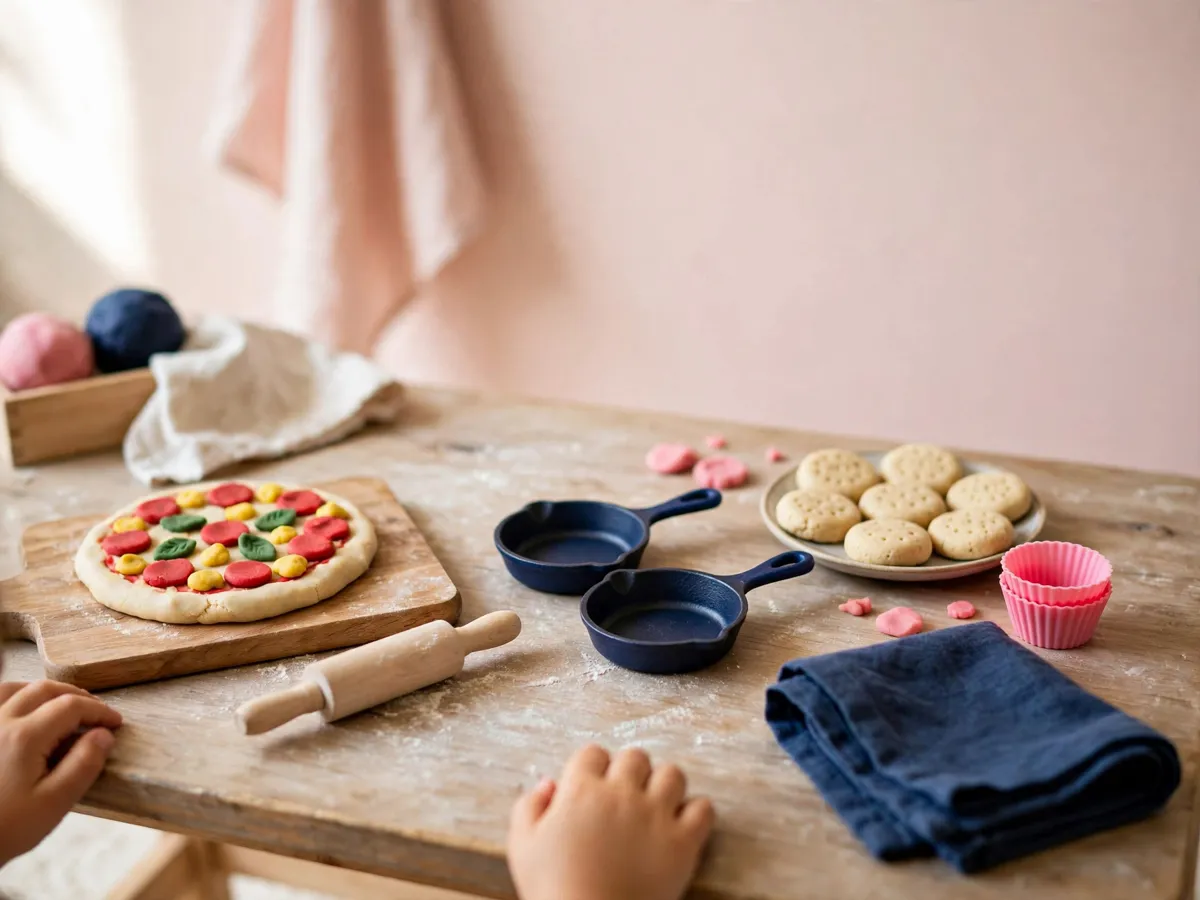
The whole set fits in one shoebox: three colors of dough, a rolling pin or a smooth cup, a plastic picnic knife, a muffin tin, three jar lids, and a couple of bottle caps. Jar lids and caps are the plates and pans of the whole game. Real cutters are optional — the rim of a glass cuts a clean circle.
Anything small from the kitchen drawer — caps, beads, buttons — is a small part, so the box lives up high and comes out only at the table, with an adult, close enough to act, for the whole sitting. Before the tray goes down, do a quick floor sweep for small objects that fell last time; it is a two-minute job that pays off every day.
Ages 2-6 · One shoebox · An adult at the table · The box goes back up high after.
Round 1: The pancake shop, ages 2-3
A ball of dough pressed flat with the palm, flipped with the butter knife, and served on a jar lid. The play is the repeat: press, flip, plate, hand it over, again. Hand the lid to whoever ordered and say the order back — “one pancake, coming up.”
The knife is the one tool in the set with an edge, so it stays in the adult hand until the tray is down, and goes back to the adult hand at tidy-up. At this age the flip is a two-hand job and misses are half the fun.
Ages 2-3 · Dough, knife, one jar lid · 15 minutes is a full sitting · An adult hands the knife.
Round 2: The pizza counter, ages 2-6
Roll a ball flat, cut it into slices with the knife or a plastic picnic cutter, and top it with dough balls from another color — peas, tomato, cheese. Older cooks call out the order first; younger cooks top first and name the toppings after.
Words that go with it: “Roll it flat.” “Cut it in eight.” “What goes on top?” Count the slices out loud as they come apart — the count is the game, not a lesson.
Ages 2-6 · Two colors of dough · Slices counted out loud · The counter gets wiped at the end.
Round 3: The cookie bakery, ages 4-6
Roll the dough flat, cut circles with the rim of a drinking glass, and press a pattern into each one with a bottle cap, a fork, or a fingertip. Set the cookies on the muffin tin to “bake,” set a timer you both can see, and take the tray out when it rings.
The timer is the round. A visible timer gives the bakery its shape: press, bake, ding, plate. No timer at hand — count to twenty together, out loud.
Ages 4-6 · Glass rim for cutting · One visible timer · Cookies go back in the box at closing time.
Round 4: The soup pot, ages 2-6
A bowl in the middle of the tray, and everyone tears dough into pinch-pieces to drop in — carrots, noodles, meatballs. The pot gets stirred with a spoon, tasted with a bottle cap, and served into the jar lids around it.
Tearing is the whole point: pinch, roll, drop. Little hands make short pieces and round pieces, and both are correct soup. Serve with the “careful, it’s hot” routine every child already knows from the real kitchen.
Ages 2-6 · One bowl, one spoon · Torn pieces, not cut ones · An adult at the table the whole sitting.
Round 5: The cafe counter, ages 4-6
The cafe is every round at once: one cook, one waiter, one customer, and a jar-lid menu drawn on paper with prices in bottle caps. Orders go in, the kitchen makes them, the waiter carries them out, and the caps go in the jar.
Two children, or one child and you. Swap roles at the third order — the cook becomes the waiter, the waiter becomes the customer — and the game starts itself again.
Ages 4-6 · Jar-lid menu · Roles swapped at the third order · An adult, close enough to act.
Your first week, and what to change
Step 1 — one round, twice. Pick the pancake shop or the soup pot and run it twice this week, the same way both times. A round run twice lands better than five run once.
Step 2 — tray down, box away. Lay out the tray before you call them to the table, and put the box back up high before the play starts. The tray is the whole offer.
Step 3 — add one prop, not six. Week two, add one thing to the box — the muffin tin, or the caps — and keep the rest the same. A shelf of new props restarts the game; one new prop grows it.
When the round ends early: the tray is too busy. Cut the props to two and the dough to one color, and run the same round again tomorrow. When the game lasts past the timer, the opposite is true — add the cafe.
Ages 2-6 · One round twice · One new prop a week · Tidy at the tray.
Safety, on every tray in this set
For anything with a hazard in it — knives, small parts — the same rule applies: an adult, close enough to act, for the whole sitting.
Small parts: anything that fits fully inside a small-parts cylinder — about the size of a child’s throat under 3 — is a choking hazard, so keep caps, beads, buttons and pins off the floor and out of the low drawer, with an adult supervising the round. A quick floor sweep for small objects is a two-minute job that pays off every day.
Store-bought or homemade, playdough is not food. Dough with a lot of salt in it can upset a small stomach if a lot is eaten, so if your cook is still in the tasting stage, keep the sitting short and stay at the table. Homemade dough keeps in a jar in the fridge; toss any batch that goes soft and sticky or smells off.
The knife with an edge stays in the adult hand until the tray is down and goes back to the adult hand at tidy-up, whatever the age on the round.
Save this for the next kitchen afternoon
Pick one round and run it twice before the week is out — the Kids Activities collection holds more kitchen-table rounds: the playdough sensory trays, the playdough mats for picture-making, and the no-prep toddler activities for the days the dough stays in its jar.