 KidNestClub
Kids Activities & Screen-Free Play
Playdough Tools for Ages 2-6: The 6 That Earn Their Tray
Six tools that sit on the tray and get used every sitting, for ages 2-6: a roller, cutters, a press, a stamp, safety scissors and a pizza wheel. Each one names what it does, what it needs beside it, and where it goes at tidy-up.
By KidNestClub · Updated 16 November 2026
Total scope: 6 tools · Ages 2-6 · one tray per sitting · 15-30 minutes.
Start with two tools, not the whole tub
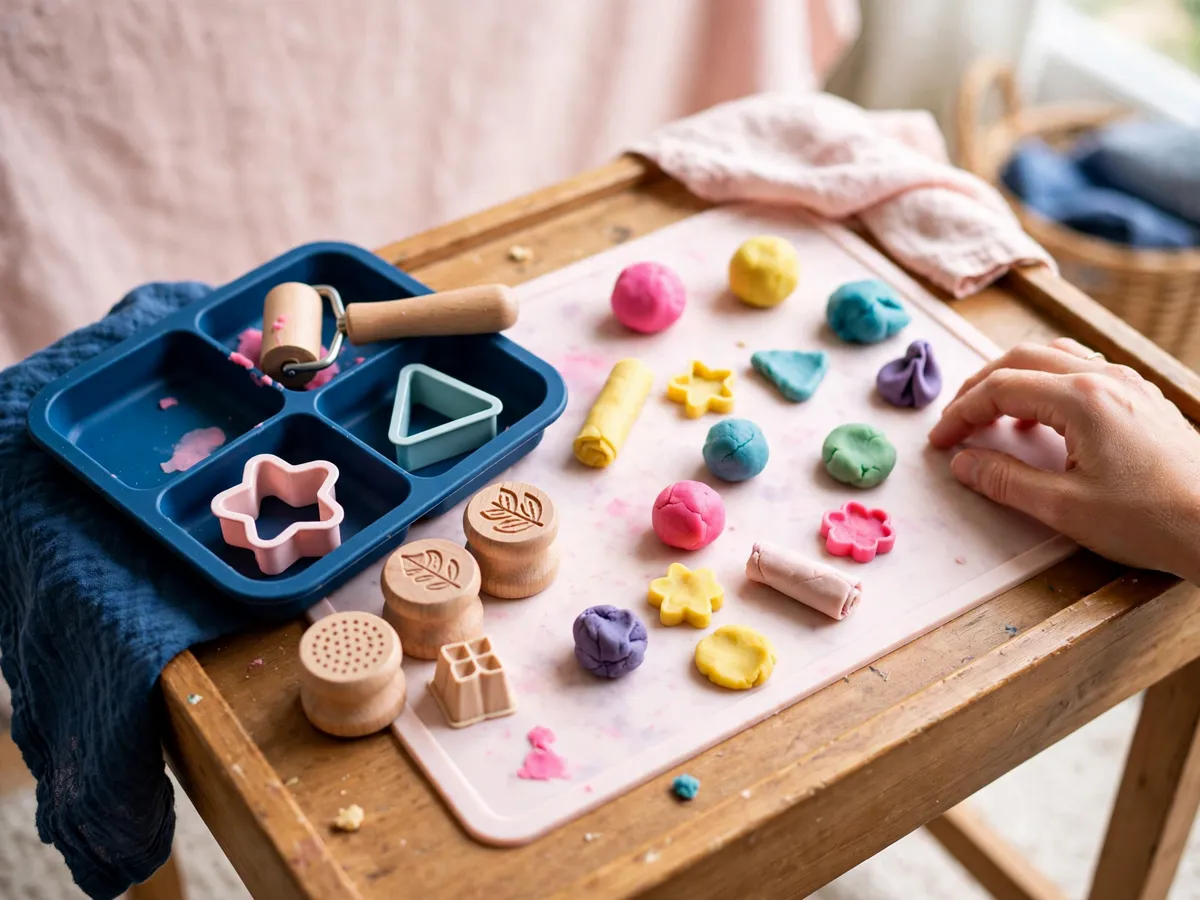
A tub of twenty gadgets turns the table into a buffet nobody finishes. Pick two tools for a sitting, set them on one tray with a ball of dough, and swap one out the next day. Keep the six-tool set together, with two tools on the tray at a time.
For anything with a hazard in it — scissors, heat, water, small parts — the same rule applies: an adult, close enough to act. The adult hands the tools over at the start and takes them back at tidy-up.
Ages 2-6 · Two tools per tray · One ball of dough · Adult hands the tools in and out.
1. The rolling pin, ages 2-6
Ages 2-6 · Roll one ball of dough into a flat sheet with a short pin with handles or a smooth wooden dowel from the kitchen drawer. Set the sheet on the tray as a base for cutters, stamps or pressed objects. Roll it flat again when the dough gathers.
Words that go with it: “Roll it flat.” “Watch it get wide.” “Roll it into a snake first.” Try a child-sized pin with ball handles, and dust the tray with a little flour if the dough sticks.
Ages 2-6 · One pin · Flat sheet play · Flour dusting on the tray.
2. Cookie cutters, ages 2-6
The classic dough tool: press, twist, lift, repeat. Animal shapes, stars, circles — name the shapes as they land on the sheet. Six to eight cutters in a small bowl is plenty; a bowl of forty turns the tray into a search party.
Press straight down with the flat of the hand, then try a twist before lifting the cutter. The leftovers around the shapes are the next part of the play: ball them up, roll flat, cut again.
Ages 2-6 · Six to eight cutters · Press, twist, lift · Scraps ball up and go again.
3. The garlic press, ages 4-6
A real kitchen tool that turns dough into hair, grass and spaghetti in one squeeze. The press needs two hands and a strong grip, so set it on the tray for ages 4-6, with an adult to unscrew it and poke the dough back out when it packs tight.
The squeezed strands are the point: “Make more hair.” “Now grass for the animals.” The press is metal with moving parts, so it goes in the adult hand at tidy-up, and the dough left inside gets poked out with a chopstick before it dries in there.
Ages 4-6 · Real kitchen press · Adult unscrews and clears it · Strands become hair, grass, spaghetti.
4. Stamps and loose parts, ages 4-6
Bottle caps press circles, wooden blocks press squares, seashells print their ridges, and peg people leave a dot with two arms. Stamping into a rolled-flat sheet leaves prints to count and name, and the parts pull back out so the same box prints a different page tomorrow.
Anything that fits fully inside a small-parts cylinder — about the size of a child's throat under 3 — is a choking hazard, so keep coins, beads, buttons and pins off the floor. A quick floor sweep for small objects is a two-minute job that pays off every day. An adult, close enough to act, stays at the table with the child while the loose parts are out.
Ages 4-6 · Caps, blocks, shells · Parts sized for the table · Floor sweep before the tray.
5. Safety scissors, ages 4-6
A rolled snake of dough and a pair of blunt-tip scissors: the snake becomes beads, wheels and bite-size chunks in a line of small cuts. Dough is forgiving stuff to cut — it holds still, and a crooked cut still makes a usable piece.
Scissors belong to the adult until the sitting starts, the cutting happens at one spot at the table, and the adult takes them back at tidy-up. For the years before scissors, a plastic knife or a play pizza wheel makes the same cuts with no blade at all.
Ages 4-6 · Blunt-tip scissors · Adult hands them in and out · Plastic knife swaps in earlier.
6. The pizza wheel, ages 3-6
A play pizza wheel — plastic, not the kitchen one — cuts a flat sheet into strips and squares with one roll. It makes the bakery counter real: the sheet becomes a base, the strips become fries or fence posts, the squares become tiles for a path.
The wheel is a moving part, so it follows the press rule: the adult hands it over, the play stays at the table, and the wheel goes back to the adult hand at the end. A chopstick through the dough makes the same lines for hands not ready for a wheel.
Ages 3-6 · Plastic play wheel · Strips, squares, tiles · Chopstick swaps in earlier.
The first week, one tray at a time
Ages 2-6 · Day one: roller and cutters, one ball of dough, twenty minutes. Day two: same two tools, new color of dough. Day three: swap the cutters for the press. Day four: roller and stamps. Day five: scissors and a rolled snake. By the weekend the tray feels new every day and the tools never grew past six.
When a sitting ends early, the tool was wrong for the day, not the child: swap to a bigger motion — pressing, rolling, squeezing — and put the fine cuts away for a week.
The tidy-up that ends every tray
Tools go into the adult hand, cutters back in their bowl, dough into its jar, hands washed, table wiped. Dough that stayed dry keeps for weeks; dough that met water gets tossed. The two-minute floor sweep under the table catches the cap that rolled away before it finds a smaller mouth later.
A shelf bin per tool set beats the shared tub: the roller and cutters live in one bin, the press and stamps in another, and the sitting starts by pulling down one bin, not the whole shelf.
Keep the tray turning
When two tools have had their month, the playdough mats add a printed base to the tray, the play dough kits guide covers what sits on the shelf beside the tools, and the playdough games turn the same six tools into sit-down games for two. For the full picture of tray play at this age, start at the Kids Activities collection.