 KidNestClub
Kids Meals & Lunchbox Ideas
Great Lunchbox Ideas That Come Home Eaten
You packed a good lunch. It came home with two bites gone and the fruit untouched. Five failure modes sit behind a full lunchbox — too much, too same, too fiddly, too front-loaded, too quiet — and each one has a single swap that changes it. Ages 2-6, one change at a time.
By KidNestClub · Updated 16 November 2026
Total scope: 5 failure modes · Ages 2-6 · one swap each · nothing new to buy.
First, read what comes home
For one week, note what is left: the whole sandwich, the sandwich crusts, the yogurt pot with the lid still on, the apple with one bite. The leftovers are the message — they tell you which of the five failure modes you are looking at, and which swap to try. A box you change at random gives you nothing to read next week.
Ages 2-6 · One week of leftovers · Notes on the fridge · Then one change.
“The whole sandwich comes back, every day”
What sits behind it
The box is sized for a hungrier moment than lunchtime. A child who has been snacking all morning arrives at the table already topped up, and a full box reads as a job. What comes back is not the food they disliked — it is the food that did not fit.
The change: halve everything. Half a sandwich, half the fruit, one small pot instead of two. An empty small box beats a half-eaten big one — you can always add back the half that worked next week.
Ages 2-6 · Half portions for one week · Add back only the empty spot. The five-part lunchbox fill sizes each part for this age.
“Three weeks of the same sandwich, then refusal”
What sits behind it
The box worked, and it kept working, and then the day it did not. A food that repeats past the point of interest lands as boring before anyone has decided anything. The swap is not a whole new menu — it is the same five foods in a new shape.
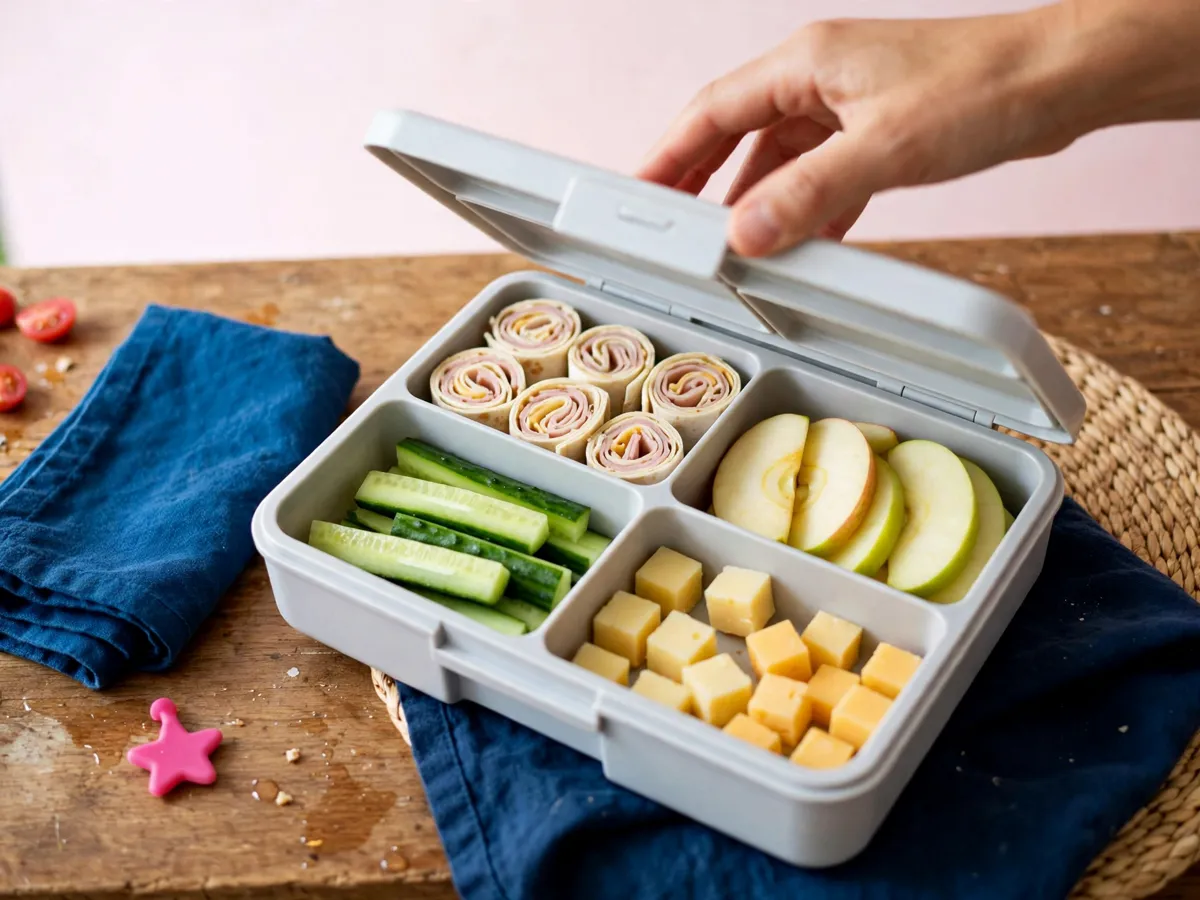
The change: keep the five parts, change the shape. Sandwich becomes pinwheels; grapes come off the vine and go on a pick; the same pasta goes in a thermos with a fork instead of cold with a spoon. The same-five-foods plans run this shape-swap for eight weeks.
Ages 4-6 · Same foods, new shape · One swap a week, not a new menu.
“The yogurt is unopened and the sandwich is in one piece”
What sits behind it
Lunch is short — often fifteen minutes — and the box is asking for two hands and a foil lid at the same time. Anything that has to be opened, peeled, unscrewed or assembled eats the minutes the eating needed. A child who spends the lunch break fighting the wrapper never gets to the food.
The change: open everything at home, halfway. Unwrap the sandwich, loosen the peel to the first turn, take the lid off the pot and clip the box shut again, pick the fruit that is ripe. Five minutes of pre-opening at the counter buys the whole lunch break back.
Ages 2-6 · Open the wrappings halfway · Nothing in the box needs two hands. The kindergarten lunch ideas run the same rule for a school table.
“The crackers are gone and everything else came home”
What sits behind it
The dry snack sits at the front of the box, the fruit and the sandwich at the back, and the first thing a hungry child reaches for is the last thing you wanted first. The box arrives in one flat layer, and the order it is eaten in is the order it is packed in.
The change: pack the order you want it eaten in — the main at the front, the fruit next, the dry snack last — or use a box with compartments and put the cracker in the smallest one. The lunchbox builder lays out the order part by part.
Ages 2-6 · Main at the front · Snack in the smallest pocket · One flat layer, no stacking.
“They are starving at three o’clock but the box is full”
What sits behind it
A busy room at lunchtime is a hard place to eat — noise, a packed table, everyone talking at once. Some children eat everything at a quiet table and close to nothing at a loud one, on the same food. The box is not the problem in this one; the room is.
The change: split the lunch. Send the same food in two smaller boxes — one for the lunch table, one for the quiet ten minutes after — and let the afternoon snack be the second half of the meal rather than a separate one. A hungry three o’clock with a half-full box is a message, not a failure.
Ages 2-6 · Two small boxes instead of one big one · The second half counts as the afternoon snack. The lunchbox snack list pairs with the second box.
One week, one change
Pick the failure mode that matches your leftovers and make that single swap for five days — not two swaps, not a new box, not a new menu. Friday, read the box again. The leftover pattern has either moved or it has not, and either answer tells you the next move. The picky eating bridges guide runs the same one-change-week loop for the dinner table.
Ages 2-6 · One swap · Five days · Read the box on Friday.
Safety, in every box on this page
At the table, keep your child in sight and in earshot from the first bite to the last — choking can happen even when a child is feeding themselves well.
Whole grapes, berries, cherries and melon balls are the classic choking hazards, so anything round gets cut up first. Slice round fruits and vegetables like grapes, cherry tomatoes and melon balls in half lengthwise, then cut them into small pieces no bigger than half an inch before serving.
Nut butters and wheat are two of the usual suspects to keep an eye on. Allergenic foods go in around the same time as your other foods — there’s no reason to hold them back. The usual suspects to keep an eye on: eggs, shellfish, nut butters and wheat.
A lunchbox is food guidance, not medical or allergy advice. New foods, allergies and growth questions belong with your pediatrician.
Save this for the next full lunchbox
Pin the failure mode that matches your week and run its single swap — the Kids Meals collection holds the lunchbox recipes, the snack list and the dinner plates that go with it.