 KidNestClub
Easy Kids Crafts
Flag Craft for Kids | 6 Paper Flags Ages 3-8
Six flags, all paper, all finishable in one sitting. None of them need a printout, a glue gun or a run to the shop, and none of them carry a message. They carry shapes and colours instead — bands, crosses, circles, stars — which is exactly what a child of three to eight can see, name and copy. Every make below lists its supplies, its age band and the step that stays with an adult.
By KidNestClub · Updated 18 November 2026
Total scope: 6 flags · Ages 3-8 · Paper, string and one stick per hand flag · Most finish inside 30 minutes.
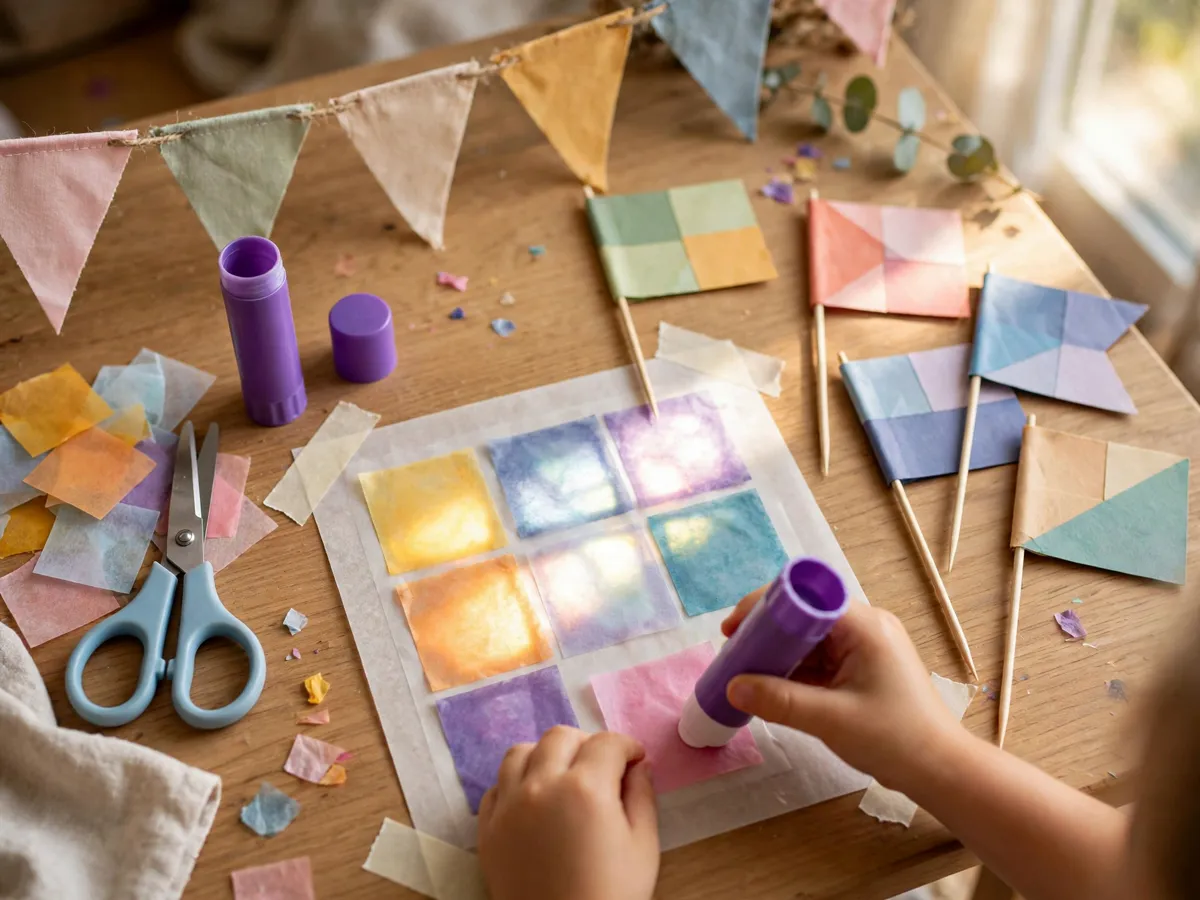
Pick two flags, not six. One flat flag for the table and one that hangs, so the work ends up somewhere you can actually see it. The other four will still be here next week, and they will need the same tray.
One tray, six flags
Every make on this page runs off the same tray, so you set it out once:
- Paper in four or five colours, plus a few squares of white card
- Glue sticks and a small bottle of white school glue
- Blunt-nosed scissors, one pair per child old enough to use them
- String, ribbon or a length of wool for the banner
- One popsicle stick or clean drinking straw per hand flag
- Newspaper under the work, and a damp cloth beside it
Paint is optional and only for the pressed print at number five: washable poster paint and a flat palm do the job. Cap the glue stick between steps, because an open stick dries out and the pennants drop off the string by evening.
1. Hand flag on a stick
Trace a hand on coloured paper, cut it out, and glue the wrist end onto the top of a popsicle stick. Spread the fingers and it reads as a flag. Make one in each colour the child picks, then hold two up at the same time.
Ages 3-5 trace and glue while an adult does the cutting. Ages 6-8 trace, cut and assemble the whole flag with blunt-nosed scissors, with you at the same table. The stick stays on the table between waves, not in the air near anyone’s face.
2. Pennant banner for the doorway
Fold a strip of paper in half lengthways, then cut triangles along the fold so one pass gives you a row of matching pennants. Punch two holes near the top corner of each, thread the string through and knot it behind. Space the pennants with a folded paper square between them so they do not cling together. Tie both ends to a door frame at head height, not above a walkway where someone would walk into it.
Ages 3-5 punch the holes and hand over the knots. Ages 6-8 fold, cut and thread the whole strand. An adult makes the first fold and the first cut so the line comes out straight, then takes the scissors back at the end of the session.
3. Stained-glass flag in tissue paper
Draw a flag big on white paper — four bands, a cross, a circle, whatever the child is copying. Run a thin line of white glue inside each shape and press torn tissue onto it, one colour per shape. Lay it flat to dry for twenty minutes, then hold it up to a window. The light does the rest and the colours go bright.
Ages 3-5 tear the tissue and place it. Ages 6-8 draw the shapes and run the glue themselves. An adult does the last brush-out and keeps the wet flag flat on the table, off the floor and away from younger siblings.
4. Torn-paper flag collage
Draw a flag rectangle on a card square. This one uses no scissors at all — tear scrap paper into strips and blocks, then fill the rectangle band by band with a glue stick, edges butted tight. Tear the last pieces small and press them over the gaps. Trim the border once it is dry.
Ages 2-3 and 3-5 both work on this one, because tearing is the whole job. An adult draws the rectangle, runs the glue stick for the youngest, and trims the border with the long scissors afterwards.
5. Pressed symmetry flag
Fold a sheet of paper in half and open it again. Drop five or six blobs of paint along the fold line in the colours the child picked. Close the sheet, press it flat with the palm rather than the fingers, then open it slowly and a mirrored flag appears. Glue the print onto a card square once it is dry and trim it to a rectangle.
Ages 3-5 place the blobs and press with both hands. Ages 6-8 run the whole flag. An adult does the trimming and keeps each blob small, so the print does not weep over the fold.
6. Standing flag row for the shelf
Cut card into six rectangles and fold each one into a little tent so it stands up on the shelf. Draw a different flag on each: three bands, a cross, a circle, two triangles, a star, a checkerboard. Line them up along a shelf or a windowsill and the row becomes a display the child can rebuild — and will knock over, which is part of the plan.
Ages 4-8 fold and draw. Under 4, an adult folds the tents and the child draws on them. Cut all six rectangles from one sheet so the row matches, and let the child decide the order.
Flags as shapes and colours, and nothing else
A flag is a rectangle with a story told in bands and symbols. For a child of three to eight, that story is shapes: a circle, a cross, three stripes, a star. Keeping the craft on the shapes is what makes a flag project work at this age instead of turning into a debate.
Three lines that keep it easy:
- Choose flags a child has already seen — in a picture book, at a school sports day, on a street they have walked down.
- Skip anything tied to a political party, a slogan or a message. Those are not a craft for a five-year-old.
- Name what you see rather than what it stands for. “Four bands and a circle” is a perfectly good conversation at this age.
If a child raises a hard news story at the table, that answer belongs to a different moment, away from the glue. Take the question seriously later in the day, and let the craft stay a craft.
Scissors, glue and supervision
For anything with a hazard in it — scissors, heat, water, small parts — the same rule applies: an adult, close enough to act. On this page the hazard is the scissors and the wet glue. At a craft table that means one adult in the chair, not in the next room.
Scissors stay with the adult for the under-5 table. A child of six or over gets a pair with a rounded tip and an adult at the same table. The long scissors that trim a finished banner are adult-only. Wipe glue off hands before anyone wanders off to the sofa, and collect the tissue and card offcuts in one pass at the end.
Every make here carries the age band it was written for, and a younger child may still need a different version. This is a craft guide, not medical advice. For questions about your child’s health, your pediatrician is the right person to ask.
Three things that go wrong, and what to do
The tissue flag dries cloudy. That is too much glue. Thin the bottle with a spoon of water, brush a coat rather than a dollop, and work from the centre of each shape outwards so the tissue lies flat.
The banner sags in the middle. Knot the string behind each pennant instead of looping it, and add the folded paper square between them. Two knots and one spacer per pennant is what holds a strand tight across a doorway.
The pressed print sticks to itself. Press with the flat palm, not the fingertips, and open the sheet from one corner rather than peeling it apart. If it still resists, slide a piece of wax paper between the folds next time and the sheet opens in one move.
Questions parents ask
Which flags do I pick?
Open a picture book or an atlas and let the child choose three by colour. Flags that are bands, crosses, circles or a single star copy well at this age. Flags covered in fine detail, small emblems or lettering will frustrate a four-year-old, so leave those out.
Does the flag have to be accurate?
Close enough is the target. At four, a flag is four bands and a circle, and the order of the colours matters more than the shade. If a child notices that a real flag differs, that is a good moment to look at the picture book together, not a mistake to correct.
How many flags fit in one afternoon?
Two, for most children aged three to five. The hand flag and the collage share one tray and finish in about twenty-five minutes between them. The stained-glass flag needs its own sitting because of the drying time.
Can a two-year-old join in?
Yes, at the collage and the tissue flag. Both are tearing and pressing, with no scissors in the child’s hand. Keep the popsicle sticks, string and glue bottles out of reach until you sit down, and put them back when the session ends.
Save the two you will actually make
Save this page and start with the hand flag and the collage — one tray, no drying time, both finished before dinner. The crafts and learning collection holds the rest of the paper projects, the scissor skills by age guide covers when a child is ready for the cutting at numbers one and two, the five-supply craft list is the fallback when the coloured paper runs out, and the cool paper crafts page pairs with the pennant banner. For the shelf of flags that marks a community helper, the community helper crafts run the same band-and-symbol idea on a bigger sheet.