 KidNestClub
Easy Kids Crafts
Christmas Scrapbook Paper Crafts Ages 3-8 | 7 Garland, Wrap and Card Makes
A pack of patterned Christmas paper holds enough for the whole season: a garland across the window, wrap for every parcel, cards for the grandparents, and ornaments for the tree. The print does the decorating, so the child’s job is cutting, tearing, folding and sticking.
By KidNestClub · Updated 18 November 2026
Total scope: 7 makes · Ages 3-8 · Patterned paper, scissors, glue sticks, a hole punch, ribbon or string · Most finishes inside 40 minutes.
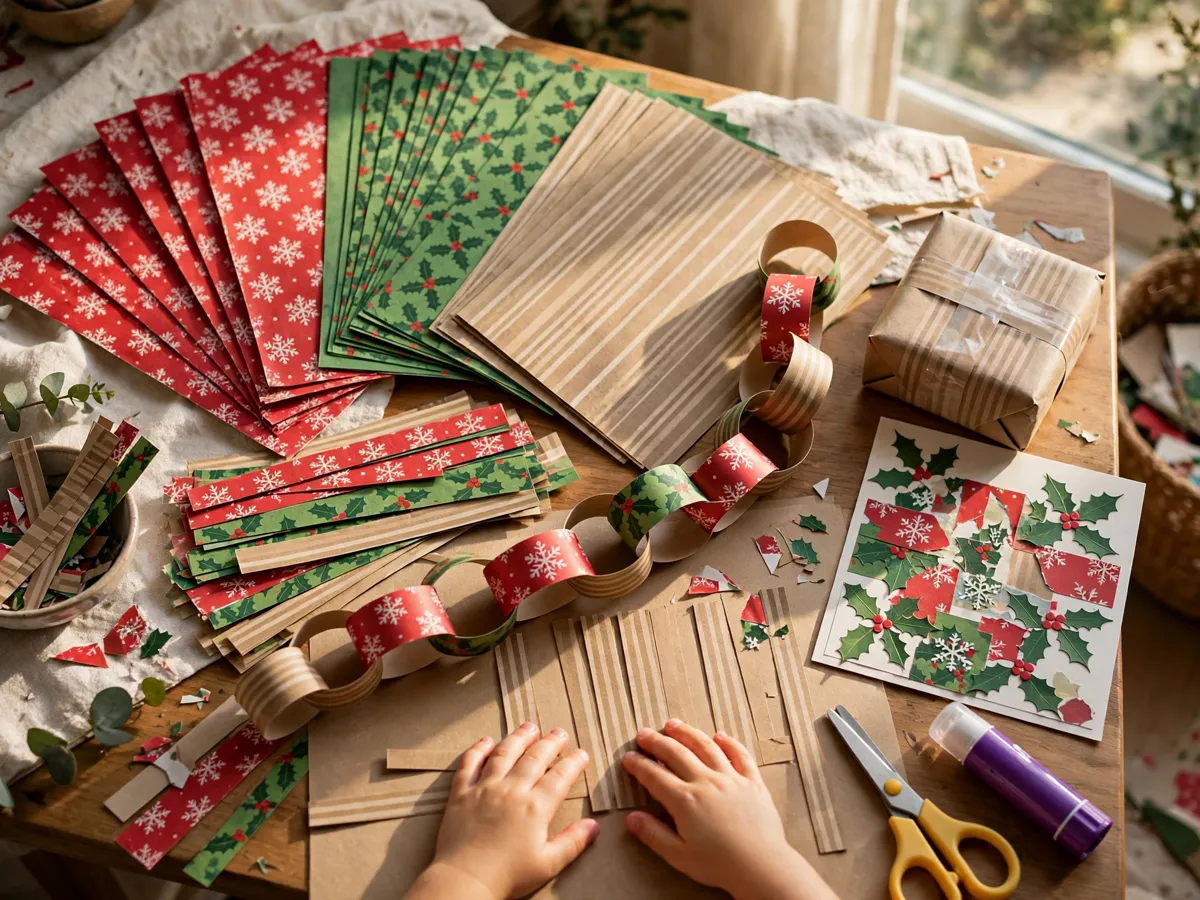
Sort the pack before anyone cuts. Lay the sheets out in two rows: the busy prints for small pieces, the quiet prints for wrap and card bases. A sheet covered in tiny snowflakes looks muddy when you cut it into eight squares, and it hides behind a folded parcel far better than a loud one does. Every activity here carries the age band it was written for, and a younger child may still need a different version.
Paper is the easiest craft material in the house to share between ages, because the same sheet works at three different sizes. That is the whole plan below: one pack, seven makes, and the offcuts kept for the eighth.
Who cuts what, by age
Scrapbook paper is thin, so scissors go through it cleanly, but a straight line is a hard ask at three. Match the cut to the hand, keep the stapler and the hole punch in adult fingers, and the sheet never ends up in the bin.
| Cut | Who does it | What it becomes |
|---|---|---|
| Tearing into strips | Ages 3-5, one sheet each | Collage cards and the frill on a bauble |
| One straight cut across a sheet | Ages 6-8, with an adult next to you | Garland squares and bunting triangles |
| A shape drawn and then cut out | Ages 6-8; ages 3-5 cut a pre-drawn line | Tree, star, stocking and snowman ornaments |
| A hole punch and a stapler | An adult holds both | Hanging loops and the garland join |
Offcuts go in one tin, not the bin. A 10 cm scrap is still a star, and a strip too short to cut is still a border on a card.
1. Square garland across the window
Cut each sheet into eight squares. Fold every square in half, punch a hole in the folded corner, and thread the squares onto a length of string so they open like a fan. Six sheets give a garland long enough to cross a window.
Ages 3-5 fold and slide the squares on. Ages 6-8 cut the squares and count them out. An adult does the punching and ties both ends of the string to the frame, and keeps the hanging strand short enough that it does not dangle into a face.
2. Gift wrap, with a paper bow the child makes
Wrap the parcel in the quiet print, then make the bow from the loud one: a strip folded into a figure eight, pinched at the crossing, and held with a strip of tape. The child folds and pinches; you do the taping and the knot under the parcel.
Ages 3-5 fold the strip and hand the bow over. Ages 6-8 pinch their own and check it against a gentle pull. Keep the roll of paper on a table, not on the floor, so nobody walks on it and tears the sheet you still need.
3. Collaged card on a plain base
Fold a plain card in half, then cover the front with torn pieces of patterned paper. A glue stick holds paper to paper and dries flat, so the card shuts and fits an envelope. Write the message inside once the glue has set, not while the pieces are still sliding.
Ages 3-5 tear and stick. Ages 6-8 cut small pieces and lay them out before any glue goes down. An adult writes the name and the address, and puts the stamp on.
4. Paper-chain ornament
Cut six strips from one sheet, join them into a chain, then squash the ring flat into a six-pointed snowflake and tape the crossings. Punch one hole in the top point and thread a short loop. It hangs on the tree and it weighs almost nothing, so a thin branch holds it.
Ages 3-5 slide the rings through each other. Ages 6-8 cut the strips and tape the crossings. An adult does the punching and ties the loop to the branch, then steps back to check the ornament hangs clear of the branches below it.
5. Bunting for the top of a door frame
Cut triangles from alternating sheets, then tape them along one long strip of paper rather than stringing each one. The strip method means a child can place the triangles wherever they like along the tape, and nothing has to be threaded.
Ages 3-5 place the triangles. Ages 6-8 cut them and leave an even gap between each. An adult cuts the base strip to the width of the frame and puts the bunting up on the day it goes.
6. Folded star with a patterned face
Cut a square, fold it diagonally twice, then cut across the folded point and open it out into a star. Glue a smaller star of a contrasting print on top of it, offset by a few millimetres, so the two prints read as one ornament with a border.
Ages 3-5 glue the small star down. Ages 6-8 make the folded cut and open it. An adult does the first cut through the folded layers, because four thicknesses of paper is more than a small hand can press through.
7. Offcut confetti for the bottom of the tree
Everything left over goes into a bowl of small squares. Snip them or tear them, then spread them on the skirt under the tree, or seal a handful inside a clear envelope and tape it to a window as a sun catcher. Do it on a tray, and tip the whole tray back into the tin when the season ends.
Ages 3-5 tear. Ages 6-8 snip the corners off each scrap. An adult keeps the paper offcuts away from the stair, because a sheet on a step is the one thing in this craft that sends somebody flying.
Scissors, the stapler and the tidy end
For anything with a hazard in it - scissors, heat, water, small parts - the same rule applies: an adult, close enough to act. Paper is a gentle craft, and the two tools that make it sharper than that are the scissors and the stapler, and both stay in adult hands for the 3-5 band.
A hole punch leaves small discs, and a stapler leaves small staples. Both fit inside a small-parts cylinder, so collect them as you go rather than at the end. When you choose toys and craft supplies, check the small-parts warning - it matters most under 3, and it stays relevant for the younger end of every playdate.
A quick floor sweep for small objects is a two-minute job that pays off every day. Here it catches the punch discs and the confetti that travel further than the paper you meant to keep.
Cleanup, and storing the rest of the pack
Sheets curl when they live loose in a bag, so the leftovers go flat in a box under the bed, not on top of the wardrobe. Glue sticks need their cap on before the box closes, or the next session starts with a dry stub. Tape the roll of wrap shut so it does not open in the cupboard, and put the offcut tin with the sheets, so next year’s garland starts from one place.
Four things that go wrong, and what to do
The glue wrinkles the sheet. Patterned paper is thinner than card, and it drinks whatever you put on it. Use a glue stick in long strokes rather than dabs, and press once, flat, instead of holding the piece down while you think.
The cut edge shows white. Some printed sheets are white underneath, and a torn edge shows the colour of the paper rather than the print. Tear towards yourself in one pull for a clean line, or turn the piece over and treat the white as the border.
The garland squares all look the same. Sort the sheet before you cut it: take every third square from a different print, and turn alternate squares so the reverse faces out. A mixed strand reads as a pattern and a matched strand reads as one long block of colour.
The ornament flattens against the branch. Card stock holds a folded shape better than a thin sheet, so for the snowflake use the heavier paper in the pack and keep the thin prints for the garland and the collage.
Questions parents ask
- How many sheets do I need for a season?
- Six to eight sheets cover a window garland, a dozen cards, the wrap for the small parcels and one tree ornament each. A pack bought for the season usually holds more than that, so the leftovers go in the box for next year.
- Can a 3-year-old use scissors on this paper?
- Yes, for tearing practice and one straight cut, with an adult sitting next to you. The thin sheets cut easily, which is exactly why they go crooked. Save the drawn shapes and the folded cuts for the 6-8 band.
- Does the print show through glue?
- A glue stick dries clear and leaves the print readable. Liquid glue darkens a thin sheet, so it is the right choice for card and the wrong one for the paper itself.
- What if we only have a few sheets left?
- Make the cards and the confetti first, because they use the smallest pieces. A garland can be strung from offcuts alone, and the wrap can go on the smallest parcel in the stack.
- Will a paper ornament survive the tree all month?
- It will, if it stays out of the way of hands and the paper is the heavier stock in the pack. Take the folded ones down on the last day and flatten them inside a book; they go back up next December.
Save two makes for this week
Start with the collaged card and the square garland, because they use the same sheet and the same tin of offcuts. The crafts and learning collection holds the rest of the seasonal makes, the paper chain guide goes deeper on the snowflake, the Christmas card list covers the envelope end of it, and the plastic cup crafts take the same paper as collars and frills. For the cutting itself, the scissor skills by age page says what each hand can do.