 KidNestClub
Easy Kids Crafts
Christmas Craft Kits Ages 3-8 | What to Pack and What to Check
A Christmas craft kit is one box, a handful of bags, and enough paper to keep hands moving for an afternoon without anybody asking what comes next. You can pack it from supplies already in the house, and it takes less time to fill than it does to wrap one present.
By KidNestClub · Updated 18 November 2026
Total scope: one kit per age band · Ages 3-8 · A lidded box, small paper bags, patterned paper, glue sticks, a jar of big beads · Assembly fits inside one evening.
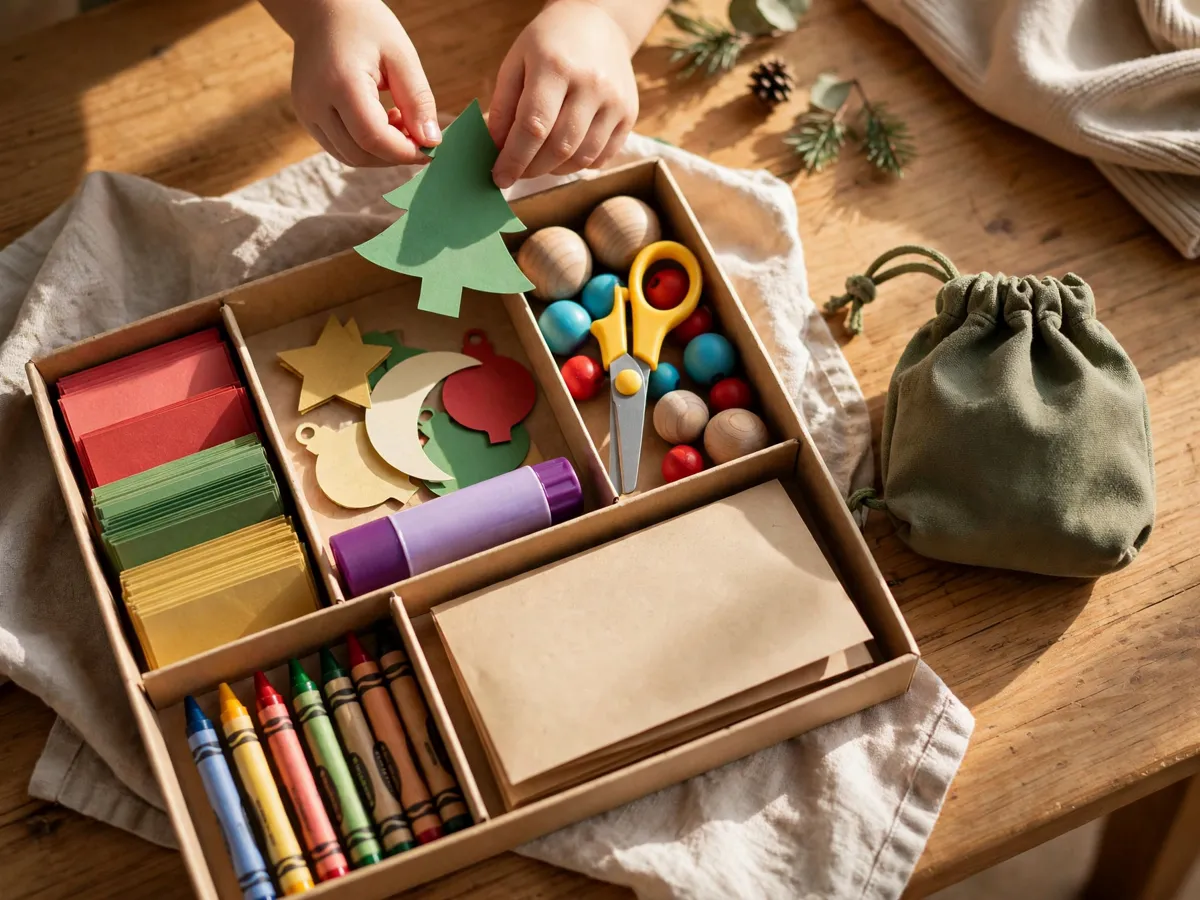
The reason to pack a kit rather than hand over a pile of supplies is the bag. One project per bag means a child opens a finished-sized job instead of a stack of loose paper, and the box closes with everything still inside it. It also means you decide, once and in advance, which steps belong to which hand. Every activity here carries the age band it was written for, and a younger child may still need a different version.
An age printed on a shop packet is the maker’s own age grade. It is not a statement about what your child can do, so treat it as a starting point and move the contents between bags if the fit is wrong.
What goes in each bag, by age band
Three bags fill a season. The 3-5 bag needs materials that forgive a loose grip and a fast move; the 6-8 bag needs something with a step in it. The shared bag holds the tools that stay with an adult.
| Bag | Holds | The adult step |
|---|---|---|
| Ages 3-5 | Four sheets of patterned paper, two card squares, a glue stick, six thumb-wide wooden beads, one short length of ribbon, one instruction card with a picture on it | Cuts anything, holds the punch, closes the bead jar |
| Ages 6-8 | Six sheets, a folded card, a glue stick, a length of string, a small tin of paper offcuts, one instruction card naming the finished shape | Checks the scissors, ties the hanging knots, keeps the stapler |
| Shared | Tape, a hole punch, a stamp set or a pen, a tray, a cloth, a bag for offcuts | Stays in the box lid, not in a child’s bag |
Nothing in that list needs a trip to the shop. The paper, the card, the beads and the ribbon all come out of the same drawers the rest of the season runs on, and the tray is the one you already own.
Pack the kit in five steps
- Lay the supplies out on a tray and count them. A kit packed from a pile ends up with two glue sticks and no paper.
- Put one project in each bag, not one material. A bag of beads is a spill; a bag of beads, a card and a ribbon is a garland.
- Write the age band on the bag in pencil, and add the number of pieces inside it. A pencilled mark can be rubbed out when the child moves up a band.
- Card each project: one sheet, one picture of the finished make, one line naming the step that belongs to an adult. The instruction on the first page is what decides whether the kit gets opened.
- Close the box and shake it once. Anything that moves loose inside is either too big for the bag or needs its own bag.
Whole evening, one box, three bags. If a bag goes unfinished, it goes back in the box sealed rather than emptied, and the next session starts from a full bag again.
Four places one kit earns its keep
A grandparent’s kitchen table. Hand the box over with the visit, not before it. Grandma gets the afternoon and you get the box back packed with offcuts, which is the same box next time.
A long car trip. Paper, a glue stick and a card work on a lap at altitude, and the tray becomes the lid of a box on the seat next to the child. Keep the bag to one project: two bags in a car means one bag under a seat.
A plane seat. Same rule, smaller bag. Glue sticks rather than liquid glue, because a bottle that opens in a cabin bag ends the trip for everybody.
A hospital waiting room or a neighbour’s sofa with a new baby on it. One bag, one chair, one finished card the child can hand over. Leave the scissors at home for this one and take paper you have already cut.
If you buy a kit instead: five checks
This page lists no price and ranks no brand, so read these as questions to ask of any packet in any shop.
- Does the packet name every material inside? A contents list you can read tells you whether a second run is possible, and a mystery bag usually runs out at step three.
- Does it hold one project or four? One project per box travels well; four projects in one box needs your own bags before it leaves the shelf.
- Does the finished result need adult strength to reach? If the last step is a hard press, a tight knot or a fiddly thread, the child watches instead of making, and the kit sits in the box.
- Does it carry a small-parts warning and an age grade? When you choose toys and craft supplies, check the small-parts warning - it matters most under 3, and it stays relevant for the younger end of every playdate.
- Does the instruction assume you will be there? Any kit with a hazard in it - a blade, a needle, a glue that needs heat - is written for an adult at the table, and that is the rule for the whole craft, not just the bought one.
A bought kit and a homemade one belong in the same box only if the bought one is opened and re-bagged. Otherwise it stays sealed, and the homemade bags are what travels.
Beads, blades and the box lid
For anything with a hazard in it - scissors, heat, water, small parts - the same rule applies: an adult, close enough to act. In a kit, that rule lives on the instruction card, so the adult step is written down before the box ever leaves your hand.
Anything that fits fully inside a small-parts cylinder - about the size of a child’s throat under 3 - is a choking hazard, so keep coins, beads, buttons and pins off the floor. Pack the thumb-wide wooden bead for the 3-5 bag and leave the seed beads out of the kit altogether. A bag of small beads handed to a 3-year-old at a grandparent’s table is the one mistake this box cannot undo, so the bead jar stays under the lid you hold.
Blades do not go in a travel kit. Scissors, a craft knife and a stapler stay in the shared bag at home, and a bag packed for the car or a waiting room holds paper that is already cut. Put the scissors back out of reach before the box closes, and check before the bag goes in the car that nothing loose is inside it.
Storage, and the end of the season
Craft supplies keep best in a lidded box, off the floor and out of the humidity, so the glue sticks stay usable until March. Empty the bags rather than the box: a finished make goes in the memory pile, an unused sheet goes back flat in the box, and a half-used glue stick goes back in its bag with the cap pressed on. A quick floor sweep for small objects is a two-minute job that pays off every day, and it is the last step before the box goes away. Label the box with the year and the band, and next November you pack from a known count instead of a rummage.
Four ways a kit goes wrong
Too much in one bag. A bag that will not close is a bag that empties on the floor within a minute. One project, one bag, and the rest waits in the box.
No instruction card. Without a picture of the finished make, a child opens the bag, takes out the paper, and puts it back. The card is the smallest part of the kit and the one most often skipped.
Liquid glue in a travel bag. A bottle that opens in a cabin bag or a car foot well ends the session. Glue sticks hold paper to card, dry flat, and cannot spill.
One band for two children. A 4-year-old and a 7-year-old cannot share one bag and both be pleased. Pack two bags from one box, and let the older child take the one with the step in it.
Questions parents ask
- How many bags does one box need?
- Three: one for the 3-5 band, one for the 6-8 band, and one shared bag of tools that stays with you. That covers a December of afternoons without the box ever looking like a tip.
- What age band is a kit best for?
- From three up, once the small beads are out of it and an adult sits at the table. Below three, the kit is a box you open together, and the child watches the paper being cut rather than handling the pieces.
- Can a kit go in a present stocking?
- A single bag can, and it is the better stocking fill than anything wrapped. Write the age band on the bag so the child who opens it knows whether it is theirs.
- Does a bought kit need re-bagging before it travels?
- If the packet holds more than one project, yes. Split it into your own bags, keep the contents list, and put the adult step on the card in your own words.
- What happens to the leftovers in January?
- Unused sheets go back flat in the box, offcuts stay in the tin, and the beads return to the jar on the high shelf. The box comes out again for the next holiday that needs hands busy, and the winter makes use the same paper.
Pack two bags for this week
Fill the 3-5 bag and the 6-8 bag tonight, and start with the paper and the beads, because those two supplies cover most of the makes on this site. The crafts and learning collection holds the rest of the seasonal makes, the patterned paper guide fills the paper half of every bag, the bead crafts name the bead size for each band, and the plastic cup crafts need nothing but a cup and a glue stick. For the trip itself, the car activity list and the craft storage guide cover where the box lives between holidays.