 KidNestClub
Learning Activities & Printables
Alphabet Tracing Pack: A-Z Practice Routine for Ages 3-5
Tracing works when it is short, daily, and in order: uppercase first, one letter a day, ten minutes with a good grip. This pack runs A-Z over about a month. Each letter gets traced, said aloud, and spotted in one real word — so the shape sticks to a sound.
By KidNestClub · Updated 13 November 2026
Total scope: 10 minutes a day · Ages 3-5 · Printed sheets or copy-onto-paper letters + a chunky crayon.
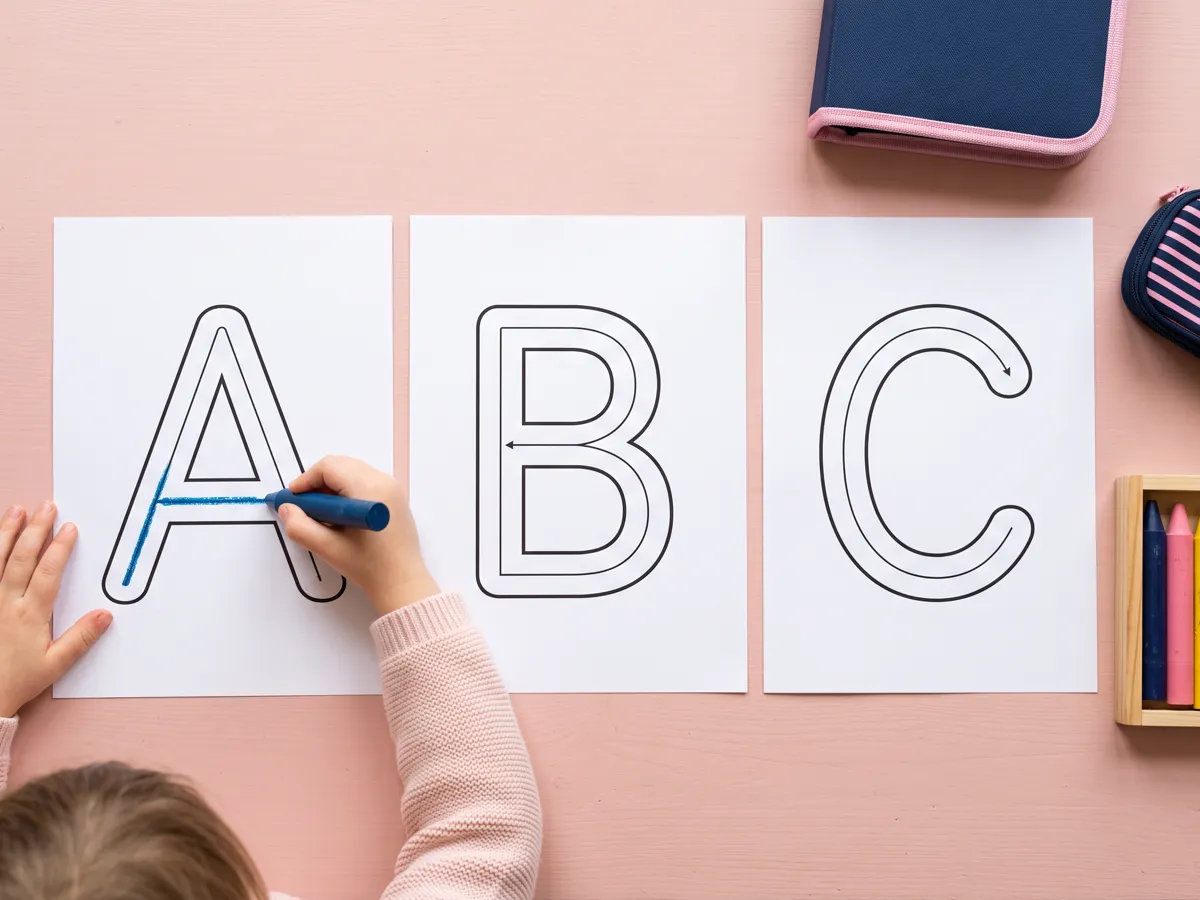
Setup: posture and grip before letters
Feet flat, paper tilted slightly toward the writing hand, chunky crayon. Most children hold a crayon or pencil between their fingers and thumb by 4, and the exact shape of the grip matters far less than whether it works. If your child fist-grips, consider letting a working grip be — plenty of kids hold a pencil in a way that still gets the words down cleanly.
Ages 3-5 · 2-minute setup · Sit at a table, not the floor — elbows need a surface.
The 10-minute routine: trace, say, spot
Every letter follows the same three moves. First, trace the big letter three times, top to bottom. Then say it aloud with its sound — "B, buh." Then spot one B-word in the room or in a picture book. Keep the same order every day.
Ages 3-5 · 10 minutes · One letter a day, A-Z in order the first pass through.
Letter order: uppercase first, tricky pairs apart
Start with straight-line capitals — L, T, H, E, F — before curves like S and G. Keep mirror-confusing pairs (b/d, p/q, m/w) weeks apart on the first pass. Lowercase joins in only after the full uppercase set feels easy.
Ages 3-5 · Uppercase A-Z first · No timing, no racing — accuracy over speed.
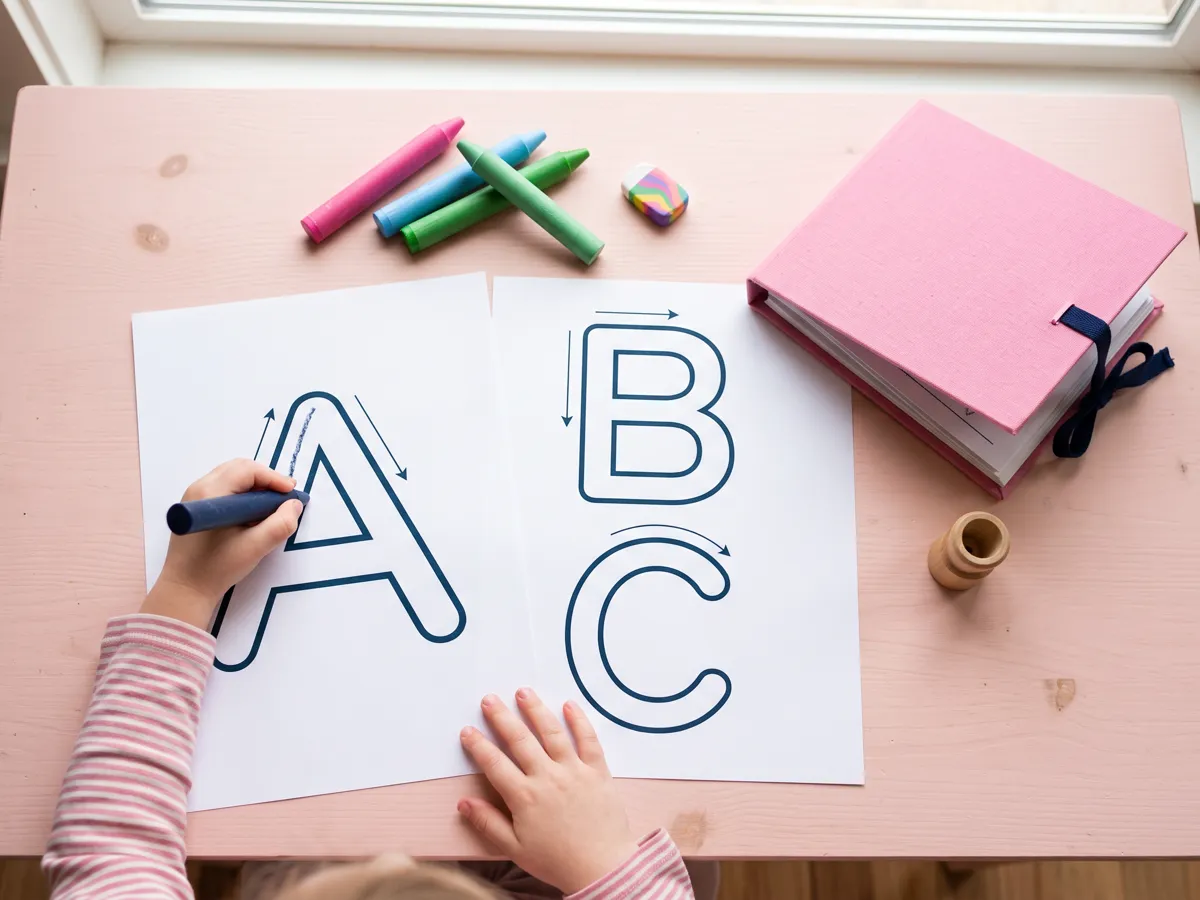
What is on each sheet
Sheet 1 carries A through I, sheet 2 J through R, sheet 3 S through Z, and sheet 4 is the A-Z review grid. Nine letter cards a sheet, three to a row, each with a hollow letter, a pink start dot and two dashed lines underneath. The review grid puts all twenty-six letters on one page.
Ages 3-5 · 4 sheets · The grid is for looking and naming; the letter cards carry the writing.
A sample week: what 5 days look like
Day 1 traces A with apple; day 2 traces B with ball; day 3 traces C with cat; day 4 reviews A-B-C on one sheet; day 5 traces D with dog. Every fourth or fifth day is review, never new. Review days are for going back over letters you have already traced.
Ages 3-5 · 4 new letters + 1 review day weekly · Keep finished sheets in a folder; flipping back is its own celebration.
When letters flip or grip slips
Writing a letter backwards happens in the early years — research has looked at exactly this in 5- and 6-year-olds, and most of them do it at least sometimes. Worth a try: chase the letter that gets flipped and practice that one first. If your child finishes early, stop early and end on a win.
This is a practice guide, not an assessment. Milestone checklists describe what about 75% or more of children can do at a given age — a guide, not a deadline for your child. Persistent concerns about vision, grip, or letter recognition belong with your pediatrician or teacher, not a tracing pack.
Download the pack: four sheets, US Letter and A4
The whole set as four ready-to-print sheets: A-I, J-R, S-Z and the full A-Z review grid. Each sheet is one page, print on plain or matte paper, portrait.
Download the tracing pack (US Letter) · A4 · 4 pages
No printer? Copy-onto-paper works
Draw one big hollow letter per half-sheet with a marker and add a start dot where the stroke begins. Three rows per letter: trace yours, trace together, solo trace. The homemade version works exactly like a printable for the first alphabet pass.
Keep letters big — at least two inches tall — until strokes go the right direction most days.
Save this for practice time
Pin the routine steps, then come back when the crayons are out — the Easy Crafts & Learning collection holds the coloring and scissor-skills packs that pair with this one.
Pediatric screen-time guidance for learning time: AAP guidance on media and children.