 KidNestClub
Parenting Tips & Routines
Chores Preschoolers Can Do | 12 Real Jobs Ages 2-5
Twelve jobs, and every one is something a household actually needs done. Nothing here is make-believe work. Pick four, not twelve — one per week is a full month.
By KidNestClub · Updated 18 November 2026
Total scope: 12 jobs · Ages 2-5 · Three bands: 2-3, 3-4, 5+ · Every job runs in under five minutes.
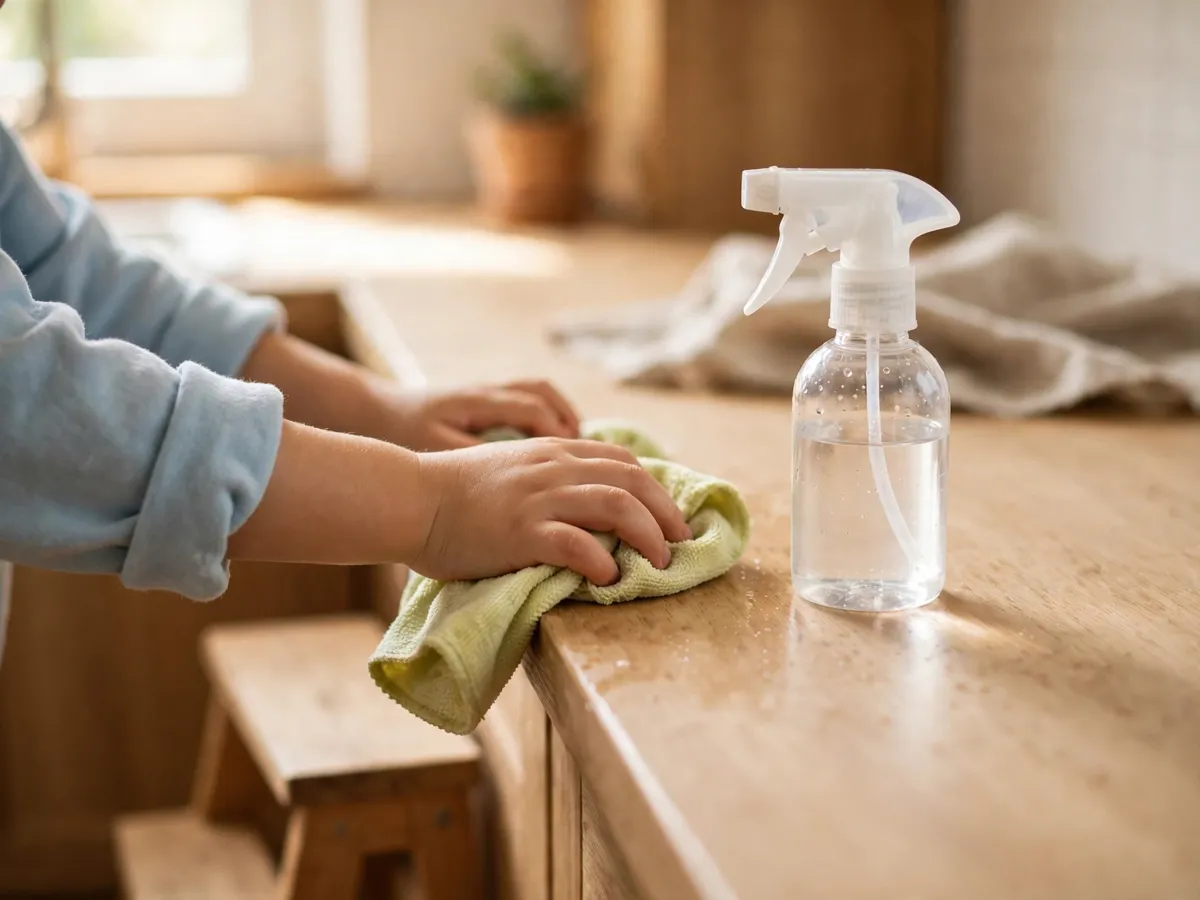
Between 2 and 4, a child doesn’t grasp danger and won’t remember ‘no’ while they’re busy playing — so the watching has to be hands-on. The same thing runs the other way on a job: a preschooler forgets the instruction mid-doing, which is why every entry below carries a reminder line and why you stand next to the child for the first week rather than calling the job from the kitchen.
How to read the twelve
Three lines per job, and the middle one matters most. The first line names the work in the child’s own hands. The second is what finished looks like when you check it from across the room, without touching. The third is the sentence you say the same way every time.
- The job — what the child’s hands actually do, start to finish.
- Finished looks like — the version you check from across the room, without touching it.
- Your line — the sentence you say the same way every time, so the job arrives with its own cue.
The reminder line names the object and the place. “Napkins on the table” beats “help me set up.” Say it once, point, then wait. Three repetitions is a nag, not an instruction.
Ages 2-3: one object, one place
At this band the whole job is a carry. One thing in two hands, from where it is to where it goes. Stop at one, because the second trip is where a two-year-old wanders off with the object.
1. Napkins to the table
The job: take one folded napkin out of the basket and lay it on the table, one per person. Give the count on your fingers — four fingers, four napkins.
Finished looks like: a napkin at each seat, none on the floor, the basket closed.
Your line:“Napkins on the table, one for each of us.”
2. Toys back in the low bin
The job: pick up the soft toys and the big blocks and drop them in the bin at floor level. Name three, not the whole room.
Finished looks like: the floor clear of the three you named; the bin lid sitting loose, not stacked full.
Your line:“Three toys in the bin, then we read.”
3. Wrappers in the small bin
The job: carry one wrapper or one dry tissue to the small wastebasket and let go of it there.
Finished looks like: the floor under the table bare, the wrapper in the bin rather than behind it.
Your line:“Wrapper goes in the bin.”
4. Books back on the low shelf
The job: stand a book up on the shelf at their height, cover facing out. Two books is the limit at this band.
Finished looks like: the floor stack gone, the two books standing rather than lying flat in a pile.
Your line:“Books standing on the shelf, cover out.”
Ages 3-4: two steps in one job
A three- or four-year-old can hold two steps if the second one follows the first immediately. The jobs below all pair a doing step with a putting-away step, which is what makes them different from the band above.
5. Wipe the table after snacks
The job: take the damp cloth from the tub, wipe one section of the table, then hang the cloth back where it dries. You put the cloth out; the child does the wiping and the hanging.
Finished looks like: no crumbs left on the section, the cloth hanging rather than balled up on the counter.
Your line:“Wipe your spot, then hang the cloth.”
6. Pair the socks from the basket
The job: pull socks out of the clean basket two at a time and roll each pair into a ball. Mismatched pairs go in a separate little heap for you.
Finished looks like: balls of matched socks in the drawer, one odd heap on the bed for the adult to deal with.
Your line:“Two socks that match, roll them up.”
7. Shoes lined up at the door
The job: set each pair of shoes side by side on the mat, toes pointing the same way, then put the sandals back in the basket.
Finished looks like: pairs standing together rather than one shoe on each side of the hall.
Your line:“Shoes side by side on the mat.”
8. Own plate to the counter
The job: carry the own plastic plate and the own cup from the table to the counter after eating, then come back for the napkin.
Finished looks like: an empty spot at the child’s seat, the plate standing on the counter within reach of the sink.
Your line:“Plate and cup on the counter, napkin too.”
Age 5 and over: a job with a standard
A five-year-old can work to a checkable standard rather than simply completing the movement. The finished line below is what you inspect once, at the end, and then leave alone.
9. Set out the forks and spoons
The job: count the people at the table, then lay one fork, one spoon and one napkin per seat. Cutlery only — the blades stay in the drawer and out of this job.
Finished looks like: the count matches the seats, handles all pointing the same way, no third spoon hiding under a chair.
Your line:“One fork, one spoon, one napkin at each seat.”
10. Fold the hand towels
The job: take the dry hand towel off the rail, fold it in half then in half again, and put it back on the rail or in the basket.
Finished looks like: a square rather than a bunched towel, and the rail clear of the wet one.
Your line:“Fold it twice, back on the rail.”
11. Empty the small bathroom bin
The job: lift the old bag out, drop it in the big bin, and pull a new bag over the rim. You tie off the full bag; the child does the lifting.
Finished looks like: the liner tucked under the rim so it will not slide out, and the empty bin standing on the floor rather than the toilet.
Your line:“New bag on, edges under the rim.”
12. Fill the pet’s water bowl
The job: carry the pet’s bowl to the sink, hold it while you run the tap, then set it back on its mat and wipe the floor around it with the cloth you both keep under the sink.
Finished looks like: the bowl on the mat rather than on the tile, and a dry cloth wiped around it.
Your line:“Bowl on the mat, wipe around it.”
Starting a job without a chart or a sticker
One job, one moment, one line. Attach the job to something that already happens every day — napkins after breakfast, the plate at the end of dinner, toys before the story. The existing moment does the reminding, so you do not have to invent a system around it.
Stand next to the child for the first week. Name the object, point at the place, then keep your hands off it. When the job lands crooked, leave it crooked: the job was the carrying and the setting-down, and a re-do tells the child the job was yours.
Add the second job only when the first one runs without you saying the line. That is usually two to three weeks at this age. Four jobs a month is a real household.
Hazards in a preschool chore list
For anything with a hazard in it — scissors, heat, water, small parts — the same rule applies: an adult, close enough to act. None of the twelve jobs above needs a knife, a stove or a cleaning spray, and that is deliberate. Three places a hazard still walks in:
- The toy bin at job 2 holds small parts. A younger sibling crawling nearby is the reason the sweep happens before the bin is emptied, not after.
- The damp cloth at job 5 goes out of reach between sessions, so a two-year-old does not drink from the tub.
- The pet bowl at job 12 sits on the floor where a toddler’s mouth is level with it. An adult lifts it, or the job waits.
Every job here carries the age band it was written for, and a younger child may still need a different version. This is a household guide, not medical advice.
Three things that go wrong, and what to do
The job gets started and abandoned halfway. The job is too big for the band. Cut it to the first movement only — one napkin rather than four — and run it again next week at the same moment.
The child asks for a reward for the job. Keep the job and the enjoyment separate. The job is the napkins; the story is still the story.
Every job stops getting done by Thursday. The ramp is too steep for the week you are in. Drop back to one job for a fortnight.
Questions parents ask
What if my child won’t start the job?
Try the job at a different moment before you try a different job. A four-year-old who will not touch the socks at bedtime will often do them on a Saturday morning beside an adult on the floor.
Do these jobs need a printed list?
No. One line on a fridge note is enough for four jobs at this age. If a picture cue works for your child, draw the object rather than buying a set — a drawn napkin on a table beats a laminated card for a three-year-old who did not choose it.
Should siblings of different ages get different jobs?
Yes, and the bands above are where you split them. Two-year-old and five-year-old can work on the same room at the same time on different jobs — the big blocks for one, the folded towels for the other. Same moment, different standard.
When does a job move up a band?
When the finished line holds without you checking it twice a day. That is the signal, not a birthday. The three-question check for raising a job sits on the page about judging whether a chore fits.
Save the four jobs for this month
Save this page and start with napkins, the small bin, the shoes and the plate. Those four hang off moments that already exist. For the wider age picture, the guide to what each stage can carry runs from two through ten, and the page on judging whether a job fits right now gives you the three-question check for raising one up. The morning routine checklist pairs two of these jobs with the before-school run, and the Parenting Tips & Routines collection holds the rest of the routine pages.