 KidNestClub
Kids Activities & Screen-Free Play
Toddler Valentine Activities | 9 Screen-Free Ideas Ages 2-3
Nine Valentine ideas a two-year-old can run on their own hands, each with about five minutes of prep: a cardboard heart stamp, a play-dough heart table, a handprint card, a counting tray and five more. Ages 2 to 3, one idea a sitting, no screens.
By KidNestClub · Updated 17 November 2026
Total scope: 9 activities · Ages 2-3 · 5 minutes of prep each · Cardboard, card, paint and play dough · nothing to buy.
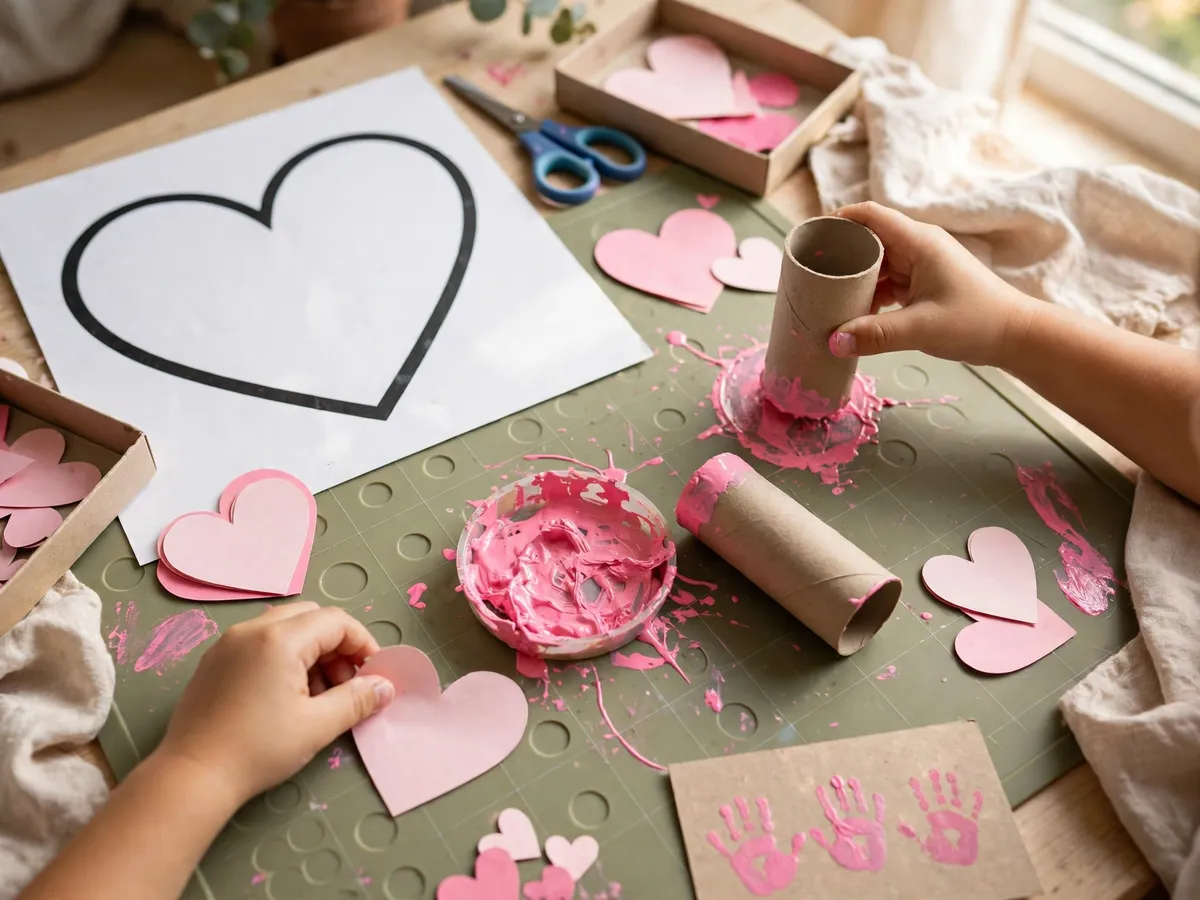
Set the table once, then leave it alone
Lay out the whole activity before your child sits down, and keep the spare supplies in a box behind your chair rather than on the table. Two colours is a full palette at this age.
- An oilcloth under the work, taped at the corners
- One sheet of paper bigger than your child’s reach
- Washable, non-toxic paint in two colours, in shallow pots
- A damp cloth inside arm’s reach of the table
- A shoebox lid for the finished pieces, so the round has an end
1. Toilet-roll heart stamps
Ages 2-3 · 5 minutes · Two cardboard tubes, paint, one big sheet.
Squash a kitchen-roll tube flat, then push the crease in from both sides until the open end makes a heart: pinch the middle of the rim down and pull the two outer curves up. Tape the tube so the shape holds, and make two.
Pour a shallow puddle of paint onto a plate. The adult dips the stamp and hands it over; your child presses it flat and lifts straight up. Tape the paper to the table first, because a sliding sheet ends the round early. Press, lift, look at the shape, press again.
2. A play-dough heart table
Ages 2-3 · 5 minutes · Play dough, one heart cutter, a rolling pin.
Roll, cut, lift, repeat. The cutter is the whole activity at two; at three, add a straw to poke a row of holes around the heart edge. Keep the table to two colours, one cutter and one rolling pin — a tray of twelve tools is a tidying job with a toddler in the middle of it.
The finished hearts go on the shoebox lid to dry, not back in the tub. At the end of the round, the dough goes back in its bag and the table gets one wipe.
3. A handprint card, colour-safe
Ages 2-3 · 5 minutes · Washable paint, a folded card, a brush.
Paint the palm with a brush — never dip the hand in the pot — then press the card flat, lift, and wipe the hand on the cloth. One print, one card. Write the date underneath.
At two, the print is mostly a smear with a thumb in it. That is the version grandparents keep. Choose paint labelled washable and non-toxic, and keep the pot on your side of the table between prints.
4. A heart-counting tray
Ages 2-3 · 5 minutes · Five felt hearts, a muffin tin.
Cut five hearts from felt, big enough to fill a muffin cup. Put one in the first cup and let your child fill the rest, counting out loud as each one lands. At two, the work is one heart per cup and the tip-out at the end; at three, cut a second set in another colour and ask for the pairs.
5. A contact-paper suncatcher
Ages 2-3 · 5 minutes · Clear contact paper, tissue paper, tape.
The adult cuts a heart from clear contact paper and tapes it sticky side up to the table. Your child presses torn tissue squares onto it until the sticky is covered, then the adult seals a second heart on top and tapes it to the window. Keep the squares big: a two-year-old tears tissue into strips, and strips are the right size.
6. A heart hunt around the room
Ages 2-3 · 5 minutes · Ten paper hearts, one basket.
Hide ten paper hearts at toddler height — on the sofa arm, under the table edge, behind the door, on a low shelf. Hand over the basket and say the one rule: hearts go in the basket. Play it twice, then let your child hide them for you. The hiding takes longer than the finding.
7. Post the valentines
Ages 2-3 · 5 minutes · A shoebox, a lid, folded cards.
Cut an opening in a shoebox lid and wrap the box in paper. The cards are folded paper hearts, saved envelopes, or the handprint cards from idea 3. Post, shake, open the lid, tip them out, post again. Cut the opening wide enough for a folded card — a narrow one turns the game into a fight with the box.
8. Threading hearts
Ages 2-3 · 5 minutes · Six cardboard hearts, one shoelace.
Punch a hole in the corner of six hearts and tie the lace to the first one. Cut them from a cereal box and glue two back to back, so they stay firm in a small hand. Wrap tape around the lace end to make a stiff tip — a frayed lace will not go through a hole, and the round ends right there.
At two, the lace goes in one hole and out again; at three, the hearts slide along the lace into a row.
9. Heart-matching cards
Ages 2-3 · 5 minutes · Ten cards, five patterns.
Draw five heart cards twice over, each pair with the same pattern: stripes, dots, one big heart, two small hearts, a zigzag. Spread the ten cards face up and match the pairs. At two, start with three pairs. The face-down version is a game for four, not before.
The adult-only shelf
Between 2 and 4, a child doesn’t grasp danger yet and won’t remember ‘no’ while they’re busy playing — so the watching has to be hands-on.
Anything that fits fully inside a small-parts cylinder — about the size of a child’s throat under 3 — is a choking hazard, so keep coins, beads, buttons and pins off the floor. When you choose toys and craft supplies, check the small-parts warning — it matters most under 3, and it stays relevant for the younger end of every playdate.
For anything with a hazard in it — scissors, heat, water, small parts — the same rule applies: an adult, close enough to act. That puts buttons, beads, googly eyes, sequins and pins on your side of the table for the whole of ages 2-3. The toddler presses the felt heart; the adult glues the button on afterwards, at the counter. Scissors and craft glue stay with you. If candy hearts come out at all, keep them off the craft tray, and check the label against the allergens in your house before they go on the table.
This is a guide, not medical advice. For questions about choking or your child’s health, your pediatrician is the right person to ask.
Save this for the week before Valentine’s
Save the page and open it on a grey afternoon in February. The heart colouring pages cover the table version for an older sibling, and the play dough kits pack the same table into a box. For the rest of the week, the indoor activities and the Kids Activities collection hold the screen-free menus that run on the same sheet.