 KidNestClub
Kids Activities & Screen-Free Play
One Year Old Sensory Play | 9 Taste-Safe Ideas
Nine taste-safe setups for the 12-24 month window: a flour-and-oil sand, edible finger paint, a spaghetti scoop, a rice bin, oobleck, edible mud, a water scoop, a treasure basket and a whipped foam — each one mixed from food, set out at the tray, and cleaned up in ten minutes.
By KidNestClub · Updated 17 November 2026
Total scope: 9 setups · Ages 1-2 · 5-10 minutes each · Pantry ingredients only · An adult, close enough to act, for every one.
The mouth rule comes first
Taste-safe means every ingredient is a food you could put on a plate. Two tests before any base goes on the tray: read the ingredient list out loud, and ask whether you would serve it to your child on a spoon. If either answer is no, the base stays off.
At 12-24 months everything still goes in the mouth. So the rule is not “don’t taste”; it is “everything on the tray is a food, an adult is close enough to act, and the tray is the only place the base goes.”
1. The moldable taste-safe sand
Ages 1-2 · 5 minutes to mix · Bowl, spoon, measuring cup.
Ingredients: 4 cups plain flour, 1/2 cup vegetable oil, optional 2 tbsp cocoa.
Steps: Tip the flour into a bowl. Pour the oil in a spoon at a time and rub it through with your fingers until the mix holds a shape when you squeeze it — like damp sand at the beach. Add cocoa now if you want a brown sand for diggers.
Storage: An airtight box keeps the sand for a week; add a spoon of oil and rub it through when it dries out.
Supervision: Mouthing is the age — sit close, keep the sand on the tray, and expect a taste. Flour and oil only — a mouthful is flour and oil. Flour is wheat — if wheat is new to your child, go one new food at a time.
2. Edible finger paint
Ages 1-2 · 10 minutes to cook and cool · Small pot, whisk, jars.
Ingredients: 2 tbsp cornflour, 1 cup cold water, food coloring.
Steps: Whisk the cornflour into the cold water in a small pot. Heat gently, stirring, until it thickens to a pudding — 2-3 minutes. Split into jars and stir a drop of coloring into each. Cool before the tray.
Storage: A covered jar in the fridge keeps for two days.
Supervision: Paint goes on paper, not in the mouth — though at this age a taste is likely, and every ingredient is a food.
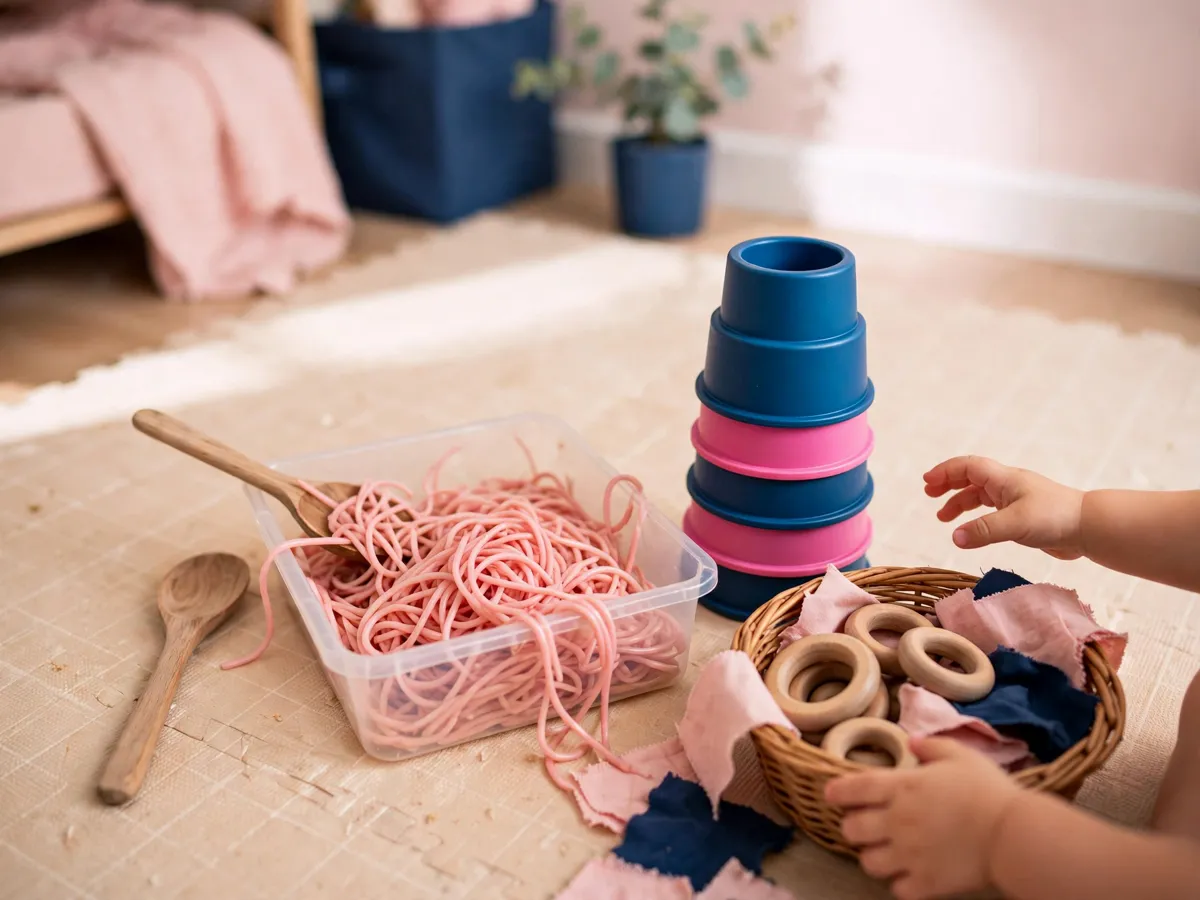
3. The spaghetti scoop
Ages 1-2 · 12 minutes to cook and cool · Pot, colander, two bowls.
Ingredients: 2 cups dry spaghetti, water for the pot.
Steps: Cook the spaghetti a minute past the packet time, drain, rinse under the cold tap until cool, then hand it over in short lengths.
Storage: A covered bowl in the fridge keeps for two days. Smell it before you reuse it and toss anything that smells off.
Supervision: Cool pasta, an adult at the table.
4. The rice bin
Ages 1-2 for pouring, 2-3 for the tray · 2 minutes to set up · Tray, sheet, cup, spoon, funnel.
Ingredients: 3 cups uncooked rice.
Steps: Pour the rice into the tray about two fingers deep. Add the cup, the funnel and the spoon, then scoop, pour and level it. Keep the tray on the floor over a sheet.
Storage: Dry rice keeps for months in a sealed bag. Anything that gets wet goes in the bin the same day.
Supervision: Dry rice is a small part. Keep it on the tray, keep the 2-3s on the dough or the pasta, and keep an adult at the table.
5. Oobleck
Ages 1-2 · 2 minutes to mix · Bowl, spoon.
Ingredients: 2 cups cornflour, 1 cup water, food coloring.
Steps: Stir the water into the cornflour a spoon at a time until it trails off the spoon. Add coloring. It squishes solid when you squeeze and runs when you let go.
Storage: Oobleck dries out; cover it or bin it the same day.
Supervision: Messy, not taste-safe past the first taste — cornflour and water only, so an early taste is just cornflour.
6. Edible mud
Ages 1-2 · 5 minutes · Bowl, spoon.
Ingredients: 1 cup flour, 1/2 cup cocoa, 1/2 cup oil, water.
Steps: Mix the flour and cocoa, stir in the oil, then add water a spoon at a time until it holds together like wet mud.
Storage: Same day.
Supervision: Cocoa is the taste risk — keep the portion small.
7. The water scoop station
Ages 1-2 · 5 minutes to set up · Basin, towel, cups, sponges.
Steps: Set a shallow basin of warm water on a towel. Add cups, sponges and a ladle. Stay within arm’s reach of your child near water — that close, all the time, is what ‘touch supervision’ means.
Supervision: Never step away from a young child near water.
8. The treasure basket
Ages 1-2 · 10 minutes to gather · Basket.
Items: a wooden spoon, a silicone muffin case, a clean sponge, a pinecone, a cardboard tube, a jar lid, a clean cork, a fabric square, a large shell.
Supervision: Sit with it — the basket is a together activity.
9. Whipped aquafaba foam
Ages 1-2 · 4 minutes to whip · Fork, wide bowl, tray.
Ingredients: 1/2 cup chickpea water (aquafaba), food coloring.
Steps: Whip with a fork about three minutes until it holds peaks. Spoon onto a tray.
Supervision: Taste-safe — chickpea water and coloring only.
Safety notes for these nine setups
Between 2 and 4, a child doesn’t grasp danger and won’t remember ‘no’ while they’re busy playing — so the watching has to be hands-on.
For anything with a hazard in it — scissors, heat, water, small parts — the same rule applies: an adult, close enough to act. Two bases here are small parts by nature — loose rice and dry pasta — so keep both on the tray and out of mouths, and keep the 2-3s on the dough or the cooked pasta.
This is a guide, not medical advice. For questions about food allergies or your child’s health, your pediatrician is the right person to ask.
Save this list for the next rainy morning
Pick the two or three setups that match what is in your cupboard and save this page now, then open it when you need a ten-minute setup — the Kids Activities collection holds the rainy-day and screen-free menus that pair with these bases.
Browse the Kids Activities collection
Pediatric guidance on toddler health: HealthyChildren.org toddler ages and stages.