 KidNestClub
Kids Activities & Screen-Free Play
Little Tikes Outdoor Play Ages 1-5 | 12 Backyard Ideas
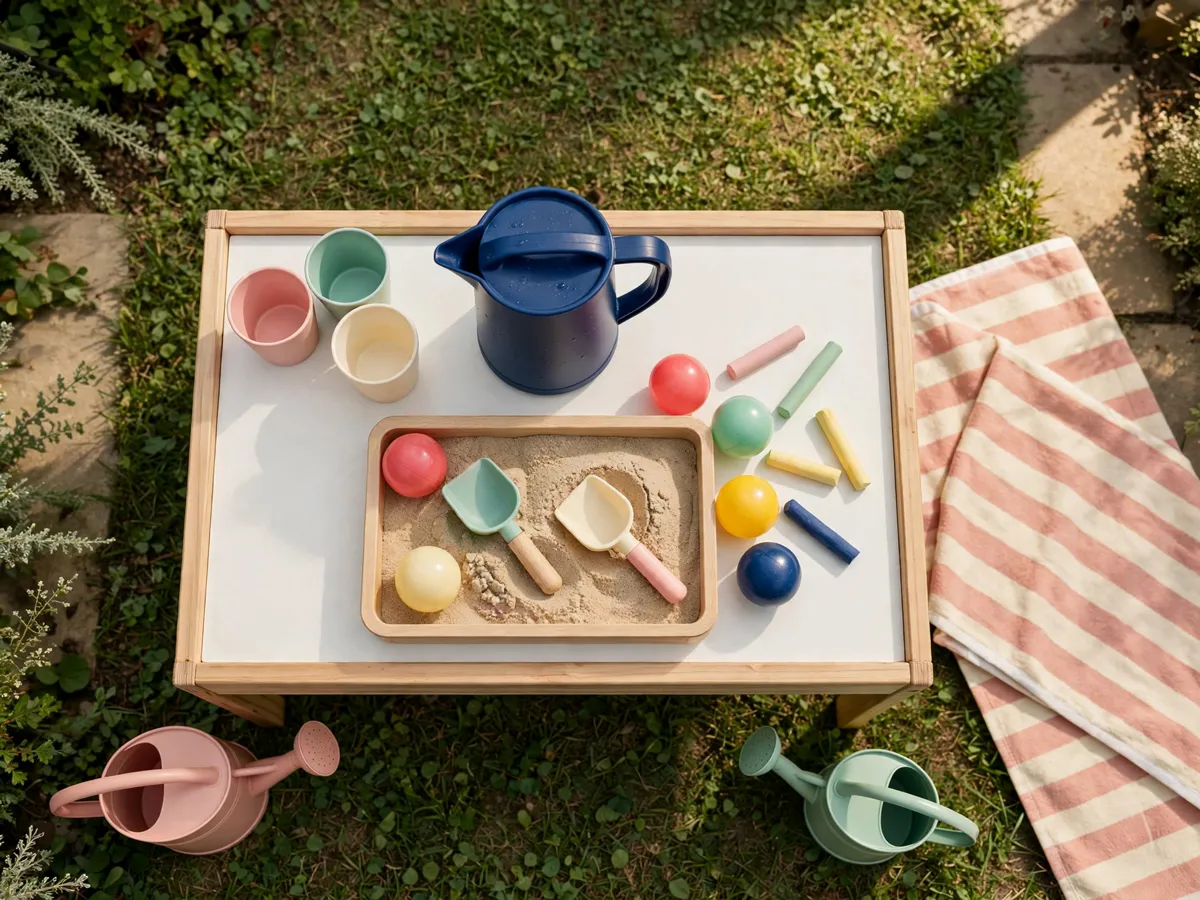
A low outdoor table is a stage, and the play on this page is the show: water, sand, balls and chalk, in twelve rounds that use one patch of yard and things already in the house. Each round lists its age band, its supplies, its minutes, and where the grown-up stands while it runs. Nothing here needs a screen, a schedule, or an afternoon of setup — the longest round to build is five minutes, and the shortest is already in the cupboard.
By KidNestClub · Updated 2026-11-28
What this page is, and what it is not
This is a catalog of backyard rounds for ages 1-5, one low table, and the boundaries that come with each. The words below describe what you do and what you watch for: we do not claim that any round has a developmental effect. Age bands follow the ages printed on the product and on the supplies, never our own guess. Every water, sand and small-parts moment carries its note beside it.
We do not restate specifications, prices, ratings or measurements for any product: see the card for the printed age band and where it is sold. We never sell what a manufacturer does not make, and we flag anything in a round that is a known hazard to the under-3s.
The twelve rounds at a glance
Water first, sand second, balls third, chalk and quiet builds last. The order goes from the wettest round to the driest, so the last rounds of the morning need no towel. Each entry lists its age band from the labels, the minutes it runs, the supplies it needs, and its supervision note in one line.
| Round | Age band | Supplies | The adult |
|---|---|---|---|
| 1. The two-bucket pour | 1-3 | Two buckets, two cups | At the table, arm's reach |
| 2. The sink-only pour | 1-2 | A washing-up bowl, sponges, cups | At the bowl, touch supervision |
| 3. The water table round | 1-5 | The play table, cups, funnels | Stay within arm's reach, never step away |
| 4. The sand kitchen | 2-5 | A storage bin of sand, scoops, jars | At the bin; sand away from faces |
| 5. The sand bakery | 2-5 | Sand, buckets, kitchen jars | Same as the kitchen round |
| 6. The ball run | 2-5 | Balls, pool noodles, a storage bin | At the ramp, catching the misses |
| 7. The ramp alley | 3-5 | A cutting board, small balls | Close by, as the balls scatter |
| 8. The bridge build | 3-5 | Two chairs, a cutting board, cups | At the chairs, steadying the board |
| 9. The chalk shapes | 1-5 | Chalk, a paintbrush, a jar of water | At the paving, sun-cream on first |
| 10. The chalk road | 2-5 | Chalk, small toy cars | Same as the shapes round |
| 11. The quiet build | 3-5 | A towel, a few plastic figures | In the shade, watching the small parts |
| 12. The wash-up | 1-5 | The hose, a towel, the lidded bin | Runs the hose, ends the morning |
The one pick
We considered folding picnic tables, sand-and-water combos, and separate sandpits before landing on one pick for this page. The method is written up in how we research, the price band in the card follows the range we found at listing time, and the links in the card are covered in the affiliate disclosure.
Little Tikes Easy Store Jr Play Table
Little Tikes · Ages 1–5
The pick for this page: one table, a flat fold, and a surface that stands up to the hose. Printed ages 1-5; anything with small loose parts stays out of the under-3 rounds.
Check price on Amazon (opens in a new tab)Affiliate link — we may earn a commission.
The four boundaries that hold all day
The water rules first. Stay within arm's reach of your child near water — that close, all the time, is what “touch supervision” means. Never step away from a young child near water — not even for a moment, and not with another child in tow. Those two sentences are the whole water rule for the yard, for the paddling pool, and for a table holding two inches of it.
The rest of the strip is short. Sand: keep scoops low, and dust stays out of eyes and mouths; wash hands at the end of the round. Small parts: anything small enough to pass through a choke tube stays out of the under-3 rounds entirely. Sun: the morning slot before ten, a hat, sun cream on every patch of skin that shows, and the shaded corner for the quiet rounds. Under 2, a child does not yet have the sense of danger that an adult has — an adult, close enough to act, is the boundary that carries the day.
For age guidance on outdoor play beyond the backyard, the American Academy of Pediatrics has a parent-facing library at healthychildren.org that covers toddlers stage by stage.
1. The two-bucket pour
One bucket holds an inch of water, the second is empty. The child carries a cup from the full bucket to the empty one, walking back and forth between them. When the full bucket empties, swap them. Spills are the round — the point is the walk and the pour, and the ground under the buckets is the towel.
Two buckets, two cups, ten minutes, and a grown-up at the table the whole time. Water means touch supervision: stay within arm's reach of your child near water, and never step away, not even for a moment.
Ages 1-3 · 10 minutes · two buckets, two cups
2. The sink-only pour
The bowl sits on the ground, half full, with sponges and cups beside it. The youngest one squeezes, soaks and pours at ground level, where a fall is a sit-down and not a tip. An older sibling can hold the cups steady as they fill.
A bowl, sponges, cups, fifteen minutes. At this age the child does not yet have the sense of danger that a grown-up has, so an adult stays at the bowl the whole time, within arm's reach of the water.
Ages 1-2 · 15 minutes · a washing-up bowl, sponges, cups
3. The water table round
This is the round the table was built for: a few centimetres of water on the floor of it, cups of different sizes, a funnel, and a wheel if the model has one. The youngest pours, the oldest routes the water through the funnel into the narrow cup, and the grown-up refills from the hose. When the floor of the table is dry again, the round ends.
The play table, cups, a funnel, twenty minutes. Any shallow basin still counts as water: stay within arm's reach of your child near water — never step away, even for a moment, and not with another child in tow.
Ages 1-5 · 20 minutes · the play table, cups, funnels
4. The sand kitchen
A shallow storage bin holds the sand, set on the ground beside the table. Kitchen jars, spoons and a small sieve are the tools; the table is the counter. The menu is whatever the yard offers — leaf soup, stone bread — and the jars get a wash before they go back to the kitchen.
A bin of sand, scoops, jars, twenty-five minutes. Sand stays low and out of faces and mouths, hands get a wash at the end, and a grown-up stays at the bin through the round.
Ages 2-5 · 25 minutes · a storage bin of sand, scoops, jars
5. The sand bakery
The bakery is the kitchen with a menu: pack wet sand into buckets and jars, tip them out, and count the cakes. Half the round is the packing and the tipping; the other half is setting the cakes out in rows on the table. Rain ends the bakery and starts the mud kitchen.
Sand, buckets, jars, twenty minutes. The same sand rules as the kitchen round: scoops low, nothing near a mouth, hands washed at the end, and a grown-up at the bin.
Ages 2-5 · 20 minutes · sand, buckets, kitchen jars
6. The ball run
Halve a pool noodle the long way, and you have two gutters. Prop one end on the table, aim the low end at a storage bin, and drop the balls in at the top. A second gutter makes a corner. The child drops, the ball rolls, the grown-up fishes the misses out of the grass.
Balls, pool noodles, a bin, fifteen minutes. Any ball small enough to fit whole in a young mouth stays out of the under-3 version of this round; an adult stays at the ramp and holds the small balls for the youngest.
Ages 2-5 · 15 minutes · balls, pool noodles, a storage bin
7. The ramp alley
A cutting board leans off the table at a shallow angle, and small balls roll down it one at a time. The round is the release: same ball, same angle, then a different angle, then two balls at once. The child judges when to let go; the grown-up stands at the bottom, holding the balls between turns.
A cutting board, small balls, ten minutes. Small balls and the under-3s do not mix: a ball small enough to fit whole in a mouth is a choking hazard, so it stays out of reach of the youngest and in the hands of an adult between turns.
Ages 3-5 · 10 minutes · a cutting board, small balls
8. The bridge build
Two chairs, a board across them, and cups lined under the bridge: drop the ball at one end, and see which cup it lands in. Moving the cups is the round; the bridge is the same bridge every time. The board is steady, the chairs are far apart enough to need it, and a grown-up stands at the chairs.
Two chairs, a board, cups, fifteen minutes. The board is a wobble, and the chairs tip: an adult steadies the board and stays at the chairs, and hands stay off the board once the balls are rolling.
Ages 3-5 · 15 minutes · two chairs, a cutting board, cups
9. The chalk shapes
Chalk on paving, and a paintbrush with a jar of water to paint over it: the shapes darken, then dry, then come back. The youngest draws lines and watches the water follow them; the oldest draws shapes and names them. The round ends when the jar runs dry.
Chalk, a brush, water, twenty minutes. Chalk is for the ground, not the mouth; the round sits in the morning slot before ten, with a hat and sun cream on every patch of skin that shows, and an adult at the paving.
Ages 1-5 · 20 minutes · chalk, a paintbrush, a jar of water
10. The chalk road
Draw a road on the paving — a loop with a bridge, a garage, a car wash — and run the small cars around it. The road grows all round; the cars stay in a box at the corner, and the box is the start and the end of every lap.
Chalk, cars, twenty-five minutes. Small cars and the under-3s do not mix: a car small enough to fit whole in a mouth is a choking hazard, so the under-3 version uses cars big enough for two hands, and an adult stays at the road with the box.
Ages 2-5 · 25 minutes · chalk, small toy cars
11. The quiet build
A towel on the table, a few figures, and no water at all. The round is the story the child tells with them — a farm, a road trip, a line of figures waiting for the bus. This is the shaded corner, the last round before lunch, and the calmest one on the page.
A towel, figures, twenty minutes. The figures are small parts: this round is ages 3-5 only, an adult sits within reach for the whole round, and the figures live in a lidded box between rounds, out of reach of the youngest.
Ages 3-5 · 20 minutes · a towel, a few plastic figures
12. The wash-up
Every morning ends the same way: the hose rinses the table, the bowls tip into the grass, the sand bin gets its lid, the small parts go into their box on the high shelf, and hands get a wash at the sink before anything else opens. Five minutes, one grown-up, and the yard is reset for the afternoon.
The hose, a towel, the bin, five minutes. The grown-up runs the hose and the water goes on the ground, not on the children; the small-parts box goes up high, out of reach of the under-3s.
Ages 1-5 · 5 minutes · the hose, a towel, the lidded bin
When to buy, and when not to
Run the two-bucket pour and the chalk shapes first, with what is in the house. Consider the table when the water rounds have become a standing date and your back is asking for standing height. Skip it if the yard has no flat patch you can sit beside all morning, or if the storage corner is already full — the fold helps, but it does not make the table smaller than it is. The card above carries the printed age band and the price band we found at listing time; we do not restate specs, and the listing page is where the measurements live.
Ready to pin this for the weekend? Save the twelve-round list to your outdoor-play board, and read the eight no-equipment setups that carry the same yard through the seasons — no new kit needed.
Frequently asked questions
Do I need the table before starting any of these ideas?
No. Nine of the twelve rounds run with a bowl, a storage bin or a patch of paving, and the table simply sets them at standing height. Start with what is in the house, and consider the table once the water rounds are part of your week. The trade-offs below are written so you can decide before buying anything.
Can a 1-year-old and a 4-year-old use the same setup?
They can share the yard, not the same round. Give the older child the pouring runs and the ball ramp, and give the youngest the sink-only pour or the chalk shapes, where nothing in reach is small. An adult stays within reach of the youngest one the whole time, whatever the older one is doing.
How much water do I fill it with?
Enough for pouring, not for wading — a few centimetres covers the floor of the table. Any shallow basin still counts as water, so the same rule holds as at the paddling pool: stay within arm's reach of your child near water, and do not step away, even for a moment.
Where does the sand go when the round is over?
Into a lidded box, stored dry and out of reach, with the scoops washed at the same time as hands. A sand round ends with a brush-off at the door, a wash at the sink, and the box closed before anything else opens.
Where the boundaries come from
The water and supervision lines quote the AAP-aligned guidance in our claim registry: touch supervision, arm’s reach, and an adult close enough to act. The small-parts rule follows the CPSC choke-tube test — anything small enough to pass through it stays out of the under-3 rounds. Age bands follow the printed ages on the product and the supplies, never our own guess. The full method, including how listings are chosen and checked, is in how we research.