 KidNestClub
Kids Activities & Screen-Free Play
Big Kid Indoor Activities | What Works at 6, 8 and 10
An indoor idea that works at six falls flat at eight, and the one that works at eight can feel like a chore at ten. Each section below solves a different problem: getting started at six, a real constraint at eight, and the rules of the game at ten. Read the section your child is in.
By KidNestClub · Updated 18 November 2026
Total scope: Ages 6-9 · sections at 6, 8 and 10 · four activities per section · paper, tape, cards and one cardboard box.
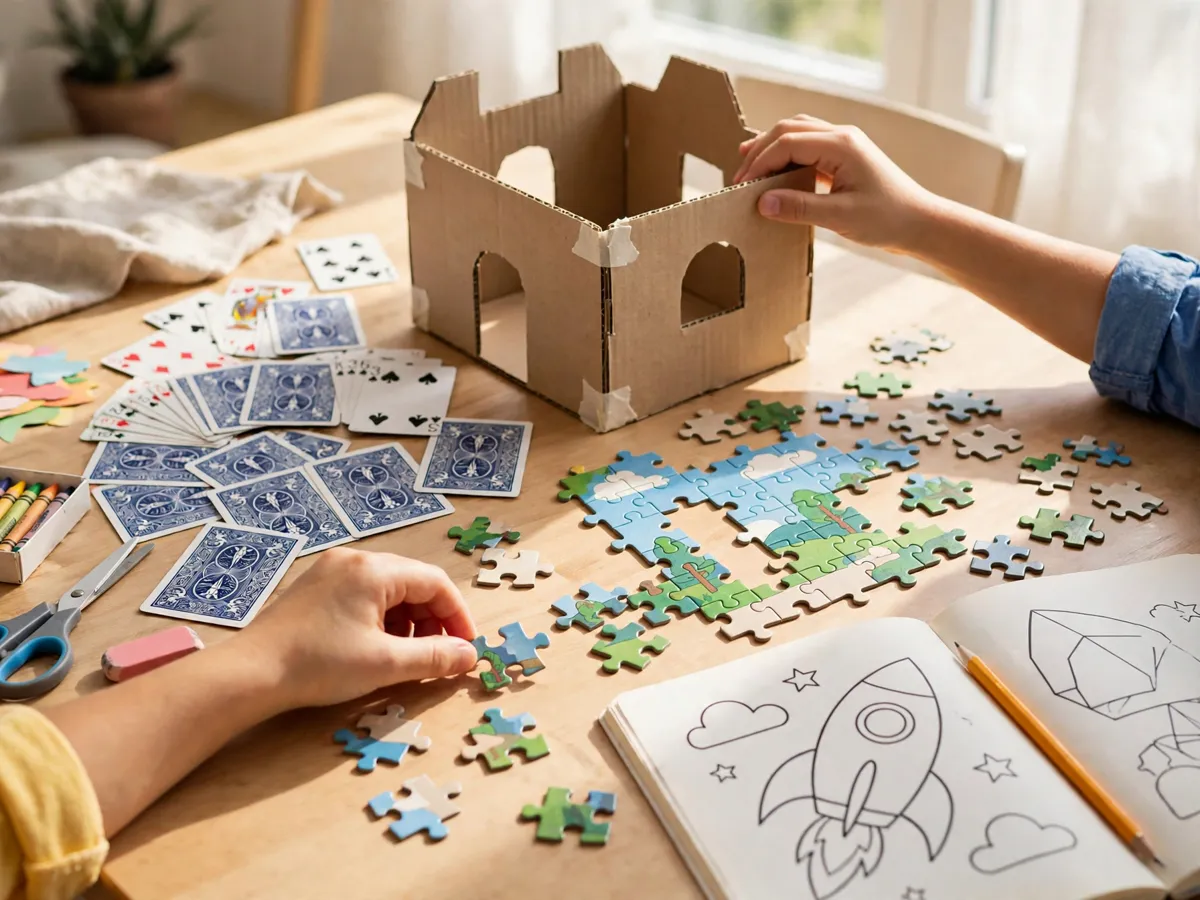
Every activity names its setup, the adult role and the test for “too easy”. The indoor activities list covers the whole family at Ages 2-6, and the indoor recess ideas suit a mixed group.
Age 6: the problem is starting
A six-year-old often needs the first move made for them. Lay the materials out as a set — tape torn into strips on the table edge, paper squared up, one pencil — then say one sentence and step back. Many six-year-olds start this without a prompt once the table looks ready.
1. One-sheet build. Setup: one sheet of paper, six strips of tape, nothing else, and the build has to stand on its own. Adult role: state the constraint, then step out. Too easy if it is finished in five minutes with no second version.
2. Card tower. Setup: one deck, a flat table, no tape. Adult role: keep the time and stay out of the building. Too easy if a tower of ten cards goes up first try — ask for one that survives a gentle table tap.
3. Four-panel comic. Setup: a sheet folded into four boxes, a pencil, a few markers. Adult role: draw the boxes and hand over the pen. Too easy if all four panels show the same picture — ask for a panel where something changes.
4. A maze for someone else. Setup: paper, pencil, one drawn example. Adult role: solve the maze and say where you got stuck. Too easy if there are no dead ends — ask for three.
Age 6 · 15-30 minutes · an adult beside the table for the whole build, and the scissors stay in the drawer.
Age 8: the problem is the constraint
An eight-year-old wants a build with a rule that bites: a limit on materials, a weight it has to hold, a time to beat. The adult supplies the rule and tests the result honestly. A build that passes first time gets a harder rule, not a round of applause.
1. Paper bridge. Setup: two book stacks, one sheet, tape, three books to load. Adult role: load the books and report the result. Too easy if the flat sheet holds — double the gap.
2. Invented board game. Setup: cardboard, a marker, dice, four counters. Adult role: play one full round by the child's written rules, with no changes mid-game. Too easy if the rules fit in one sentence.
3. Ping-pong run. Setup: cardboard tubes, tape, a ping-pong ball, a bowl. Adult role: hold the shelf steady and time the run. Too easy if the ball drops straight in — ask for two turns before the bowl.
4. Card game with house rules. Setup: one deck, one index card for the rules. Adult role: play as written and let the child referee. Too easy if the card is still blank after ten minutes — the rules are the activity.
Age 8 · 30-45 minutes · an adult sets the constraint and tests the build, and any cutting is done with an adult.
Age 10: the problem is other people
A ten-year-old will still build indoors, but only if the activity has a social edge: someone to beat, a rule to argue over, a job that belongs to them alone. Hand over the running of it — the rules, the score sheet, the referee call — and take a seat as a player.
1. Three-round tournament. Setup: one game, a score sheet, three rounds. Adult role: play, lose gracefully, and let the child keep the sheet. Too easy if the rounds are over in ten minutes — ask for a rule that makes round three harder.
2. A puzzle chain for the family. Setup: four written clues, one box, one small prize inside. Adult role: solve it as a player, not as the designer. Too easy if every clue is a straight instruction — ask for a clue that points at another clue.
3. Two-person build, one instruction giver. Setup: blocks or boxes, a cloth between the pair. One describes, the other builds, then swap. Adult role: time the round and call the swap. Too easy if the build matches first try — forbid the words for the shapes.
4. A quiz the ten-year-old hosts. Setup: ten questions on cards, a buzzer, a prize for the winner. Adult role: compete and let the host rule on the answers. Too easy if every question is a fact the host already knows — ask for two questions with more than one right answer.
Age 10 · 30-60 minutes · the child runs the game and an adult plays, with any cutting done by an adult.
The same three rules at every age
Ages 6-9, and the tenth-birthday version too. One: any cutting is an adult job, and the knife goes back in the drawer before the building starts. Two: the build stays off the floor where a younger sibling plays, and small pieces live in a lidded box. Three: an adult stays in the room, close enough to step in.
Frequently asked questions
What if my eight-year-old says every idea is boring?
Hand over the constraint instead of the activity: one sheet of paper, six strips of tape, something that stands up. A child who sets the rule of the build works from their own idea rather than yours.
How long does an indoor activity run?
Until the child stops. Some builds finish in ten minutes and some run across three sittings on the same table. Leave an unfinished build out overnight with a cloth over it.
What about a six-year-old and a ten-year-old at the same table?
Give them different jobs in the same build rather than the same job at different speeds. The younger child tapes and fetches, the older one plans and measures, and the build belongs to both.
What if the activity ends in an argument?
Name the rule that broke, not the child who broke it, and write the rule on a card before the next round. A game with a written rule survives the second round.
Can my child work on these without me in the room?
For the paper and card builds, many children work at the table while an adult stays nearby and checks in. Anything with scissors, a craft knife or a hot pan stays with an adult at every age here.
Save the age your child is in
Pin the section that fits this year and come back when the build gets easy — the Kids Activities & Screen-Free Play collection holds the rainy-day rescue menu for the days when the weather decides the plan.