 KidNestClub
Kids Meals & Lunchbox Ideas
Bento Snacks for Kids | 8 Compartment Ideas They Actually Eat
A bento snack box is a small box with three or four compartments, packed for the gap between meals. This page is for the box that comes home full: eight snack builds, the portions by age, and the three reasons a child skips the box. Ages 2-10, one box per gap.
By KidNestClub · Updated 17 November 2026
Total scope: 8 builds · Ages 2-10 · 3-4 compartments · packs cold, no reheating · one ice pack.
The two safety rules, before the builds
Cut everything round. Whole grapes, berries and cherry tomatoes are the classic choking hazards, so anything round gets cut up first: slice grapes, strawberries and tomatoes in half lengthwise, then cut them into small pieces no bigger than half an inch.
Stay in sight for every bite. At snack time, stay within earshot and in sight — choking can happen even when a child is feeding themselves well, and the watching is not delegated to an older sibling. For anything your school or childcare setting rules out, check your school or childcare policy first.
The three-compartment snack box
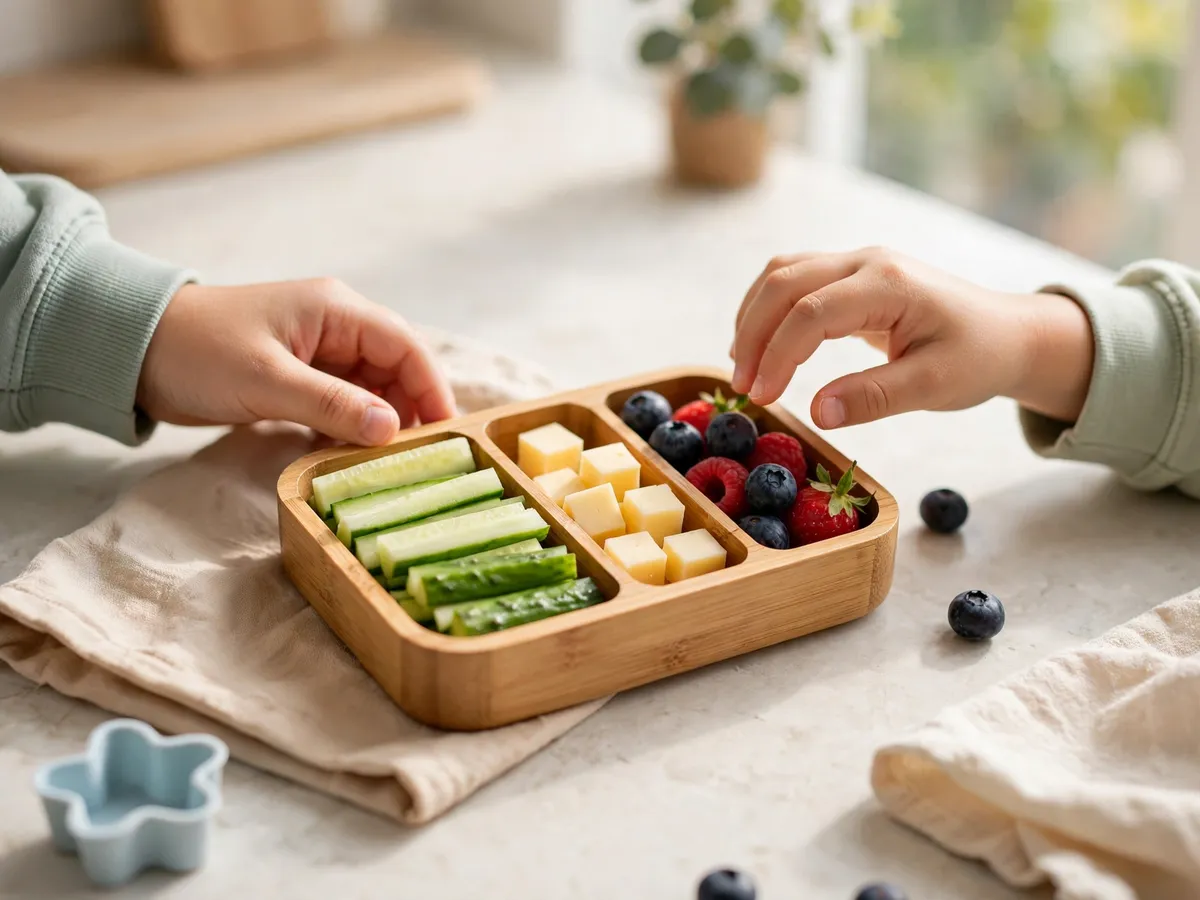
Three compartments is the sweet spot for a snack: something to hold (a cracker, a cheese cube), something wet (fruit or vegetable), and something small and familiar that always gets eaten. A fourth compartment, if the box has one, is for the dip. Foods do not touch, and an unfinished build shows which part came home empty.
Ages 2-10 · Hold, wet, familiar · Pack to two-thirds, not full.
1. Cheese, crackers and halved grapes
Mild cheese in half-inch cubes in the hold compartment, square crackers stacked beside, and grapes halved lengthwise then again in the wet corner. The build for the first week a box is out: dry, familiar, four minutes.
Hold: cheese and crackers · Wet: grapes, halved twice · Ages 2-10, under-5 grapes cut to half-inch pieces.
2. Cucumber moons and hummus
Cucumber half-moons in the wet compartment, a spoonful of hummus in the dip corner, flat crackers for scooping. The moons are a shape a small hand picks up easily, and hummus is the one dip that survives a morning in a cubby without a fridge.
Hold: crackers · Wet: cucumber moons · Dip: hummus · Ages 4-10; under-4s get cucumber sliced thin enough to squash between two fingers.
3. Apple slices and yogurt dip
Apple slices kept overnight in cold water with a squeeze of lemon, drained and packed dry, with plain yogurt in the dip corner. Skip the water step and the apple browns by noon.
Hold: apple slices · Dip: yogurt · Ages 4-10; under-4s get apple in pieces smaller than half an inch.
4. Mini muffin and berries
A savory mini muffin in the hold compartment, blueberries halved in the wet corner, a cheese cube if the box has a third spot. Bake muffins while the oven is on for something else and freeze half the batch — they pack frozen and thaw by snack time.
Hold: mini muffin · Wet: blueberries halved · Ages 2-10, under-5 berries halved lengthwise.
5. Pinwheel strips and carrot
A tortilla spread thin with cream cheese, rolled tight and sliced into one-inch rounds, packed flat on their cut sides. Carrot coins, steamed until a thumb squashes one, go in the wet corner. Nothing rolls and nothing leaks on the ride.
Hold: pinwheel rounds · Wet: soft carrot coins · Ages 4-10; carrot steamed soft for the under-4 band.
6. Hard-boiled egg and melon
A hard-boiled egg cut into small pieces in the hold compartment, melon cubes in the wet corner, a cracker or two for the familiar spot. The egg keeps with an ice pack and cut melon holds its shape — two foods that travel well in a small box.
Hold: egg pieces · Wet: melon cubes · Ages 4-10; egg cut into small pieces for the under-5 band.
7. Rice ball and edamame
Warm rice pressed firmly into a cup, tipped out, with a strip of nori stuck on as a belt. Edamame beans, popped from their pods, go in the wet corner — only the beans go in the box. The rice ball reads as a meal without being one.
Hold: rice ball · Wet: shelled edamame · Ages 4-10; edamame beans halved for the under-5 band.
8. Dried apricot and cracker stack
Dried apricot cut into small pieces in the sweet spot, square crackers stacked in the hold compartment, halved cherry tomatoes in the wet corner. The build for the day the fridge is empty: pantry-only, dry, three minutes.
Hold: crackers · Wet: tomatoes halved lengthwise · Sweet: apricot pieces · Ages 4-10; tomatoes halved for the under-5 band.
“The whole box came home full”
What sits behind it
A box that comes home full usually means one of three things: portions too big for the gap, foods too unfamiliar for the setting, or a box too hard to open. What changes is rarely the food — it is the portion, the familiarity, or the latch.
- Cut every portion by a third for a week and watch which compartment empties first.
- Swap one new food for one that already came home empty twice.
- Open and close the latch together at the table before the box goes in the bag.
Ages 2-10 · Portion, familiarity, latch · Change one at a time.
“Only the sweet part is gone”
What sits behind it
A child who eats the sweet compartment and nothing else is not refusing the box. The hand reaches for the part that reads “treat” first, and the rest has to earn its place.
- Move the sweet into the hold compartment so it shares space with the cracker or the cheese.
- Drop the sweet to a two-bite size and fill the rest with foods that already come home empty.
- Skip the sweet for a week and let fruit carry the corner: halved grapes, melon cubes, berries halved.
Ages 2-10 · Sweet shares the hold, or fruit takes the corner · One change for a week.
“The wet compartment always comes home full”
What sits behind it
The wet compartment is the fruit and vegetable corner, and it is the one that comes home full most often. The reason is usually the cut: a cucumber stick too long for a small mouth, a grape too round to hold, a carrot coin too hard to chew in the time a snack gap allows.
- Cut fruit and vegetables into pieces smaller than half an inch, the size a small hand holds in one go.
- Steam the carrot or sweet potato coin until a thumb squashes one — soft is the shape that gets eaten.
- Swap the wet food for one that already came home empty: halved grapes and melon cubes travel well.
Ages 2-10 · Cut smaller, steam softer, swap once · Round foods halved lengthwise, every time.
Where this page sits
Two pages cover the bento box from other angles. The bento lunches for preschoolers page runs seven full-lunch builds for ages 3-5, and the lunchbox lunches page carries ten packable ideas for the 4-10 band. This one is the snack box.
Save this for the next box wash
Pin the two builds that match your fridge shelf, then run them on alternate days — the Kids Meals & Lunchbox Ideas collection holds the lunch and dinner builds.