 KidNestClub
Learning Activities & Printables
Truck Colouring Pages Ages 4-8 | 12 Bold Free Printables
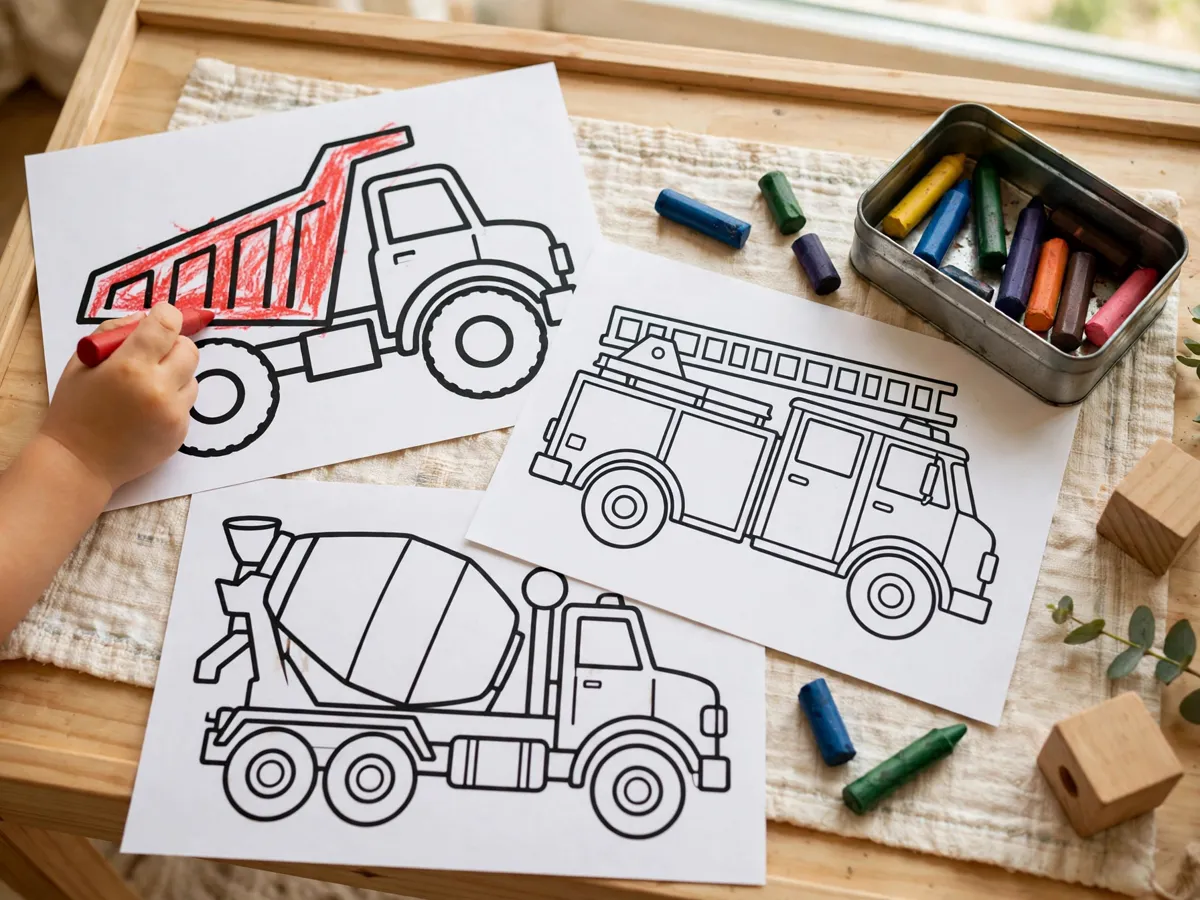
Twelve trucks across two printable sheets, drawn the way a young child names them from the sidewalk: a boxy cab, one clear bed or tank, two big wheels, and big open panels a crayon can reach. Sheet one holds the everyday set — dump truck, fire truck, pickup, cement mixer, tow truck and a delivery truck. Sheet two holds the work shapes — garbage truck, flatbed, box truck, monster truck, an excavator and a construction-site scene. One sheet a sitting works well for most children in this band: cab first, wheels last.
By KidNestClub · Updated 19 November 2026
12 pictures · 2 sheets · Ages 4-8 · Bold outlines for chunky crayons · US Letter and A4.
Download the truck set, US Letter and A4
Both sheets as one ready-to-print file, twelve trucks in total. Print on plain or matte paper, portrait, at one hundred per cent, one sheet a sitting — and keep an adult, close enough to act, in the room while the crayon box is out.
Download the truck set (US Letter) · A4 · 12 pictures on 2 sheets
Sheet one: six trucks your child already knows by name
The first sheet keeps every truck side-on and standing on a ground line, so the shape names itself the moment the page is laid on the table. A colour hint for each one keeps the conversation going while the crayons move:
- Dump truck — a tall open bed tipped slightly up behind a square cab, drawn loaded with a mound. The bed is the biggest colour area on the page, and a yellow or orange body with a grey load makes it read as the real thing at a glance.
- Fire truck — a long body with a ladder laid along the top and a hose reel at the side. Red across the panels, a stripe of yellow along the bottom and silver-grey on the ladder, and this one looks finished before it is.
- Pickup truck — a small cab and one flat open bed behind it, the simplest shape on the sheet. Any two colours work, and the empty bed is a good place for the colourer to decide what the truck is carrying.
- Cement mixer — the tilted barrel with its spiral band, sitting behind the cab on a low chassis. The drum is one large curved area, and a light grey or white body with a coloured stripe around the barrel suits it.
- Tow truck — a cab with a hooked boom arm angled up at the back, drawn ready to lift. The boom and hook are the interesting lines here, and they take a strong colour against a plainer body.
- Delivery truck — a boxy cargo body with a roll-up door on the side and a compact cab at the front. The big flat panel is the widest open space on sheet one, and one even pass of colour covers most of the page.
Ages 4-8 · Side-on trucks, named at a glance · One sheet a sitting.
Sheet two: the work vehicles and one big scene
The second sheet trades the street set for the machines a child spots behind a fence — the ones with arms, buckets and heaps. These outlines carry more going on inside them, which is what the age 7-8 end of the band tends to reach for first:
- Garbage truck — a high-sided body with a loading jaw at the back, drawn with a bin tipped toward it. The body is one wide panel and the jaw is the detail worth saving for last; green or white with a coloured trim works.
- Flatbed truck — a long open deck with no sides at all, standing on three axles. Because the deck is empty, it is the page on this set that invites something to be drawn on it afterwards.
- Box truck — the tallest cargo body of the set, a single rectangle on a chassis with the cab tucked under the front. Almost the whole page is one colour area, which suits the youngest colourers on the band.
- Monster truck — a small body sitting on four enormous wheels, drawn with the suspension raised. The tyres are huge open circles and take a lot of crayon, so this is the fastest page to fill on sheet two.
- Excavator — a cab on a tracked base with a jointed arm and a bucket reaching around it. The arm breaks into three separate shapes, good for the colourer who likes to work one section at a time.
- Construction scene — the busiest page of the set, several machines together with a heap of earth and a cone. It is the page on this sheet that fills a whole sitting in itself, and the ground and heap take greys while the machines take the bold colours.
Ages 4-8 · The construction scene is a full sitting in itself · Six work vehicles.
One sheet a sitting, cab first, wheels last
The trucks are drawn to be worked in a rough order that matches how children naturally hold a crayon: the cab first, while interest is highest, then the bed, drum or cargo box, and finally the wheels, mirrors and the ground line under the truck. Keeping the truck body the biggest colour area on the page is what the order is for. For ages 4-5, the goal is one good pass of colour across the cab and the bed, and the rest of the page is a bonus. Ages 6-7 can usually stay inside most of the wide outline and start matching two colours to one truck. Ages 8 fill the wheels, the windows and the small fittings and often want to add their own background: road, cones, a second truck, a heap of dirt.
Twelve trucks spread over a fortnight at one sheet a sitting. The sheets repeat well — print the dump truck three times and let three different colour plans happen, or print the construction scene again next month and watch the machines get more planned out.
Ages 4-8 · Cab first, bed next, wheels last · Sheets repeat well.
Chunky crayons, short pencils and what suits each age
Every outline in this set is drawn with a bold, even line, and the colourable areas are shaped wide, so a chunky crayon completes the job without needing a sharp point. That is the reason the pack skews simple: a four-year-old with a fat crayon and an eight-year-old with a thin-tipped felt pen can both finish the same page of the same truck and come away with a picture they like. Short crayons — the broken ones — are easier for small hands than long ones, and they will not snap under pressure the way the long ones do.
For the younger end, offer two or three crayons rather than the whole box, and let the choice be theirs. For the older end, lay the box out and step back — truck colours are up to the colourer, and a purple cement mixer is a perfectly good purple cement mixer. Either way, print on plain printer paper or matte card, and have a second sheet of paper under the page if the markers leak through.
Ages 4-8 · Bold lines suit chunky crayons · Two or three crayons on the table for the youngest colourers.
What to do with the finished pages
Finished truck sheets are useful in their plain form: taped up on the fridge, folded in half around a homemade card, or clipped into a folder for rainy days. The pickup and the delivery truck make good cards for grandparents. The construction scene tends to earn a frame.
For the older end of the band, a finished sheet also becomes something to play with at the kitchen table: cut the trucks out along their outlines and line them up on the rug as a convoy, or let one truck stand in the middle of a home-made card with a border drawn around it. Nothing fancy is needed — the pages simply give the sitting a shape to end on.
Ages 4-8 · Fridge, card, folder, frame · Cut a few out for a convoy on the rug.
Safety, every colouring day
For anything with a hazard in it — scissors, heat, water, small parts — the same rule applies: an adult, close enough to act. The colouring itself is a crayon-and-paper activity, so the hazards to watch are around it: crayons snapped in half end up in mouths with the youngest colourers, so check the table when the sitting ends, and keep the crayon box off the floor. If cutting the trucks out brings scissors to the table, the adult stays at the table while they are out and puts them away high afterwards.
Save this for the next rainy day
Pin the sheet your child will pick first, and come back to it when the crayons come out. The Learning Activities & Printables collection also holds the car printable coloring pages for the smaller vehicles that share the road with these trucks, and the train colouring pages if the next thing your colourer reaches for is the long one.