 KidNestClub
Learning Activities & Printables
Owl Colouring Pages: 12 Bold Printables for Ages 4-8
Twelve owls across two printable sheets, every one drawn with the round head and forward-facing eyes that make an owl an owl at a glance. Sheet one holds six you can name — a barn owl, a snowy owl, an owlet in down. Sheet two holds six owls doing owl things — asleep, preening, clutching an acorn, in a tree hollow. One sheet a sitting: body first, background last.
By KidNestClub · Updated 19 November 2026
12 pictures · 2 sheets · Ages 4-8 · Bold outlines for chunky crayons · US Letter and A4.
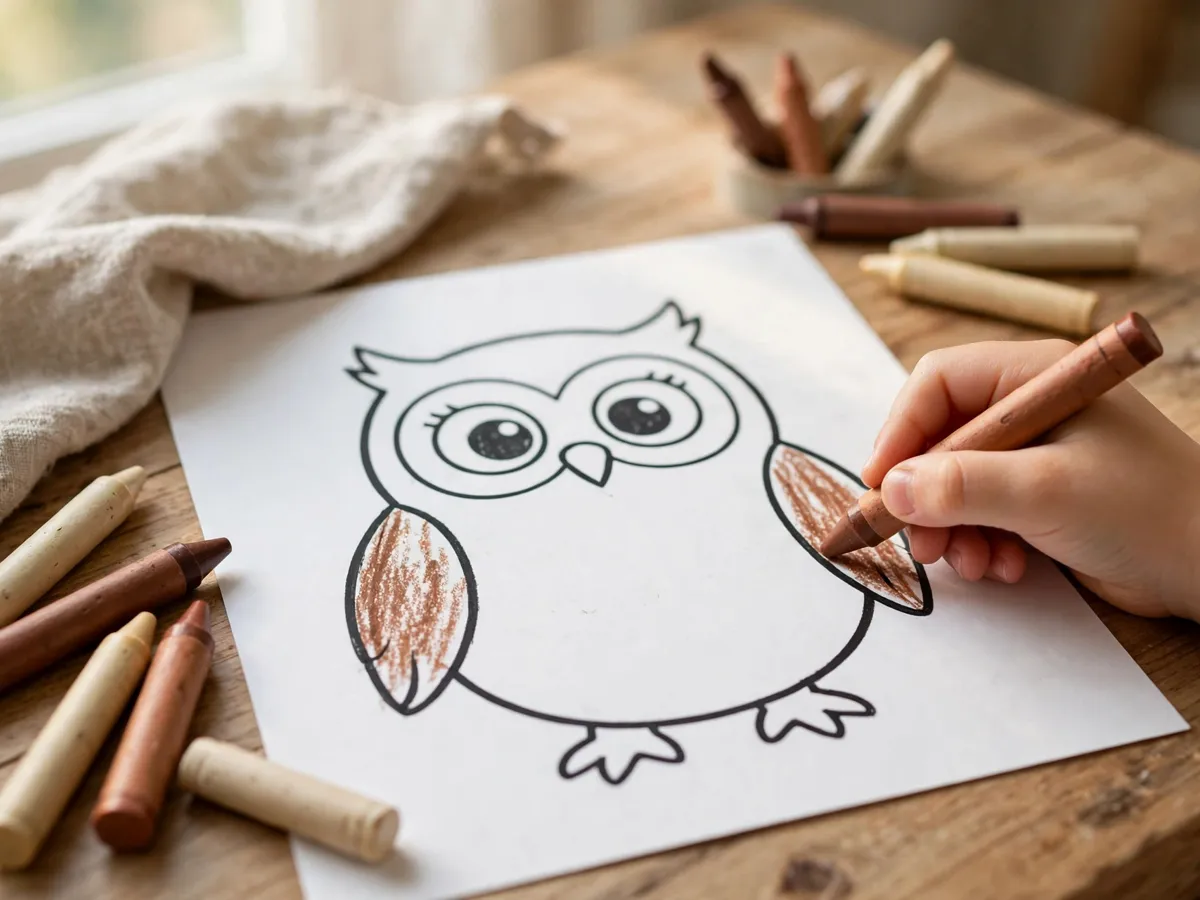
Download the owl set, US Letter and A4
Both sheets as one ready-to-print file, twelve owls in total. Print on plain or matte paper, portrait, at full size — and keep an adult, close enough to act, in the room while the crayon box is out.
Download the owl set (US Letter) · A4 · 12 pictures on 2 sheets
Sheet one: six owls you can name
The first sheet keeps every owl upright and round, so the shape reads at a glance. A colour hint for each:
- Barn owl with a heart-shaped face — pale gold across the wings, a white heart round the face, small dark eyes.
- Snowy owl with wing markings — white nearly everywhere, with dark bars drawn across the wings. Yellow eyes finish the page.
- Owl perched on a bare branch — upright, talons wrapped round the wood. Brown on the back, paler on the chest.
- Owl in mid-flight with both wings spread — the widest wings on the sheet. Darker on the flight feathers, lighter underneath.
- Owl turning its head nearly upside down — the head-tilt owls are famous for. Keep the face pale and let the eyes carry the page.
- Owlet in fluffy down — the roundest bird here, drawn as soft fluff. One warm grey or buff does the whole body.
Sheet two: asleep, preening, an acorn and a hollow
The second sheet gives each owl something to do, which is where the age 7-8 end reaches first:
- Owl asleep with eyes closed — the calmest page on the sheet. One colour across the body and the page is done.
- Owl preening one wing — head turned back towards the raised wing. Two browns: one for the body, one for the feathers.
- Owl clutching an acorn — talons closed round an acorn with a dark cap. Brown bird, darker cap.
- Owl in a tree hollow — a pale face framed by a dark opening. Dark ring first, then the face inside it.
- Two owls on a fence post — a pair page. Give each owl its own shade so the two birds read apart.
- Owl standing beside its chick — the tall adult next to a small fluffy chick. One colour family, two sizes.
What makes an owl an owl
Every owl here shares the same three giveaways: forward-facing eyes inside a round disc of feathers, a short hooked beak, and feet. Barn owls wear the disc as a pale heart; snowy owls carry white feathers with dark bars; the owlet has only fluff. Owls rest by day and fly after dark, so most of these twelve are perched.
Body first, face disc next, eyes last
Before the crayons come out, lay both sheets on the table and walk the twelve names once — which owl is white, which has the heart-shaped face, which is the baby. Then body first, face disc next, eyes and branch last. Ages 4-5 finish with one pass across the body. Ages 6-7 put two colours on one owl. Ages 8 take the snowy owl and the mid-flight page, where the wing markings ask for a steady hand. Print the barn owl twice and let two plans happen.
Chunky crayons suit the bold lines
Every outline here is drawn bold and the colourable areas are wide, so a chunky crayon finishes the job without a sharp point. Short crayons — the broken ones — are easier to hold and do not snap under pressure. For the younger end, put two or three crayons on the table rather than the whole box. The snowy owl and the barn owl are the two-tone pages: one colour on the body, the darker shade on the wings and the face.
What to do with the finished pages
Finished owl sheets work taped on the fridge, folded round a card, or clipped into a folder. The fence-post pair makes a good card for grandparents; the tree-hollow owl tends to earn a frame. Cut the owls out and perch them along a bookshelf.
Safety, every colouring day
For anything with a hazard in it — scissors, heat, water, small parts — the same rule applies: an adult, close enough to act. Colouring is a crayon-and-paper activity, so the hazards sit around it: crayons snapped in half end up in mouths with the youngest colourers, so check the table when the sitting ends and keep the box off the floor. If a card-making step brings scissors to the table, the adult stays while they are out and puts them away high afterwards.
Save this for the next rainy day
Pin the sheet your child will pick first, and come back to it when the crayons come out. The Learning Activities & Printables collection also holds the jungle animal colouring pages for the rest of the animal set, and the bear colouring pages for the animals next door.