 KidNestClub
Easy Kids Crafts
Needlepoint Christmas Stocking for Kids | 7 Safe Starter Projects
Seven stocking projects a child can actually stitch — none of them needs a sharp needle. The young bands weave thick yarn through plastic canvas with fingers and a blunt tapestry needle; the older bands lace felt, applique a cuff and work pre-punched canvas shapes. Every project lists its needle type, its age band and the supervision note that goes with it. Ages 3-12, one project each.
By KidNestClub · Updated 17 November 2026
Total scope: 7 projects · Ages 3-12 · plastic canvas, felt, thick yarn, blunt tapestry needles · 30-60 minutes each.
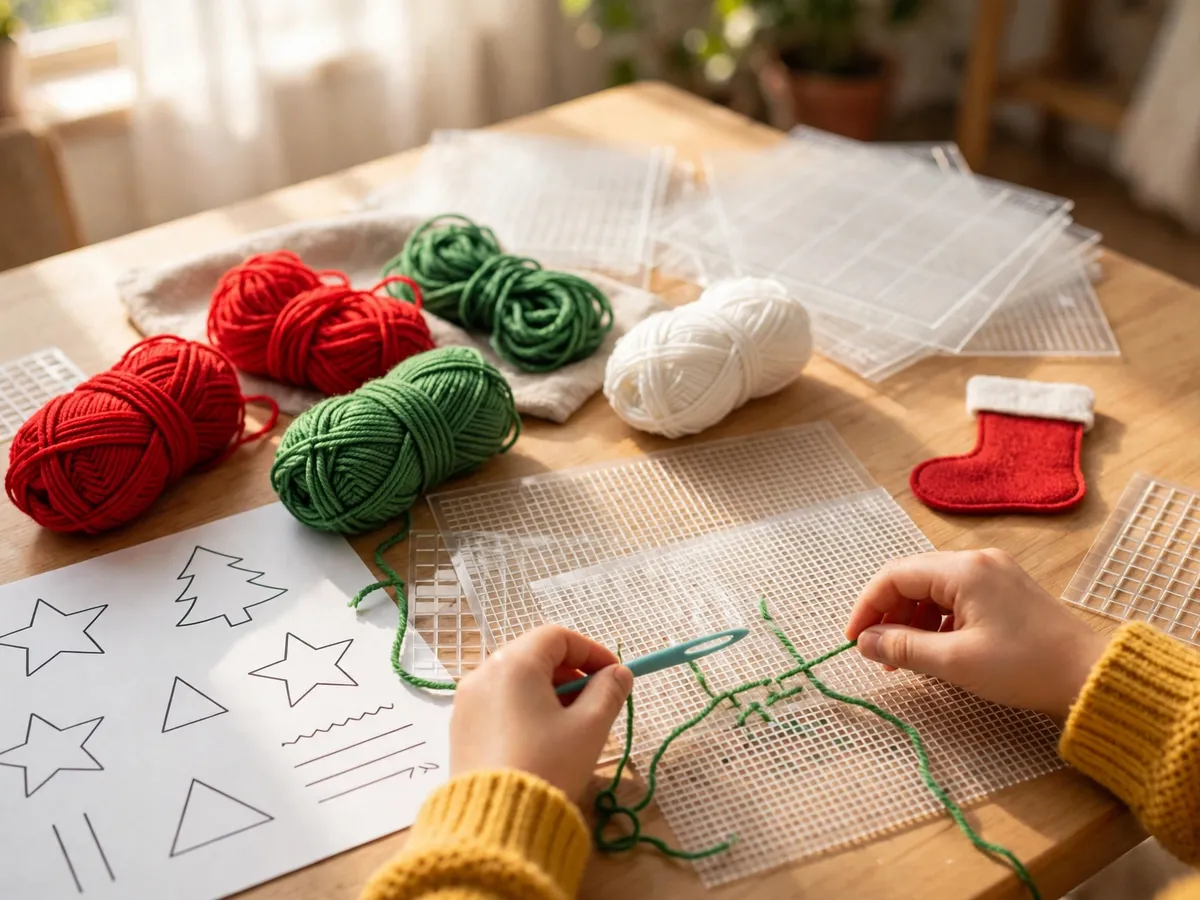
The needle rules, before any project starts
Blunt tapestry needles only — a rounded tip pushes between the canvas holes instead of through skin, and a large eye holds thick yarn without a threader. Plastic canvas is the base for every project under 9: rigid, hole-punched, and it holds its shape so the stitching is visible from both sides. Real sharps — crewel needles, sewing-machine work, anything that pierces fabric without a pre-punched hole — stay adult-only in every project below. For anything with a hazard in it — scissors, heat, water, small parts — the same rule applies: an adult, close enough to act.
Ages 3-12 · Blunt tips, big eyes, plastic canvas · Sharps are an adult tool.
Ages 3-5: yarn weaving on plastic canvas
The youngest band does not stitch at all — they weave. Cut a stocking shape from plastic canvas before the session, then hand over a length of chunky yarn with a stiffened end (a wrap of clear tape works as a makeshift tip). The child pushes the yarn over one hole, under the next, across the row. There is no needle in hand for the first passes; the tape tip is enough. When the weaving covers the front, an adult trims the ends and a ribbon loop turns it into a hanging stocking.
Ages 3-5 · Fingers first, tape tip · An adult at the table the whole time — cut canvas edges and yarn ends are small parts.
Ages 6-8: lacing and the first blunt needle
Two projects sit here. The felt stocking with punched holes: a pre-punched felt blank, a blunt tapestry needle threaded with perle cotton, and a running stitch around the edge — the holes are already there, so the needle only ever finds a hole. The button-hole lacing cuff: a felt cuff strip with a row of slots, laced with ribbon the same way a shoe laces. Both use the same blunt needle from the rules section, and both finish in one sitting.
Ages 6-8 · Running stitch in pre-punched holes · The needle stays tied to the yarn, an adult in the room.
Ages 9-12: real stitches, still a blunt needle
Three projects open here. The counted canvas stocking: a small plastic-canvas blank and the half-cross stitch, worked row by row with the same blunt tapestry needle — plastic canvas is forgiving, so a missed hole shows immediately. The felt-applique cuff: cut felt shapes, whip-stitch them to a cuff with the blunt needle. The name band: letters worked in cross stitch on waste canvas, then the band stitches onto the stocking. Any project that wants a sharp needle or a sewing machine is an adult step, marked as one.
Ages 9-12 · Half-cross, whip stitch, cross stitch · Sharps and machine steps stay with an adult.
The seventh project: a family stocking, banded
The last project spans the ages: one large plastic-canvas stocking front, and each child works one band of it. The 3-5 band weaves their band with the tape-tip yarn, the 6-8 band laces a pre-punched ribbon band, the 9-12 band stitches a cross-stitch row. An adult assembles the front, the backing and the hanger. It takes two sittings and it hangs on the mantel with every band signed in stitched initials.
Ages 3-12 · One stocking, three bands · Assembly is an adult step.
Setting the table so it goes smoothly
Pre-cut every canvas and felt blank before the session — scissors work belongs to the adult at these ages, and a child who starts with shapes in hand starts stitching in the first minute. Cut yarn lengths in advance and knot one end; a knotted end holds the first stitch without a lesson. Keep a small tray for needles between passes: a blunt needle on the tablecloth is a needle under the sofa cushion ten minutes later. When you choose supplies, the small-parts warning on the packaging matters most under 3, and it stays relevant for the younger end of every playdate — keep the tray out of reach of younger siblings.
Ages 3-12 · Pre-cut, pre-knotted · Needle tray, not tablecloth.
Safety, every stitching session
For anything with a hazard in it — scissors, heat, water, small parts — the same rule applies: an adult, close enough to act. Anything that fits fully inside a small-parts cylinder — about the size of a child's throat under 3 — is a choking hazard, so keep coins, beads, buttons and pins off the table when a child under 3 is in the room. This guide's hazards are the scissors that cut the yarn and the felt, the needles (blunt only, and sharps are adult-only), and the small parts — buttons, beads, yarn ends and canvas offcuts. An adult stays at the table for every project, the needle tray gets a count at the end of each sitting, and the sharps live in the adult sewing kit, never on the craft table.
Save this for the December craft box
Pin the project band your child starts with, then come back when the yarn basket is out — the Easy Kids Crafts collection holds the Christmas ball ornaments and the printable crafts pack for the quieter afternoons between stitching sessions.