 KidNestClub
Learning Activities & Printables
Giraffe Colouring Pages: 12 Bold Printables for Ages 4-8
Twelve giraffes across two printable sheets, every one drawn long-necked so the shape reads at a glance before the patches go on. Sheet one holds six you can name right away, from one standing tall to a reticulated with its patch pattern drawn in; sheet two holds six with a necking pair, a tree or a foal around them. One sheet a sitting: body first, patches and background last.
By KidNestClub · Updated 19 November 2026
12 pictures · 2 sheets · Ages 4-8 · Bold outlines for chunky crayons · US Letter and A4.
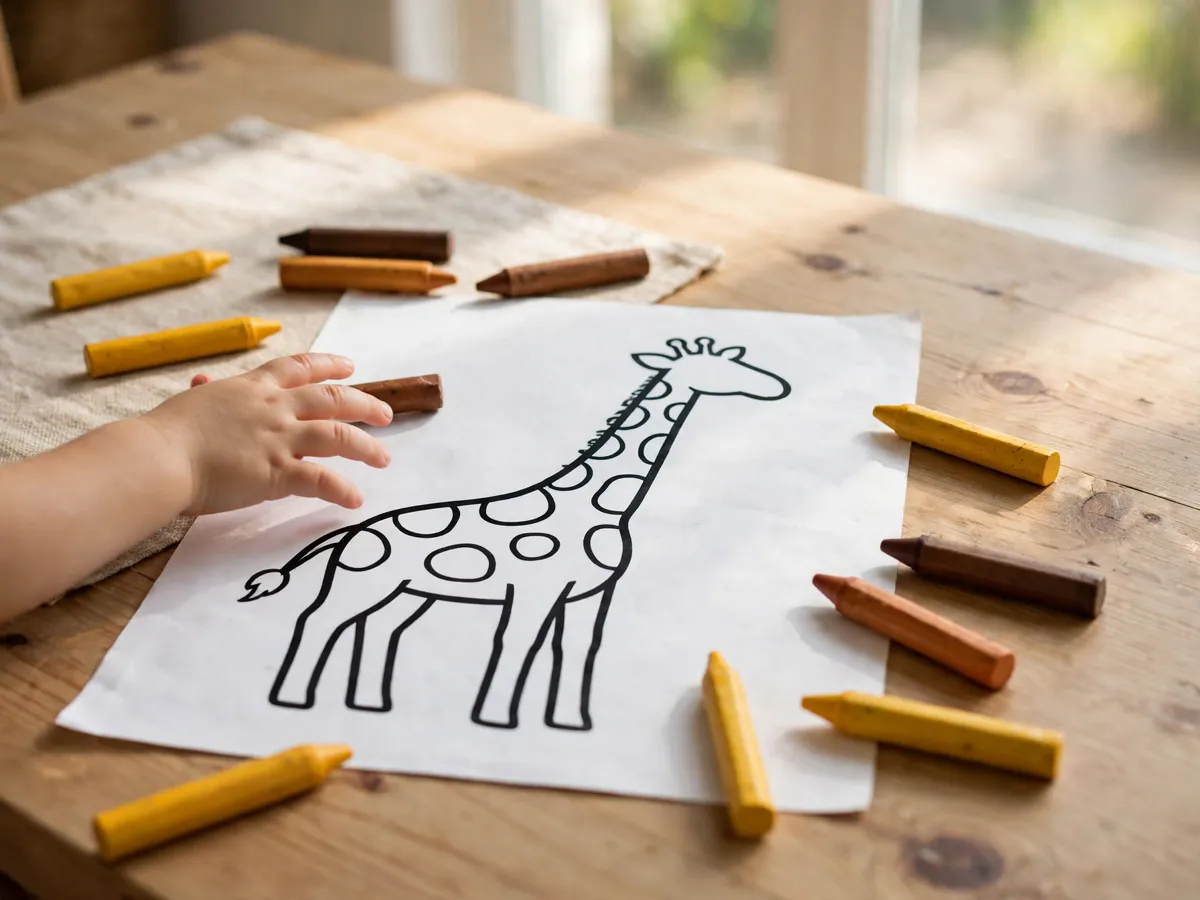
Download the giraffe set, US Letter and A4
Both sheets as one ready-to-print file, twelve giraffes in total. Print on plain or matte paper, portrait, at 100 per cent — and keep an adult, close enough to act, in the room while the crayon box is out.
Download the giraffe set (US Letter) · A4 · 12 pictures on 2 sheets
Sheet one: six giraffes, from standing tall to sitting down
The first sheet sorts the giraffes by posture, and the patches are drawn in only where the drawing calls for them. A hint for each:
- Giraffe standing tall — the full height on one page, legs straight and neck up. Orange-brown on the body, the lines between patches left pale.
- Giraffe bending to drink — front legs splayed and the neck dropped to a water line. The neck becomes one long band, so a single pass covers most of it.
- Baby giraffe — short-legged with a head big for its body. Soft cream and light tan, no dark mane.
- Reticulated giraffe with patch pattern — the squares drawn edge to edge, the busiest sheet-one page. Bright orange inside each square, cream in the net between them.
- Close-up muzzle and tongue — the head fills the page, tongue curled out. Grey on the muzzle, pink on the tongue.
- Giraffe sitting with legs folded — knees tucked under and the neck still upright. The folded legs make the largest pale area on the sheet.
Sheet two: the necking pair, the acacia and the waterhole
The second sheet puts something around the giraffe — a partner, a tree, a foal, a pool — which is what the age 7-8 end reaches for first:
- Two giraffes necking — two necks crossing in the middle. Give each giraffe its own shade and the crossing stays readable.
- Giraffe walking — legs caught mid-stride, tail out behind. Near legs one colour, far legs a darker shade so the stride shows.
- Giraffe under an acacia tree — a flat-topped canopy drawn over the back. Green in the canopy, warm tan on the animal.
- Foal beside its mother — the height difference is the whole drawing. Match the coats and lighten the foal.
- Head-on giraffe — facing the reader, both ossicones and the wide muzzle showing. The face is the colour area here.
- Giraffe at the waterhole — standing in a drawn pool with a reflection line under it. Blue on the water and a spare sheet below.
Body first, neck next, patches and background last
Before the crayons come out, lay both sheets on the table and walk the twelve names once — which giraffe is bending, which one is sitting down, which page has two of them. Then body first, neck and head next, legs, patches and background last. For ages 4-5, one pass across the body and neck is the page done. Ages 6-7 put two colours on one giraffe. Ages 8 fill the patch squares one at a time and add the tree or water line. Print the reticulated three times and let three patch plans happen.
Chunky crayons suit the bold lines
Every outline here is drawn with a bold, even line and the colour areas are long and wide, so a chunky crayon finishes the page without a sharp point. Short crayons — the broken ones — are easier to hold and do not snap under pressure. Put two or three crayons on the table for the younger end. The neck is the longest single shape on the sheet, and three short passes beat one drag from the head. Print on plain or matte paper with a spare sheet below.
What to do with the finished pages
Finished giraffe sheets work taped on the fridge in a row so the necks line up, folded around a card, or clipped into a folder. The baby giraffe makes a good card for grandparents; the reticulated one tends to earn a frame. At the older end, cut the giraffes out and stand them along a shelf, tallest first.
Safety, every colouring day
For anything with a hazard in it — scissors, heat, water, small parts — the same rule applies: an adult, close enough to act. Colouring is a crayon-and-paper activity, so the hazards sit around it: crayons snapped in half end up in mouths with the youngest colourers, so check the table when the sitting ends and keep the box off the floor. If cutting the giraffes out brings scissors to the table, the adult stays while they are out and puts them away high afterwards.
Save this for the next rainy day
Pin the sheet your child will pick first, and come back to it when the crayons come out. The Learning Activities & Printables collection also holds the lion colouring pages for the animals that share the same grass, and the horse colouring pages for another long-legged set to lay beside this one.