 KidNestClub
Learning Activities & Printables
Fish Colouring Pages | 12 Free Printables Ages 3-8
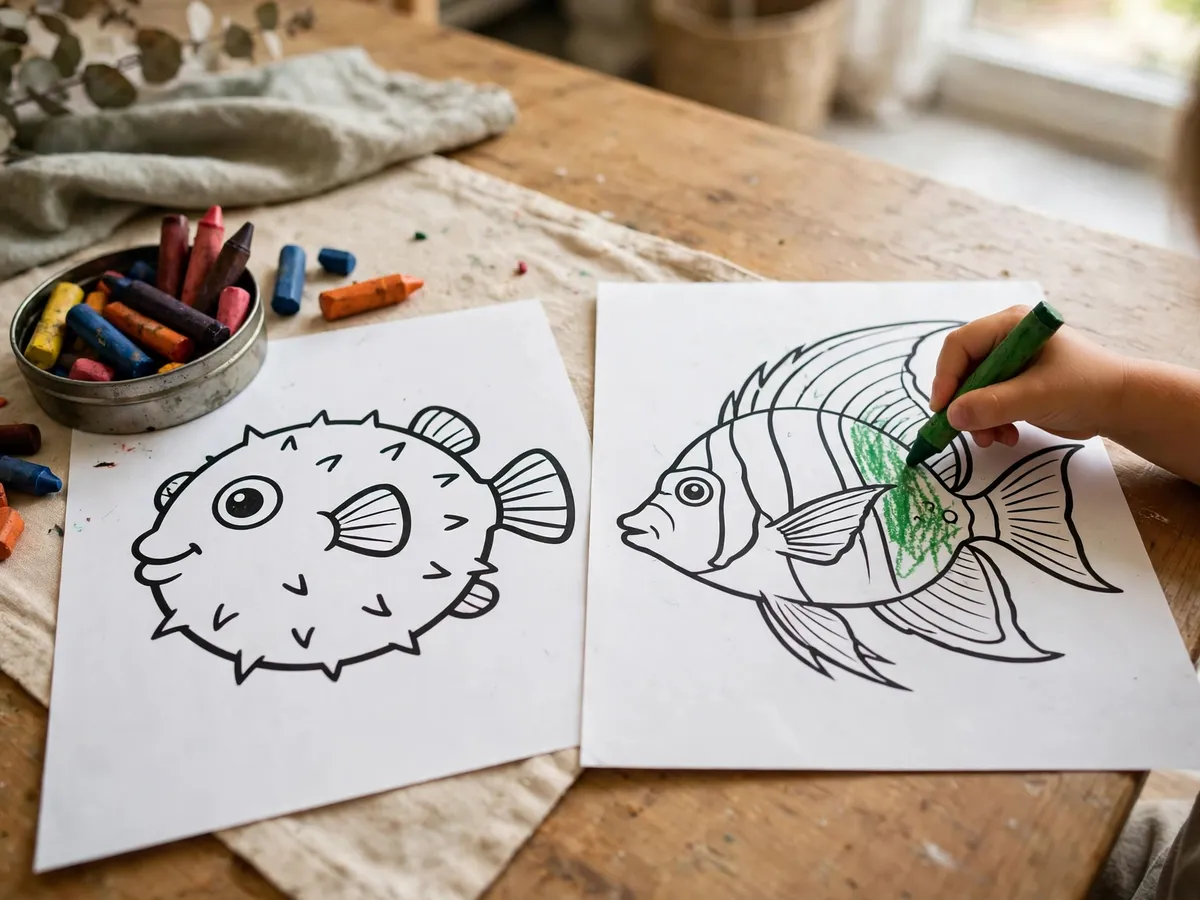
Twelve fish across two printable sheets, drawn with round bodies and fins wide enough for a crayon to turn around in. Sheet one holds the recognisable set — a goldfish, an angelfish, a clownfish, a pufferfish, a catfish and a shark. Sheet two holds the flowing set — a swordfish, a flat flounder, a betta, a guppy, a striped discus and a little reef scene to finish. The routine printed right on the sheet: body first, stripes next, fins last. One sheet a sitting.
By KidNestClub · Updated 18 November 2026
12 fish · 2 sheets · Ages 3-8 · Bold outlines, wide fins · US Letter and A4.
Download the fish set, US Letter and A4
Both sheets as one ready-to-print file, twelve fish in total. Print on plain or matte paper, portrait, one sheet a sitting — and keep an adult, close enough to act, in the room while the crayon box is out.
Download the fish set (US Letter) · A4 · 12 fish on 2 sheets
Sheet one: six fish with a shape that names itself
The first sheet keeps to the fish a child meets in storybooks and garden ponds, each drawn round-bodied with the tail and fins as broad, open shapes. A colour hint per fish keeps the talk going while the crayons move:
- Round goldfish — the classic round body, a wide fan tail and three bubbles rising. Orange with a touch of white in the tail is the usual plan, and the bubbles take blue if your colourer wants the water drawn in.
- Angelfish, tall fins — tall sloping fins above and below a small round body, the most dramatic outline on the sheet. The big fins are separate crayon-shaped areas: two colours, one per fin, and the body takes a third.
- Clownfish stripes — three white stripe bands drawn wide across an oval body. Orange body with white stripes left uncoloured is the well-known look, and each stripe band is big enough to stay in for young hands.
- Pufferfish, all spines — a full circle body with small spines fanned out in every direction. A paler fill with the spines picked out in a second colour makes the round shape pop; some children colour every spine gold.
- Catfish, whiskers out — a long, flat bottom-hugging body with whiskers forward and feelers back. Greys and browns fit, and this is the sheet’s good pick for a child who likes the unusual fish.
- Shark with the fin up — the tall dorsal fin makes this one recognisable before a single crayon lands. Grey body, white belly, a thin line of teeth — usually the first page picked by the age 6-8 end of the band.
Ages 3-8 · Round bodies, broad fins · Recognisable before the first crayon lands.
Sheet two: long, flat and flowing — the betta is the sitting
The second sheet pushes the shapes further: a sword nose, a flat sand-sitter, fins that trail like ribbons. These pages suit the colourers who want more going on:
- Swordfish, nose first — a long flat body with the sword pointed straight ahead, drawn cutting through the water. Blue and grey with a pale belly reads well, and the pointed nose is one long, satisfying stroke of crayon.
- Flounder on the sand — the widest body on the whole set, drawn flat on the sea floor with the spots circular and open. Brown or sand-grey with the spots in a contrasting colour, and the sand strip takes a soft yellow.
- Betta, fins flowing — the showpiece of the set, with four broad trailing fins drawn like ribbons streaming off a small round body. One colour per fin — red, purple, blue, teal — and the tail alone fills a whole sitting. This is the fish version of the peacock page: save it for the day there is time to spare.
- Guppy and the bubbles — a small fish with a cheeky face and bubbles rising on every side. Any bright combination is fair game; the bubbles take blue or left white.
- Striped discus, side view — a round, dinner-plate body with four wide vertical stripes. Two crayons alternate down the stripes and the page organises itself.
- Little reef scene — two small fish, a swaying weed line and a couple of bubbles: the only page with a backdrop built in. Green weed, one fish bright and one pale, and let the background come last.
Ages 3-8 · The betta tail fills a sitting · Six flowing shapes.
Body first, stripes next, fins last
The sheets print that order right under the heading because it is the way the shapes are built: the round body carries the biggest area, the stripe bands or spots come inside it, and the fins and tail sit at the edges where a change of direction is needed. A child who starts at the body always has the big shape to show for the session, even if the fins stay white. For the 3-4 end of the band, colouring one whole body inside the lines is the win; the fins get a single scribble and that is a finished page. Ages 5-6 tend to plan two or three colours per fish. Ages 7-8 work fin by fin and often add water lines, weeds or a second fish of their own drawing.
Twelve fish at one sheet a sitting stretches the set across two weeks. The pages repeat well — a second printing of the clownfish with a different stripe scheme, or the reef scene again with new colours on every weed.
Ages 3-8 · Big shape first, edges last · Sheets repeat well.
Crayons, felt pens and the paper that suits this set
Every outline in this set is drawn with a bold, even line, and the colourable areas are shaped wide, so a chunky crayon finishes a fish without needing a sharp point. Felt pens run close to the lines more cleanly for the older end, but they show through thin paper, so if markers are the pick, put a second sheet underneath or print on light card. Colouring pencils suit the age 7-8 fish with stripe bands and spot patterns, where a sharper point earns its keep.
For under-5s, put two or three crayons on the table rather than the whole box, and let the fish be whatever colour they choose — a green shark is a loved shark. Everyone works at a table or bench with the paper flat, so the wrist rests while it moves.
Ages 3-8 · Bold lines, wide areas · Two or three crayons out for the youngest colourers.
What to do with the finished pages
A finished fish has more lives than the fridge door. The aquarium trick is the favourite: tape the sheets up along a window or a hallway wall in a row at child height, and the row becomes a walking gallery. The reef scene sets the scene, and the rest of the fish swim in around it.
Flat fish cut around their outlines from card versions become puppets on a craft stick, bath-time decorating (well away from the water itself), or a mobile hung with string from a coat hanger. The flounder, cut in half and reassembled mis-matched, makes a puzzle worth a laugh — and a second printing of the same sheet makes the pieces fair for two children.
Ages 3-8 · Window aquarium, stick puppets, coat-hanger mobile · Cut the card ones out.
Safety, every colouring day
For anything with a hazard in it — scissors, heat, water, small parts — the same rule applies: an adult, close enough to act. The colouring itself is a crayon-and-paper activity, so the hazards to watch sit around it: short crayon ends travel toward mouths with the youngest colourers, so check the tray when the sitting ends, and if the card-cutting step brings scissors to the table, the adult stays at the bench and puts them away high afterwards. Bath-time decorating stays on the dry side of the bathroom door — paper and water do not mix, and no child is in the bath with the fish puppets.
Save this for the next rainy day
Pin the sheet your child will dive into first, and come back when the crayons are out. The Learning Activities & Printables collection also holds the animal colouring sheets for land favourites beyond the water, and the butterfly colouring pictures if wide, patterned wings are the next thing your colourer reaches for.