 KidNestClub
Learning Activities & Printables
Cursive Letter Tracing Sheets | 8 Free Printable Pages Ages 6-9
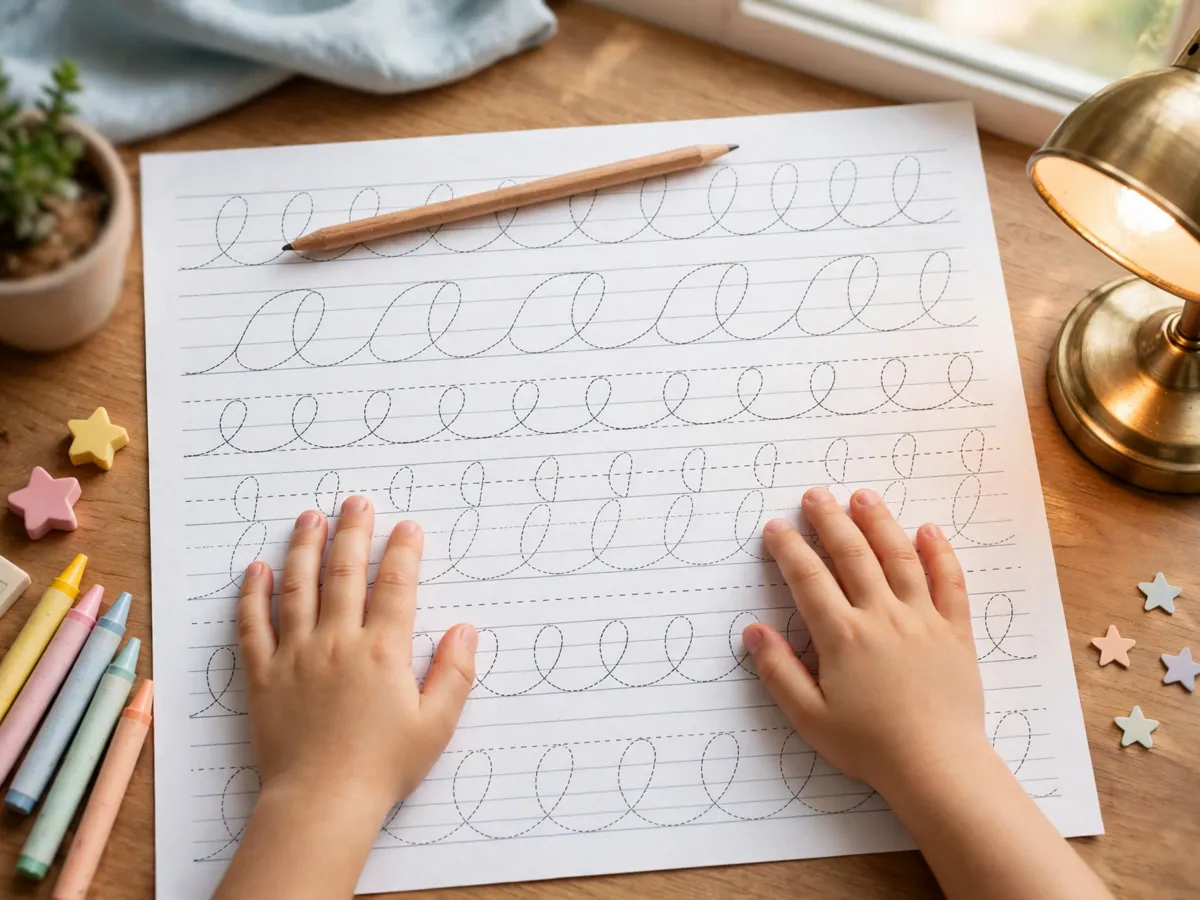
Eight free cursive tracing sheets for ages 6-9: the six lowercase entry strokes first — a, c, d, g, o, s — then two joined pairs, then a blank name line for the child’s own name in cursive. Every stroke carries a start dot and a direction arrow, so the pencil always knows where to land and which way to go.
By KidNestClub · Updated 17 November 2026
Total scope: 8 pages · Ages 6-9 · one stroke a day, ten minutes a sitting · pencil, not crayon · US Letter and A4.
Download the set: 8 pages, US Letter and A4
The whole set as one ready-to-print file. Print on plain or matte paper, portrait, one stroke a day — and keep an adult, close enough to act, in the room while the pencils are out.
Download the set (US Letter) · A4 · 8 pages
Why the stroke comes before the alphabet
Cursive is six curves wearing different clothes. The a, the c, the d and the g all begin with the same round shape; the o is that shape closed. A child who has traced those six shapes meets the rest of the lowercase as new combinations — which is why page 1 holds the six of them.
Ages 6-9 · Six strokes first · One a day, then combine.
What is on the pages
Page 1 carries the six entry strokes — a, c, d, g, o, s — each as a bold hollow outline with a pink start dot and a direction arrow. Page 2 joins them: the pair a-o and the pair o-s, with a blank name line underneath. The downloaded set runs the same pattern across eight pages.
Ages 6-9 · Trace, then join, then name · One page a sitting.
The name line is the finish line
Everything on these pages points at one blank ruled line: the child’s own name, signed in cursive. It is the signature they will use on birthday cards, on library cards, on the first envelope they address themselves. Write it once in faint pencil at the far left of the line so the first letter is there to copy, then let the rest of the line be theirs. Ages 6-9 usually sign the name line twice — once wobbly on the day the joins click together, and once again a week later, steadier. The second copy is the one that goes on the fridge.
Ages 6-9 · One name line · One copy today, one copy next week.
Pencil, paper, and the hand
A sharpened pencil beats a crayon at this age — cursive joins live in thin lines, and a crayon is too blunt to show them. Rest the page flat on the table, not propped, and sit beside your child so the writing hand and the page face the same way. Tilt the paper a little to the right for a right-handed writer and to the left for a left-handed one; the tilt is what keeps the wrist relaxed through a whole line of joins.
Ages 6-9 · Sharpened pencil, flat page · Tilt the paper, not the wrist.
Safety, every tracing day
For anything with a hazard in it — scissors, heat, water, small parts — the same rule applies: an adult, close enough to act. The pencil-sharpening step is the one hazard on a tracing day, so the sharpener runs with an adult at the table and the pencil goes back in the cup when the page is done.
Save this for the first signature
Pin the page that matches this week’s stroke, then come back when the pencils are out — the Learning Activities & Printables collection holds the alphabet tracing workbook for the print stage that comes before this one and the letter B coloring pages for a lighter day between joins.