 KidNestClub
Learning Activities & Printables
Cow Colouring Pages: 12 Bold Printables for Ages 4-8
Twelve cows across two printable sheets, every one drawn round-bodied with the wide muzzle and soft ears that make a cow a cow at a glance. Sheet one holds six you can name right away — a Holstein, a Jersey, a Highland, a Hereford, a dairy cow with a bell and a calf. Sheet two holds six out in the field, from grazing to a fence. One sheet a sitting: body first, field and fence last.
By KidNestClub · Updated 19 November 2026
12 pictures · 2 sheets · Ages 4-8 · Bold outlines for chunky crayons · US Letter and A4.
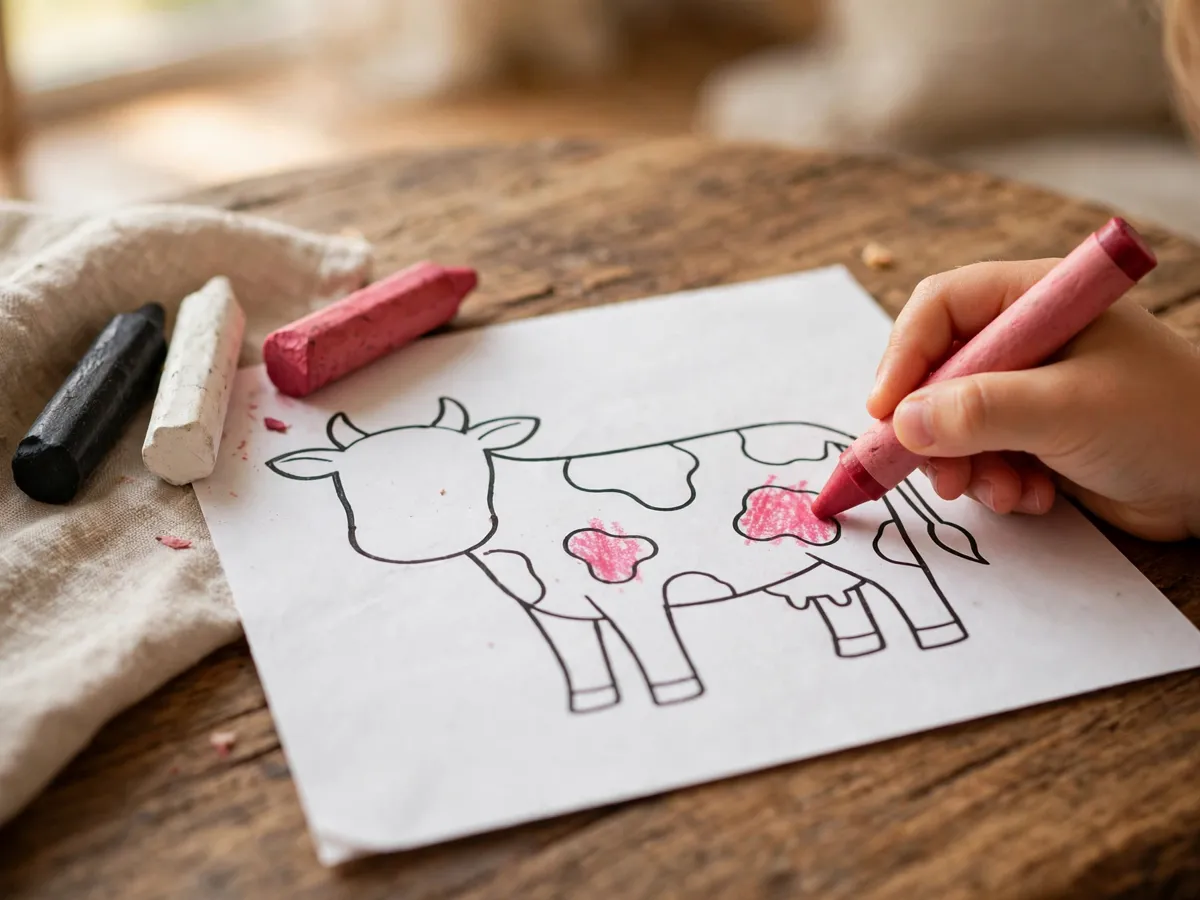
Download the cow set, US Letter and A4
Both sheets as one ready-to-print file, twelve cows in total. Print on plain or matte paper, portrait, at 100 per cent — and keep an adult, close enough to act, in the room while the crayon box is out.
Download the cow set (US Letter) · A4 · 12 pictures on 2 sheets
Sheet one: six breeds, each one drawn differently
The first sheet sorts the cows by coat, and the colour tells the breeds apart. A hint for each:
- Holstein black-and-white — the patchwork coat, wide blobs drawn across the body. Two colours do the page: black on the patches, the paper left white between them.
- Jersey cow — smaller than the Holstein, with a big head and short horns. Fawn over the body, darker grey on the muzzle.
- Highland cow with long fringe — the hair drawn as loose lines over the eyes and along the back. Rusty orange on the coat, cream on the fringe, long curved horns.
- Hereford cow — a red body with a white face and a pale band behind the shoulders. The white face is the area to leave bare.
- Dairy cow with a bell — the same round shape with a bell on a strap at the neck. Yellow or brass on the bell makes the brightest small shape on the sheet.
- Calf standing — short-legged with a head too big for the body and tufted knees. Soft brown, the tuft the one detail worth doing.
Sheet two: the field, the trough and the fence
The second sheet puts something around the cow — grass, a trough, a fence, a calf — which the age 7-8 end reaches for first:
- Cow grazing — head down to a line of drawn grass. Green under the muzzle, one coat colour above it.
- Cow lying down — folded on the ground, knees tucked and the tail out to one side. The calmest page here: one warm colour is plenty.
- Cow with its calf — two animals on one page, the small shape against the big one. Match the coats and lighten the calf.
- Cow at the trough — standing over a long drawn box with a water line. Brown on the boards, blue on the water, spare sheet below.
- Close-up cow face — the head fills the page: wide muzzle, two nostrils, soft ears. Pink inside the ears and on the muzzle; the biggest colour area on either sheet.
- Cow in a field with a fence — the animal in front of drawn rails and posts. Grey or brown on the fence, green on the field.
Body first, head next, hooves and background last
Before the crayons come out, lay both sheets on the table and walk the twelve names once — which cow has the fringe, which one is black and white, which page has the calf. Then body first, head and muzzle next, ears, hooves, bell and background last. For ages 4-5, one pass across the body is the page done. Ages 6-7 put two colours on one cow. Ages 8 fill the patches, the fringe and the fence rails. Print the Holstein three times and let three patch plans happen.
Chunky crayons suit the bold lines
Every outline here is drawn with a bold, even line and the colour areas are shaped broad, so a chunky crayon finishes the page without a sharp point. Short crayons — the broken ones — are easier to hold and do not snap under pressure. Put two or three crayons on the table for the younger end. The Holstein and the Hereford are the two-tone pages.
What to do with the finished pages
Finished cow sheets work taped on the fridge, folded around a card, or clipped into a folder. The calf makes a good card for grandparents; the Highland, once the fringe is filled in, tends to earn a frame. At the older end, cut the cows out and stand them along a shelf, biggest breed first.
Safety, every colouring day
For anything with a hazard in it — scissors, heat, water, small parts — the same rule applies: an adult, close enough to act. Colouring is a crayon-and-paper activity, so the hazards sit around it: crayons snapped in half end up in mouths with the youngest colourers, so check the table when the sitting ends and keep the box off the floor. If cutting the cows out brings scissors to the table, the adult stays while they are out and puts them away high afterwards.
Save this for the next rainy day
Pin the sheet your child will pick first, and come back to it when the crayons come out. The Learning Activities & Printables collection also holds the pig colouring pages for the other animals in the same yard, and the horse colouring pages for the ones out in the next field over.