 KidNestClub
Learning Activities & Printables
Christmas Preschool Worksheets: Trace, Count, Match | Ages 3-5
Two printed sheets, one theme, four things to do on each: trace the big shape, count the baubles, match the pairs, colour the frame at the bottom. Every sheet runs that same loop in the same order, so a three-year-old knows exactly where the page starts and where it ends — and so the second sheet feels familiar instead of new work to fight. This guide walks the loop and the cutting line at the bottom of each page, with an adult at the table the whole time the scissors or the glue stick are out.
By KidNestClub · Updated 18 November 2026
Ages 3-5 · Two sheets · Trace, count, match, colour · US Letter and A4.
Download the two sheets, US Letter and A4
The whole set as one ready-to-print file. Print on plain or matte paper, portrait, and set the printer to double-sided so the two sheets run back to back on a single sheet of paper — one turn of the page and the second worksheet is there. Stay at the table while the glue stick and scissors are out.
The loop: trace, count, match, colour
Each sheet is one loop of four small jobs in the same order, and the order matters more than any single job.
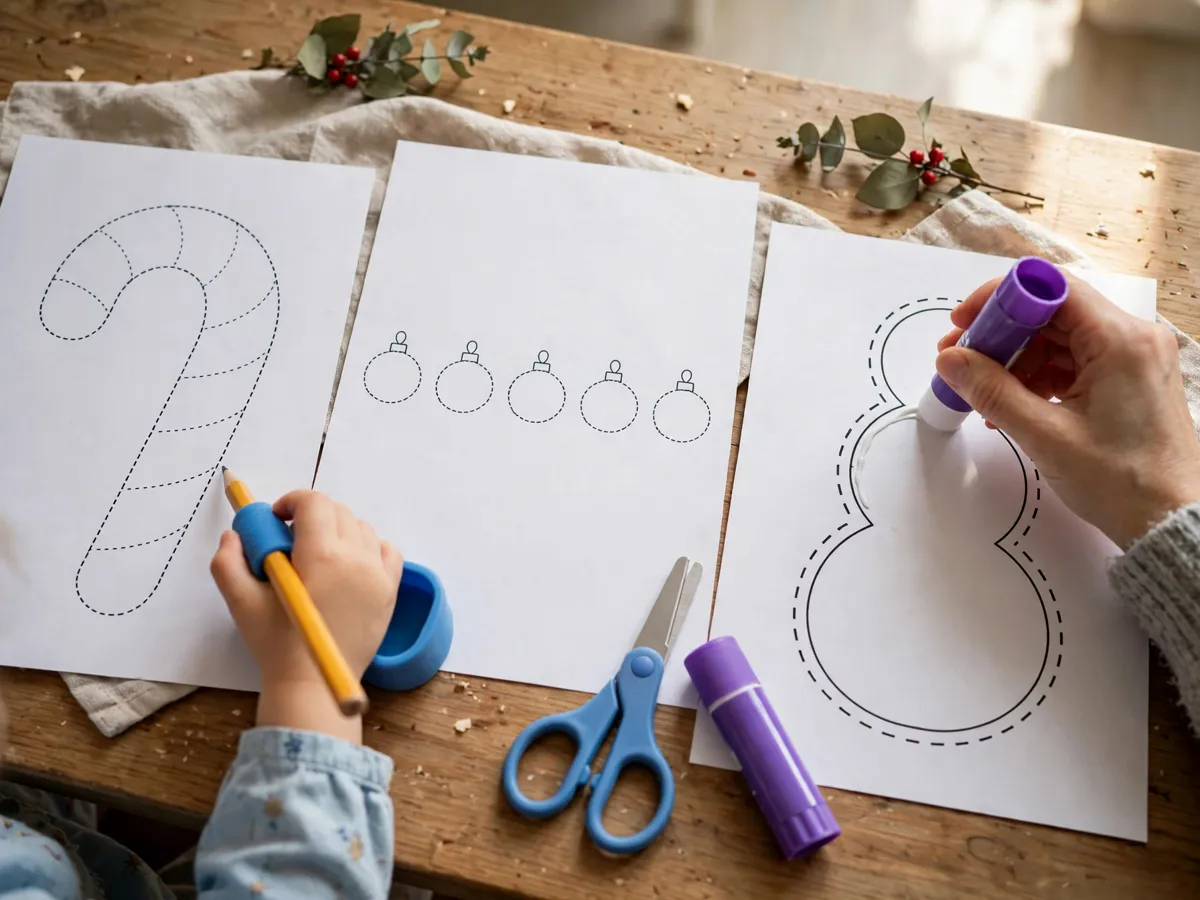
1. Trace the big shape, top to bottom. Wide dashed lines run across the top of the sheet in Christmas shapes — a candy-cane curve, a zigzag tree edge, the outline of a stocking. Trace with one finger first, the same finger-then-crayon routine on every tracing page, then two or three passes with a chunky crayon. The lines are wide on purpose: a fist-held crayon fits inside them at 3-5, wherever along the journey from whole-arm drawing to fingertip drawing your child happens to be.
2. Count the baubles. Groups of Christmas objects sit in boxes with an answer space each. Point and count out loud together, running a finger under each object so nothing is counted twice. The numerals are on the sheet on purpose — at 3-5, matching a spoken count to the shape of the 3 or the 4 is the whole exercise — and a tick, a scribble or a copied numeral all count as a finished answer. If a group is miscounted, count it again together from the start; recounting from one is the job, not getting the total stated first time.
3. Match the pairs. The matching strip pairs Christmas objects — a mitten to its twin, a star to the tree it hangs on. Draw the line from left to right together with one finger before any crayon touches the sheet, then let your child draw the connecting lines. If two objects get paired wrongly, trace the line again in a different colour rather than erasing: the sheet shows the pairs it was given, not a grade.
4. Colour the frame, last. One bold colouring frame waits at the bottom of each sheet, and it stays for last on purpose — it is the part with no rules, the reward seat at the end of the loop. Purple snowman, green star, whatever happens. When the frame is under way and interest is fading, the sheet is done; the loop gave it a beginning, a middle and an end that matches how a preschool session actually goes.
The loop only forks if you print the file twice and let both copies live at once: one copy stays whole for the tracer and the counter, the other goes to the scissors. Cutting a sheet does not spoil a page that has already done its tracing; it is the second half of the job, the part that turns the same worksheet into a snipping challenge and then a strip to glue onto a backing sheet.
The cutting line at the bottom
Each sheet ends with a straight cutting line along the bottom edge — one straight line, not a zigzag, which is the right challenge for first scissors. Blunt-tip scissors only, and the adult hands over one page at a time, staying at the table for the whole cutting step: an adult, close enough to act, is the rule for anything with a hazard in it. Cut sitting down, never standing or walking while scissors are anywhere in the room, and the scissors go back in the cup the moment the strip is off.
Snips count. If your child cannot run the full line yet, an adult makes the first cut to open the path and the child takes the next ones along it, or the adult strips the cut piece most of the way off and lets the last snip finish it. The cut-off strip becomes the collage: glue it to a backing sheet with a glue stick — not liquid glue, which pours and spreads and needs a drying rack — and the offcut of a worksheet turns into the Friday collage taped to the fridge.
Keep the scissors story short. At 3-5 the whole rule set is four sentences — sit down, blunt tips, stay at the table with an adult, scissors back in the cup afterwards — and the same four sentences every time, in the same order, works the way routines work: nothing to remember, nothing new to argue with. A child who hears the rules once a week hears a rule; a child who hears them with every pair of scissors that comes out hears a routine, and routines are things three-year-olds are remarkably good at holding on to. The same four sentences travel well past these two sheets, to every pair of scissors that comes out of the cupboard for years afterwards.
The second run: sleeves and reprint
The tracing, counting and matching parts survive a second sitting if you slip the sheet into a plastic sleeve and use a dry-erase marker — the marks wipe off, the sheet goes back in the folder, and next week the same groups of baubles become fresh work again. Cut the bottom strip off a sleeve sheet before it goes in, so the cutting step stays a real scissors step in its own turn rather than a marker event. Nothing here needs to survive as a keepsake: print the file twice in December and let the copies meet busy ends.
Space the sittings two or three days apart, not morning after morning — the pages stay new enough to feel chosen rather than assigned. On a tired day, one sheet, one loop, is the whole session, and the colouring frame can hold the last five minutes after dinner just as well as it held the end of the morning. By the second week of December most families have met every part of the loop at least once; the third and fourth sittings can mix the order — colouring first to start easy, then matching, then tracing — because by then the sheet structure is familiar enough to survive being walked backwards.
Save this for the busy holiday weeks
Pin the guide now and print the two sheets the first morning the holiday energy arrives. For one letter at a time there is the letter S preschool worksheet, and for the year-round non-seasonal version the preschool activities worksheets set stays live in the Learning Activities & Printables collection all year.