 KidNestClub
Easy Kids Crafts
Cat Hat Craft for Kids Ages 3-8 | 5 Paper Hats
Five paper cat hats that hold their shape through a dress-up afternoon. These are plain cats with a face your child draws, not a costume from a book or a film, so the tabby stripes, the colours and the whiskers are whoever the wearer decides they are. Each hat lists its supplies, its age band and the single step that stays with an adult.
By KidNestClub · Updated 18 November 2026
Total scope: 5 hats · Ages 3-8 · Card, paper and tape · 10-20 minutes each.
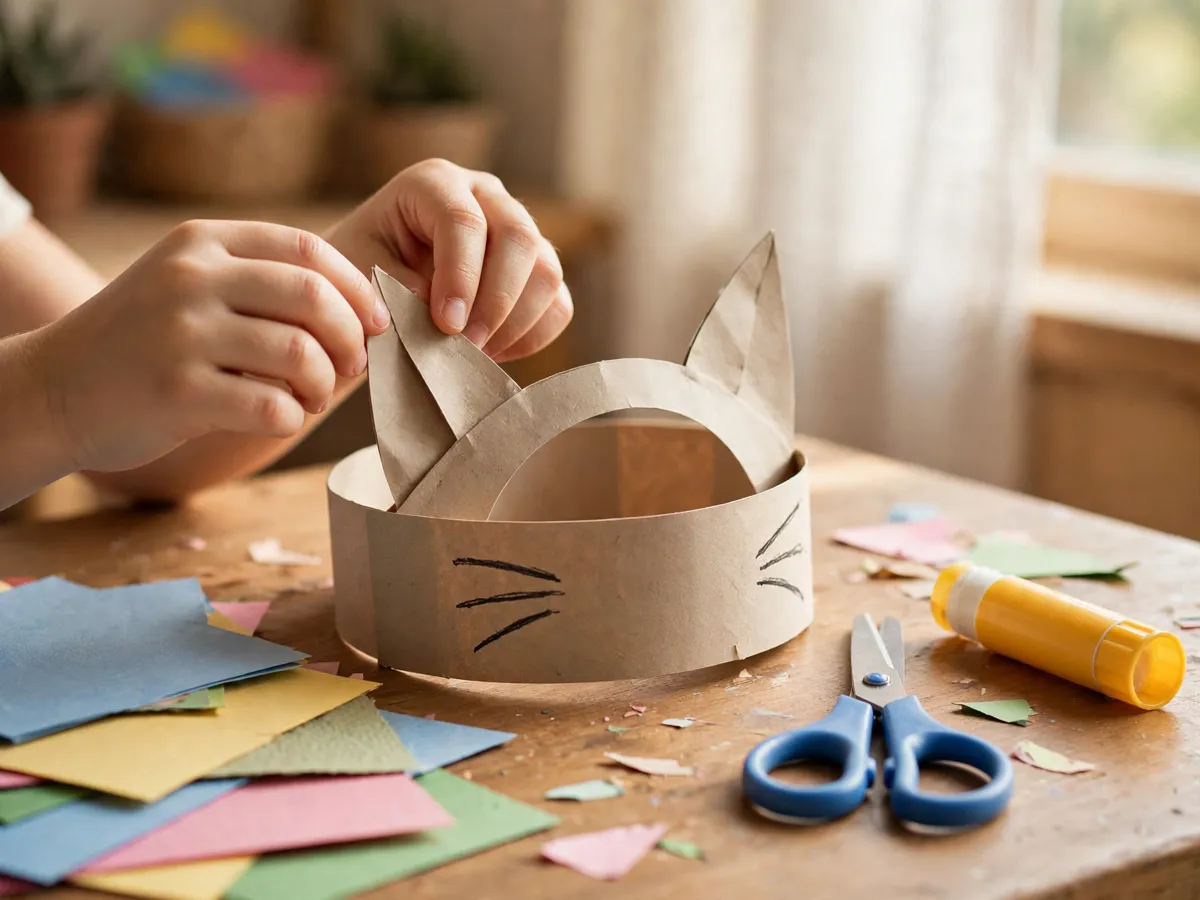
A paper cat hat works when the ears are part of the band instead of glued onto a finished hat, and when the band fits before any decorating starts. Try the band on twice: once flat, once closed. A hat that fits gets worn all afternoon, and a hat that slips down over the eyes gets taken off and crushed in a toy box.
Fit the band first, then decorate
- Cut a card strip about two inches wide, long enough to circle the head with a thumb’s width of overlap
- Wrap it, mark the overlap in pencil, then close the band at the mark with tape or two staples
- Draw the ears on the band while it is still flat, because drawing on a finished hat means drawing around a curve
- Keep a second strip going, since a first attempt usually comes out a size loose on a small head
- Card from a cereal box, a shoe box lid or a stock of craft card all behave the same way
1. The folded ear band
Mark two triangles along the top edge of the flat band, bases touching so the ears sit side by side. Fold each triangle forward along its base and run a fingernail along the crease. The ears stand on their own with no glue, and the front of the band takes a drawn nose, two eyes and whiskers to the edges.
If the ears flop, fold the same crease a second time in the opposite direction and press, which sets a sharper edge in the card. Tabby stripes go on as short crayon bars rather than drawn outlines, and they read from across the room.
Ages 6-8 · 10 minutes · Card strip, pencil, scissors, crayons · An adult cuts the strip and hands over the folding; scissors stay with an adult at the under-5 table.
2. The cone kitten
Roll a sheet of card into a cone, tape the seam, then trim the bottom rim level so the hat sits flat on the head. Draw the face low on the front, with the whiskers reaching back toward the seam, and glue two triangles at the top for ears.
A cone wants a chin line to stay on during running. An adult cuts a short length of elastic, fits it with two fingers of slack under the chin, ties it off and tucks the knot under the band. Cut it short rather than long, and take it off before the hat goes into the dress-up box.
Ages 6-8 · 15 minutes · Card, tape, scissors, crayons, thin elastic · An adult rolls, trims and fits the elastic line.
3. The two-piece pouch cat
Cut two matching cat-head shapes from card, ears included, then join them with a curved strip of paper around the top so the hat opens like a clamshell. The face goes on the front piece and the strip hides the join. It is the sturdiest of the five and the one that survives being worn to grandma’s.
Ages 4-8 · 20 minutes · Card, paper strip, stapler, crayons · An adult runs the stapler and presses each staple flat, because a raised staple point scratches a forehead.
4. The drawn-face hat
For the youngest crafters, keep the build flat and put the cat in the drawing. A wide band, two pre-cut triangles glued at the back, and then the whole face: big eyes, a small triangle nose, whiskers drawn out to both edges, and a mouth on the band’s front.
Glue the ear triangles in pairs, one on each side of the band, so the ear has card behind it. A single triangle glued to the front of a band peels at the corner by lunchtime.
Ages 3-5 · 10 minutes · Paper band, pre-cut triangles, glue stick, crayons · An adult cuts everything first and glues alongside the child.
5. The masking-tape cat
No glue at all. A card band, and the ears, whiskers and spots are built from short lengths of masking tape pressed down and coloured over with crayon. Crayon grabs the tape and the drawing looks printed.
Keep every tape piece under a hand’s width. Long strips hang, snag on a doorknob and pull the band out of shape, and they end up on the floor where a younger child finds them.
Ages 3-5 and 6-8 · 15 minutes · Card band, masking tape, crayons · An adult tears the strips and keeps the roll off the table.
Five hats at a glance
| Hat | Ages | Supplies | Adult step |
|---|---|---|---|
| Folded ear band | 6-8 | Card, crayons | Cuts the strip |
| Cone kitten | 6-8 | Card, tape, elastic | Rolls and fits the chin line |
| Two-piece pouch | 4-8 | Card, stapler | Staples and presses flat |
| Drawn-face hat | 3-5 | Paper, glue stick | Cuts and glues alongside |
| Masking-tape cat | 3-8 | Card, tape, crayons | Tears the strips |
The four things that go wrong, and what to do instead
Ears glued onto a finished hat peel off within the hour. Fold them from the band, or glue them in pairs with card on both sides, and they last the afternoon.
Liquid glue on thin card leaves a buckle where it soaked through. A glue stick holds paper to card and dries flat, and a capped glue stick is still usable weeks later.
A band cut to a guess never fits. Cut long, wrap, mark, then close at the mark with the overlap included. Two short cuts beat one confident one.
A hat that lives in the dress-up box with a long chin cord is a hat you will not want in that box. Take the cord off when the wearing stops, or use a cord short enough to stay clear of a chair back.
Questions parents ask
- What paper holds a cat hat shape?
- Card. Printer paper folds into soft ears that lie flat inside an hour, and card holds a crease, so the ears stay up. An empty cereal box, flattened, is the cheapest card in the house.
- Can a 3-year-old make one?
- Yes, once everything is cut. The drawn-face hat and the masking-tape cat are built around colouring and pressing, so a 3-year-old does the decorating and an adult does the fitting at the same table.
- How do you keep the ears up?
- Fold them from the band itself, or glue two triangles back to back with the band edge sandwiched between them. A doubled ear has card on both sides and holds a crease.
- Will the hat stay on a running child?
- A band fitted with the overlap included stays on for walking, dancing and sitting. For running, add a short elastic line that an adult fits, ties and removes afterwards.
- How do you store a paper hat between wearings?
- Flat, under a book, or on top of a shelf with nothing stacked on it. The pouch and the cone keep their shape on their own; the band versions want to be stored flat.
Staples, small parts and the adult at the table
For anything with a hazard in it — scissors, staples, small parts — the same rule applies: an adult, close enough to act. At a craft table that means the adult who runs the stapler sits at the table rather than working in the next room.
Anything that fits fully inside a small-parts cylinder — about the size of a child’s throat under 3 — is a choking hazard, so keep beads, buttons, sequins and loose staples off the floor. A quick floor sweep for small objects is a two-minute job that pays off every day. When you choose craft supplies, check the small-parts warning — it matters most under 3, and it stays relevant for the younger end of every playdate.
Between 2 and 4, a child doesn’t grasp danger and won’t remember “no” while they’re busy playing, so the watching has to be hands-on. Every hat here carries the age band it was written for, and a younger child may still need the version with everything pre-cut.
This is a guide, not medical advice. For questions about choking or your child’s health, your pediatrician is the right person to ask.
Save two hats for the next dress-up day
Save this page and start with the drawn-face hat for the younger crafter or the folded ear band for the older one. The crafts and learning collection holds the rest of the paper makes, and the paper handbag craft and the flower craft guide finish a dress-up afternoon on the same supplies. If your household runs on boxes, the box crafts roundup uses the same card, and the scissors practice sheets turn the adult cutting step into a shared one, with a pair of rounded-tip scissors each.