 KidNestClub
Learning Activities & Printables
Bird Colouring Pages | 12 Free Printables Ages 3-8
Twelve familiar birds across two printable sheets, drawn the way a young child recognises them: a round body, one clear beak, feet or a branch to anchor them, and big open areas a crayon can reach. Sheet one holds the garden set — sparrow, robin, owl, penguin, duck and a songbird with music notes around it. Sheet two holds the big shapes — peacock, parrot, flamingo, swan, eagle and a hen with her chick. One sheet a sitting works well for most children in this band: body first, branch last.
By KidNestClub · Updated 18 November 2026
12 pictures · 2 sheets · Ages 3-8 · Bold outlines for chunky crayons · US Letter and A4.
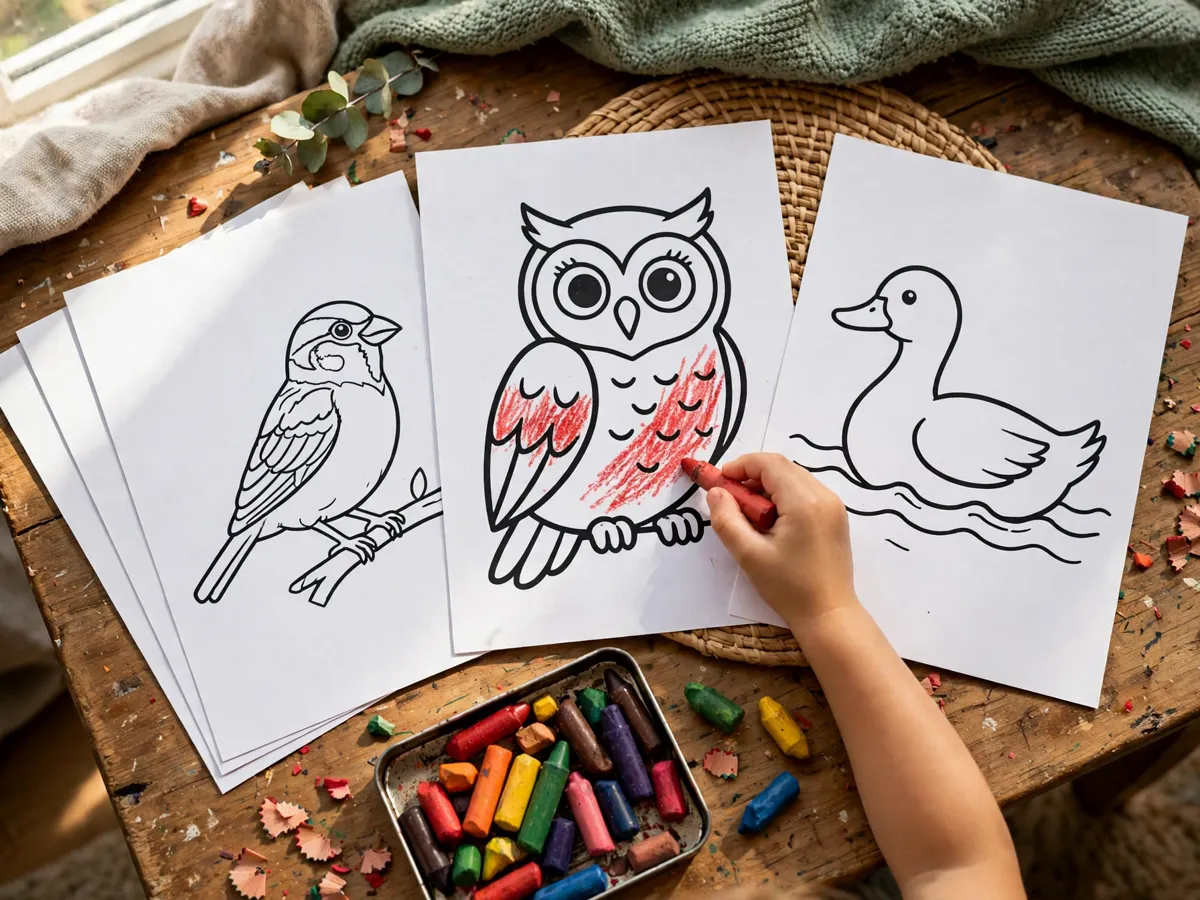
Download the bird set, US Letter and A4
Both sheets as one ready-to-print file, twelve birds in total. Print on plain or matte paper, portrait, one sheet a sitting — and keep an adult, close enough to act, in the room while the crayon box is out.
Download the bird set (US Letter) · A4 · 12 pictures on 2 sheets
Sheet one: six birds your child already knows by name
The first sheet keeps every bird round-bodied and close to the ground or the water, so the shape names itself the moment the page is laid on the table. A colour hint for each one keeps the conversation going while the crayons move:
- Sparrow on the ground — small, plump and standing on two short legs, the easiest bird on the sheet to fill in. Sparrows wear brown and grey in patches, so two crayons side by side do the whole body.
- Robin on the lawn — a little round bird with a bright chest, drawn perched airless and upright. The chest patch is the famous part, and a red-orange crayon there against a brown body makes the page look like the real thing.
- Owl on a branch — the wide face and the two big round eyes make this the most dramatic page on the sheet. The feather tufts on each side of the head stand up like little horns; soft browns, warm greys, an afternoon of orange.
- Penguin on the ice — upright belly, wide feet, a neat little beak. Black and white with a splash of orange or yellow at the beak, and this one is finished in two minutes.
- Duck on the pond — flat back, lifted head, drawn swimming with small ripples under it. Any yellow or white body with an orange beak works, and the water line takes blue.
- Songbird and the tune — a small bird with its beak lifted and a few music notes floating above, aimed at children who like a page with a little story in it. Music notes are a free choice; the bird suits a bright, cheerful body colour.
Ages 3-8 · Round bodies, named at a glance · One sheet a sitting.
Sheet two: long necks, wide tails and one big sitting
The second sheet trades the garden set for the dramatic shapes — birds a child spots at the zoo, the lake or the farm. These outlines carry more going on inside them, which is what the age 7-8 end of the band tends to reach for first:
- Peacock fanned wide — the fan of long feathers is the whole event, and the picture is built from generous feather circles so each one gets its own colour. Green, teal, blue, pink, purple, gold — every circle can take a different crayon, and this is the page on this set that fills a whole sitting in itself.
- Parrot on its perch swing — hooked beak, rounded head, drawn mid-swing on a hanging perch. Bright red, green and a wash of yellow bring the picture together.
- Flamingo in shallow water — one long curved neck, one bent leg, standing in a ripple of water. Pink is the obvious pick, and the water takes a soft blue.
- Swan, neck arched — an S-shaped neck over a wide flat body, drawn gliding. White with an orange beak leaves most of the page for a single colour, which suits the youngest colourers on the band.
- Eagle head, white cap — a head portrait with the hooked beak front and centre. A white head against a brown body is the classic look, and the strong beak line takes yellow or orange.
- Hen with her chick — the only page with two birds on it, a large hen and a small round chick beside her. Warm brown for one and soft yellow for the other makes them easy to tell apart when the page goes up on the fridge.
Ages 3-8 · The peacock page is a full sitting in itself · Six zoo-and-lake birds.
One sheet a sitting, body first, branch last
The birds are drawn to be worked in a rough order that matches how children naturally hold a crayon: the large body shape first, while interest is highest, then the small details — beak, feet, eyes — and finally the ground line, branch or ripple under the bird. For ages 3-4, the goal is one good pass of colour in the middle of the body, and the rest of the page is a bonus. Ages 5-6 can usually stay inside most of the wide outline and start matching two colours to one bird. Ages 7-8 fill the small areas around the eyes and feet and often want to add their own background: sky, sun, grass, a second bird.
Twelve birds spread over a fortnight at one sheet a sitting. The sheets repeat well — print the sparrow three times and let three different colour plans happen, or print the peacock again next month and watch the feather circles get more planned out.
Ages 3-8 · Body first, details next, ground last · Sheets repeat well.
Chunky crayons, short pencils and what suits each age
Every outline in this set is drawn with a bold, even line, and the colourable areas are shaped wide, so a chunky crayon completes the job without needing a sharp point. That is the reason the pack skews simple: a four-year-old with a fat crayon and a seven-year-old with a thin-tipped felt pen can both finish the same page of the same bird and come away with a picture they like. Short crayons — the broken ones — are genuinely easier for small hands than long ones, and they will not snap under pressure the way the long ones do.
For the under-5s, offer two or three crayons rather than the whole box, and let the choice be theirs. For the school-age end, lay the box out and step back — the pigeon colours are up to the colourer, and unusual birds are half the fun. Either way, print on plain printer paper or matte card, and have a second sheet of paper under the page if the markers leak through.
Ages 3-8 · Bold lines suit chunky crayons · Two or three crayons on the table for the youngest colourers.
What to do with the finished pages
Finished bird sheets are useful in their plain form: taped up on the fridge, folded in half around a homemade card, or clipped into a folder that gets flipped through on rainy days. The swan and the robin make good cards for grandparents. The peacock, once the whole feather fan is filled, tends to earn a frame.
For the older end of the band, a finished sheet also becomes a keepsake at the kitchen table: cut it into a few large pieces and reassemble it as an impromptu puzzle, or let one bird stand in the middle of a home-made thank-you card with a border drawn around it. Nothing fancy is needed — the pages simply give the sitting a shape to end on.
Ages 3-8 · Fridge, card, folder, frame · Cut one up for an impromptu puzzle.
Safety, every colouring day
For anything with a hazard in it — scissors, heat, water, small parts — the same rule applies: an adult, close enough to act. The colouring itself is a crayon-and-paper activity, so the hazards to watch are around it: crayons snapped in half end up in mouths with the youngest colourers, so check the table when the sitting ends, and keep the crayon box off the floor. If a card-making step brings scissors to the table, the adult stays at the table while they are out and puts them away high afterwards.
Save this for the next rainy day
Pin the sheet your child will pick first, and come back to it when the crayons come out. The Learning Activities & Printables collection also holds the animal colouring sheets for land favourites beyond the bird family, and the butterfly colouring pictures if wide open wings are the next thing your colourer reaches for.